
大型动物与陆地生态系统
Article 1:
Title: Equids engineer desert water availability
Download website:
https://science.sciencemag.org/content/372/6541/491
Main contents:
Megafauna play important roles in the biosphere, yet little is known about how they shape dryland ecosystems. We report on an overlooked form of ecosystem engineering by donkeys and horses. In the deserts of North America, digging of ≤2-meter wells to groundwater by feral equids increased the density of water features, reduced distances between waters, and, at times, provided the only water present. Vertebrate richness and activity were higher at equid wells than at adjacent dry sites, and, by mimicking flood disturbance, equid wells became nurseries for riparian trees. Our results suggest that equids, even those that are introduced or feral, are able to buffer water availability, which may increase resilience to ongoing human-caused aridification.
Methods:
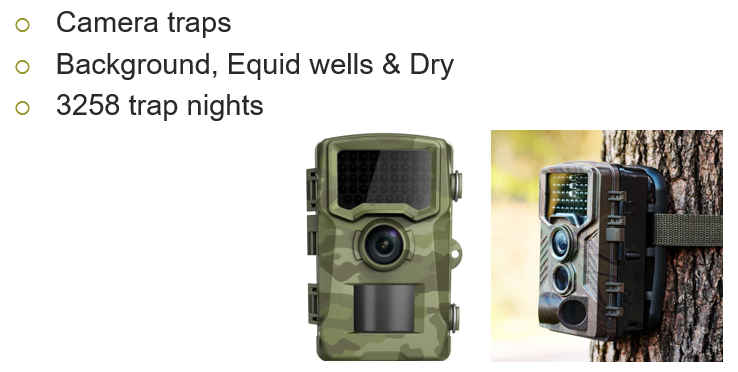
红外相机
Results:
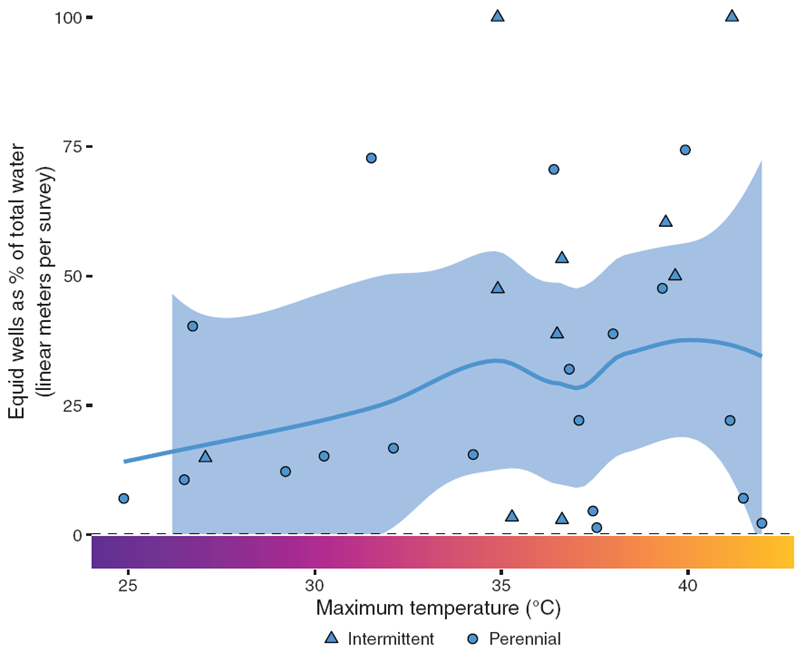
Equid wells were particularly important to provisioning water in midsummer as temperatures increased and water tables receded.

Overall, we detected 59 vertebrate species at equid wells, of which 57 were recorded drinking.
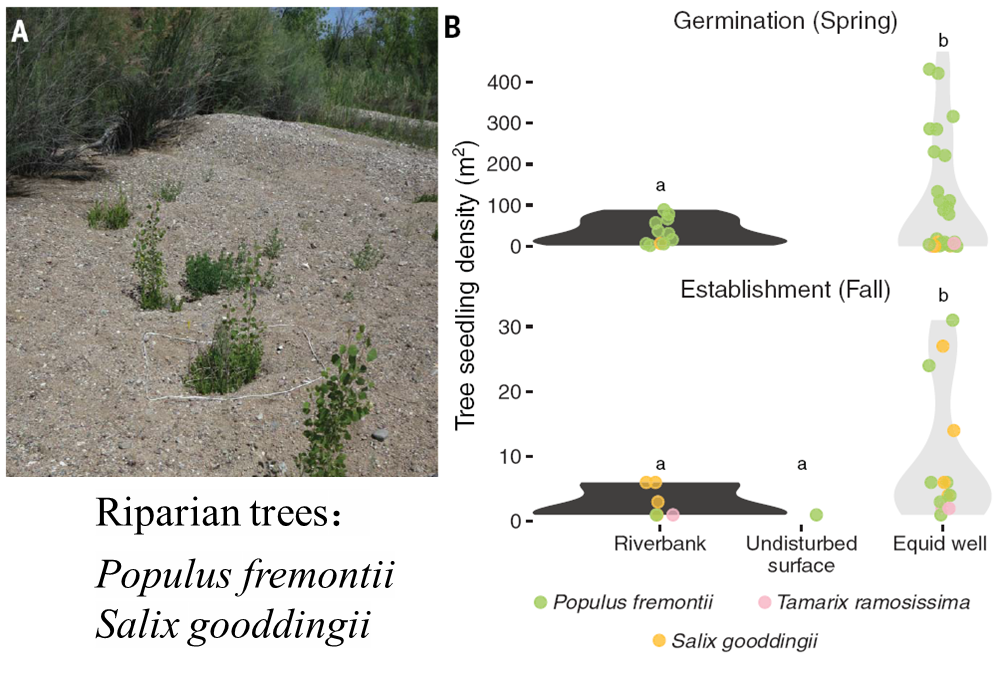
Well-digging megafauna contribute the capacity to buffer water availability across many drylands.
Conclusion:
Feral equids can increase water availability in drylands, with associated effects on a variety of species and ecosystem processes.
Article 2:
Title: Deer slow down litter decomposition by reducing litter quality in a temperate forest
Download website:
https://esajournals.onlinelibrary.wiley.com/doi/10.1002/ecy.3235
Abstract:
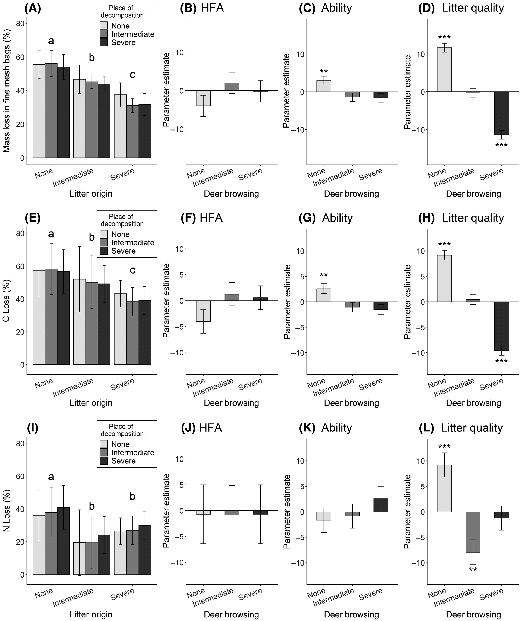
Litter decomposition is a key process that allows the recycling of nutrients within ecosystems. In temperate forests, the role of large herbivores in litter decomposition remains a subject of debate. To address this question, we used two litterbag experiments in a quasiexperimental situation resulting from the introduction of Sitka black-tailed deer Odocoileus hemionus sitkensis on forested islands of Haida Gwaii (Canada). We investigated the two main pathways by which deer could modify litter decomposition: change in litter quality and modification of decomposer communities. We found that deer presence significantly reduced litter mass loss after 1 yr, mainly through a reduction in litter quality. This mass loss reflected a 30 and 28% lower loss of carbon (C) and nitrogen (N), respectively. The presence of deer also reduced the ability of decomposers to break down carbon, but not nitrogen. Indeed, litter placed on an island with deer lost 5% less carbon after 1 yr of decomposition than did litter decomposing on an island without deer. This loss in ability to decompose litter in the presence of deer was outweighed by the differences in mass loss associated with the effect of deer on litter quality. Additional effects of feces deposition by deer on the decomposition process were also significant but minor. These results suggest that the effects dramatic continental-scale increases in deer populations may have on broad-scale patterns of C and N cycling deserve closer attention.
Results:
主要观点:
有蹄类改变了凋落物质量,从而影响到凋落物分解的速率。
Article 3:
Title: Transformation of litter carbon to stable soil organic matter is facilitated by ungulate trampling
Download website:
https://www.sciencedirect.com/science/article/pii/S0016706120325830
Abstract:
Plant litter is an important source of soil organic carbon (SOC) in terrestrial ecosystem. The formation of SOC from plant litter and SOC mineralization to atmosphere is a critical determinant of long-term net ecosystem C balance. While it is generally understood that grazing plays a role in SOC cycling, what mechanisms are involved in driving SOC dynamic are not clear. Trampling enhances microbial processes by incorporating litter into the soil, likely influencing the fate of litter C and SOC mineralization. We conducted a controlled microcosm experiment to assess the role of trampling on the fate of litter C, litter-derived SOC mineralization (priming effect), and net C balance through incubation of 13C isotopically labelled Stipa krilovii litter placed on the soil surface, or incorporated into soil via simulated trampling, for 6 months. Litter C transferred into the SOC pool was further fractionated into mineral-associated soil organic carbon pool (MASOC, <53 μm) and particulate organic carbon pool (POC, >53 μm). We analyzed soil enzyme activities and litter-derived microbial biomass carbon (MBC) to determine microbial activities. We found trampling increased overall losses in litter mass (+16%) and litter C (+14%), with proportionally more decomposed litter C transferred to SOC pools (MASOC + 47% and POC + 157%), compared to absence of trampling. The litter-derived MBC was positively correlated with SOC formation, which was increased (+40.78%) by trampling, indicting a stronger microbial contribution to SOC formation. The disturbance of trampling did not induce significant positive priming effects, consistent with invariant soil total MBC and soil enzyme activities following trampling. As a result, trampling induced an increase in SOC formation and invariant priming effect, which contributed to positive net soil C balance (-230.74 ± 89.44 vs 100.33 ± 32.65 mg C/kg soil). Our results show trampling incorporates litter into soil and promotes microbial utilization of litter C and physiochemical stabilization of decomposed litter C, suggesting trampling is an important mechanism of SOC storage with litter C efficiently transferred into SOC pool. We demonstrate the importance of trampling in SOC formation and stabilization. Our findings indicate SOC formation efficiency from C input should be included in SOC predictive models in managed ecosystems.
Results:
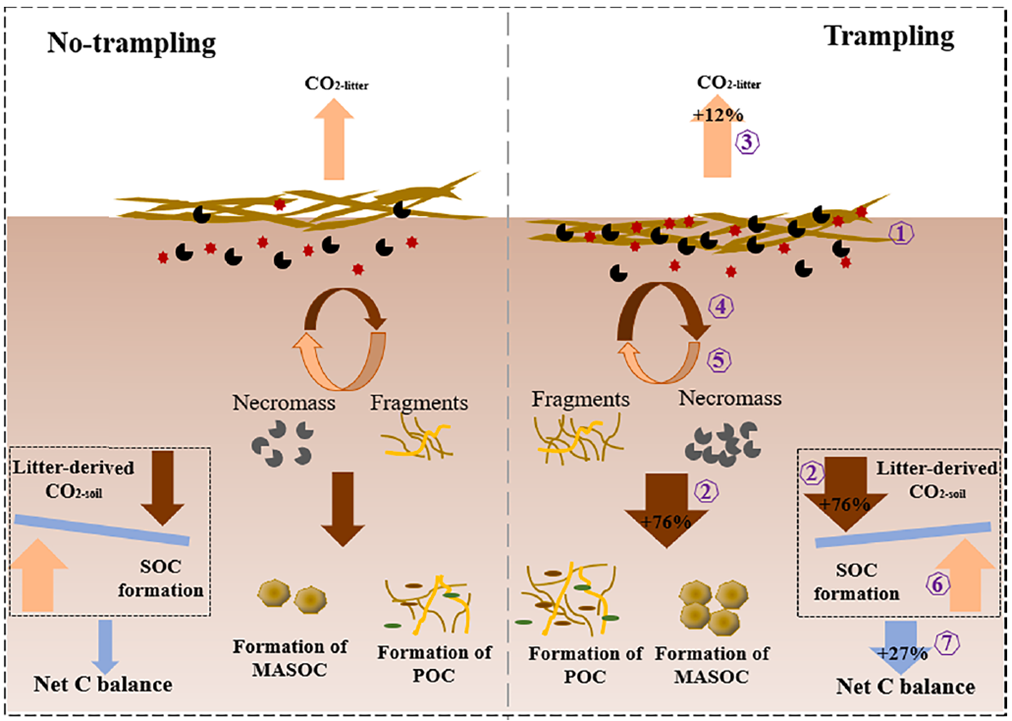
主要观点:
有蹄类对凋落物的踩踏作用于土壤碳库,从而影响到凋落物分解的速率。
Contact: Luo Yunchao
E-mail: luoyunchao@outlook.com; luoyunchaolyc@qq.com