
Article 1:热预处理玉米秸秆木质素对纤维素酶的吸附及其机理
Title:Adsorption and mechanism of cellulase enzymes onto lignin isolated from corn stover pretreated with liquid hot water
DOI: 10.1186/s13068-016-0531-0
Abstract
Background: In the bioconversion of lignocellulosic substrates, the adsorption behavior of cellulase onto lignin has a negative effect on enzymatic hydrolysis of cellulose, decreasing glucose production during enzymatic hydrolysis, thus decreasing the yield of fermentation and the production of useful products. Understanding the interaction between lignin and cellulase is necessary to optimize the components of cellulase mixture, genetically engineer high-efficiency cellulase, and reduce cost of bioconversion. Most lignin is not removed during liquid hot water (LHW) pretreatment, and the characteristics of lignin in solid substrate are also changed. To understand the interactions between cellulase and lignin, this study investigated the change in the characteristics of lignin obtained from corn stover, as well as the behavior of cellulase adsorption onto lignin, under various severities of LHW pretreatment.
Results: LHW pretreatment removed most hemicellulose and some lignin in corn stover, as well as improved enzymatic digestibility of corn stover. After LHW pretreatment, the molecular weight of lignin obviously increased, whereas its polydispersity decreased and became more negative. The hydrophobicity and functional groups in lignin also changed. Adsorption of cellulase from Penicillium oxalicum onto lignin isolated from corn stover was enhanced after LHW pretreatment, and increased under increasing pretreatment severity. Different adsorption behaviors were observed in different lignin samples and components of cellulase mixtures, even in different cellobiohydrolases (CBHs), endo-beta-1, 4-glucanases (EGs). The greatest reduction in enzyme activity caused by lignin was observed in CBH, followed by that in xylanase and then in EG and β-Glucosidase (BGL). The adsorption behavior exerted different effects on subsequent enzymatic hydrolysis of various biomass substrates. Hydrophobic and electrostatic interactions may be important factors affecting different adsorption behaviors between lignin and cellulase.
Conclusions: LHW pretreatment changed the characteristics of the remaining lignin in corn stover, thus affected the adsorption behavior of lignin toward cellulase. For different protein components in cellulase solution from P. oxalicum, electrostatic action was a main factor influencing the adsorption of EG and xylanase onto lignin in corn stover, while hydrophobicity affected the adsorption of CBH and BGL onto lignin.
Keywords: Lignin, Cellulase, Adsorption, Liquid hot water pretreatment
Result analysis:
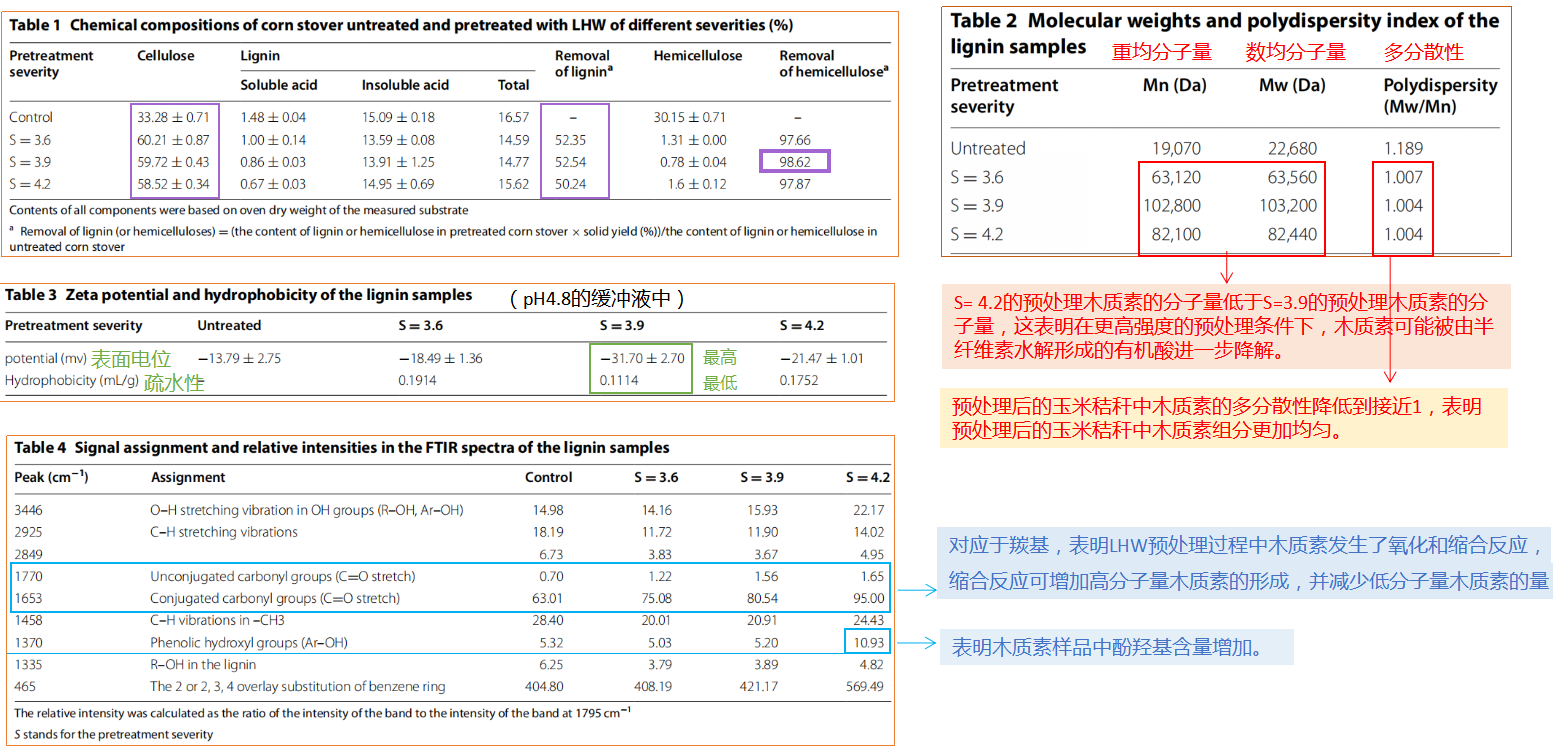
①下图为预处理后木质素的化学性质和结构的表征。首先解释一下,这些图表中S=3.6,S=3.9,S=4.2分别是对应的190℃下,预处理10min、20min、40min。在分析化学组成的表1中,半纤维素的去除率达到97%以上,其中在S=3.9的条件下达到98.62%,木质素的移除率达到50%以上。再看表2,预处理后分子量都大幅度增加,但是其中S= 4.2的预处理木质素的分子量低于S=3.9的预处理木质素的分子量,这表明在更高强度的预处理条件下,木质素可能被由半纤维素水解形成的有机酸进一步降解。此外,预处理后的玉米秸秆中木质素的多分散性更接近1,表明预处理后的玉米秸秆中木质素组分更加均匀。表3是对木质素表面ζ电位和疏水性的表征,预处理后表面电荷都更加偏负,因为蛋白质的等电点高于4.8 ,大多数纤维素酶蛋白质在研究中使用的pH 4.8的反应系统中带有正电荷,所以结合这个数据看,可以解释后续的吸附结果。表4是傅里叶红外表征的木质素官能团变化,1370的波段看出,木质素样品中酚羟基含量增加。1770、1653对应的是C=O键,表明LHW预处理过程中木质素发生了氧化和缩合反应,缩合反应也印证了表2中高分子量木质素的形成。
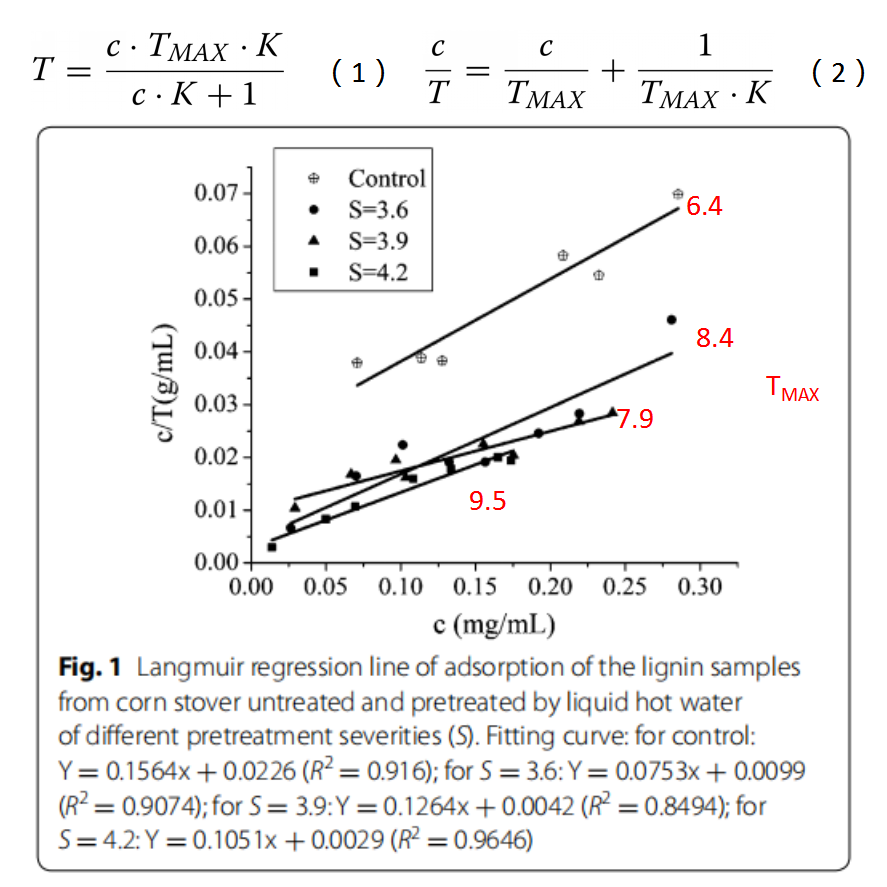
②下图为木质素对纤维素酶的吸附模型的建立。利用朗缪尔吸附等温线估算了木质素样品的最大吸附容量,平衡等温线吸附数据通过以下朗缪尔表达式进行分析
c:吸附后上清液中的酶平衡浓度
T:木质素吸附的蛋白质量(mg蛋白质/g木质素)
TMAX:木质素的最大吸附质量
K:吸附常数
为了测量TMAX,我们将公式(1)转换为公式(2 ),如下所示:
在该公式中,通过木质素吸附实验确定c和T,通过测量c/T和c的拟合直线斜率的倒数获得TMAX。
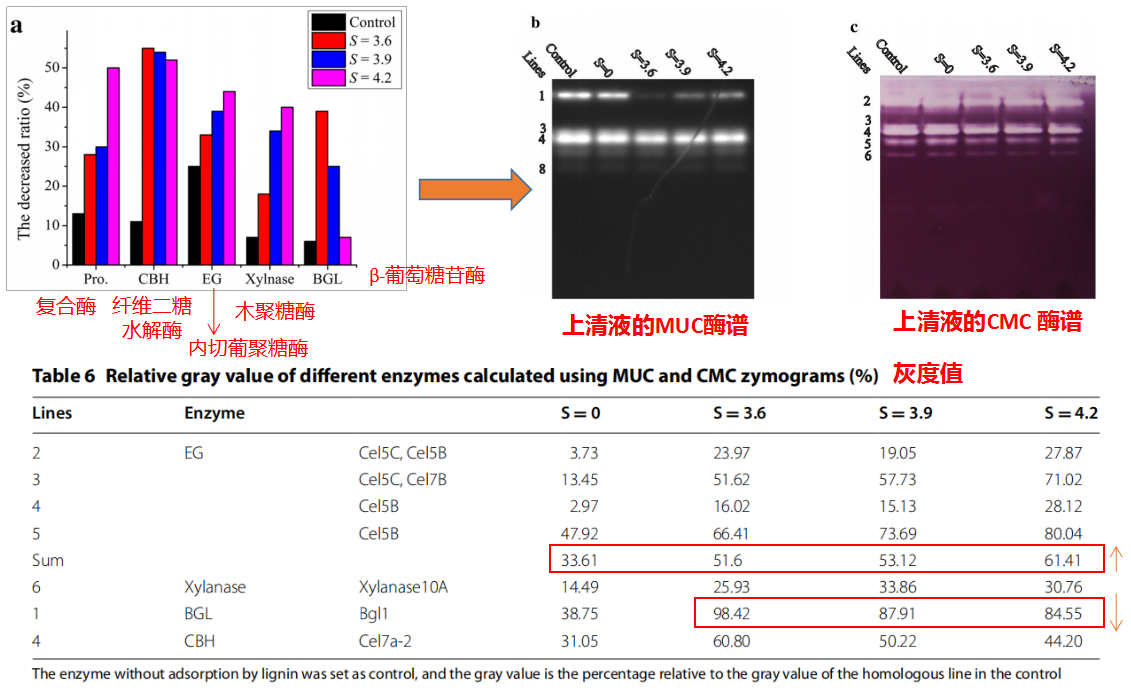
③预处理后的木质素对纤维素酶不同组分吸附的影响。这部分是关于预处理后的木质素对纤维素酶不同组分吸附的影响。首先看左边这张图,反映的是上清液的减少量,可以看做是吸附量。复合酶的吸附量,是随着预处理强度的增加而增加的,但不同酶组分的吸附量随预处理强度增加变化不同,特别是β-葡萄糖苷酶,β-葡萄糖苷酶的吸附量随着预处理强度的增加而减少,预处理对减少BGL蛋白的吸附的减少最明显。除此之外,还做了上清液的MUC酶谱和CMC酶谱,并分析了灰度值,与左图的结果相符合。
结论与总结:1. LHW预处理去除了玉米秸秆中的大部分半纤维素(最多98.62%)和部分木质素(50%左右),提高了玉米秸秆的酶消化率。2. 木质素的疏水性和官能团也发生了变化,木质素分子量明显增加(氧化和缩合反应),但其多分散性降低。3. 疏水和静电相互作用可能是影响木质素和纤维素酶不同吸附行为的重要因素。大多数纤维素酶蛋白质在pH 4.8的反应系统中带有正电荷,因为蛋白质的等电点高于4.8 。热预处理产生的有机酸使得半纤维素水解产生有机酸,带负电荷,增加了静电作用。4. 在不同的木质素样品和纤维素酶混合物组分中观察到不同的吸附行为,甚至在不同的纤维二糖水解酶(CBHs)、内切葡聚糖酶(EGs)、木聚糖酶、β-葡萄糖苷酶组中也观察到不同的吸附行为。
Article 2:植物细胞壁纳米结构与酶消化率有什么关系?
Title:How Does Plant Cell Wall Nanoscale Architecture Correlate with Enzymatic Digestibility?
DOI: 10.1126/science.1227491.
Abstract:Greater understanding of the mechanisms contributing to chemical and enzymatic solubilization of plant cell walls is critical for enabling cost-effective industrial conversion of cellulosic biomass to biofuels. Here, we report the use of correlative imaging in real time to assess the impact of pretreatment, as well as the resulting nanometer-scale changes in cell wall structure, upon subsequent digestion by two commercially relevant cellulase systems. We demonstrate that the small, noncomplexed fungal cellulases deconstruct cell walls using mechanisms that differ considerably from those of the larger, multienzyme complexes (cellulosomes). Furthermore, high-resolution measurement of the microfibrillar architecture of cell walls suggests that digestion is primarily facilitated by enabling enzyme access to the hydrophobic cellulose face. The data support the conclusion that ideal pretreatments should maximize lignin removal and minimize polysaccharide modification, thereby retaining the essentially native microfibrillar structure.
研究背景:传统的求解方法受到由这些复杂生物量混合物的分析所产生的限制的影响;因此,收集的数据有时是不确定的,部分是矛盾的。因此,本研究采用明场光学显微、共聚焦激光扫描显微镜(CLSM)、双色受激拉曼散射显微(SRS)和原子力显微镜(AFM),在受控的消化条件下实时观察这些酶系统对未处理和脱木质素的植物细胞壁的作用。
Result analysis:
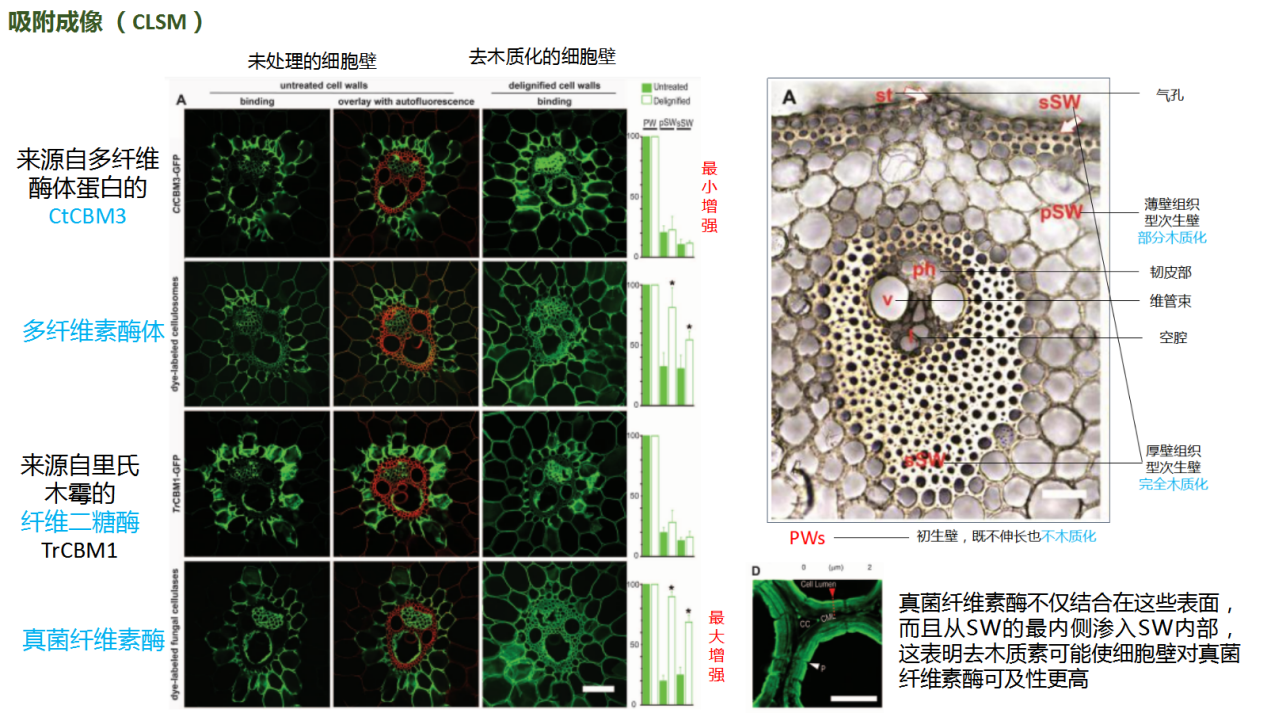
①下图为去木质化的细胞壁的共聚焦荧光扫描显微镜的图像。
图中可以看出纤维素酶的吸附与非生产性吸附,能够得出三个结论,首先,未木质化的细胞壁,纤维素酶吸附于韧皮部和与气孔相连的表皮之下的PWs和部分木质化的pSW,纤维素酶的可及性与细胞壁木质素含量呈强烈负相关。木质素去除增强了所有探针与木质化壁的整体结合(即pSW和sSW)。其次,从最高增强的真菌纤维素酶的图像来看,真菌纤维素酶不仅结合在这些表面,而且从SW的最内侧渗入SW内部,这表明去木质素可能使细胞壁对真菌纤维素酶可及性更高。
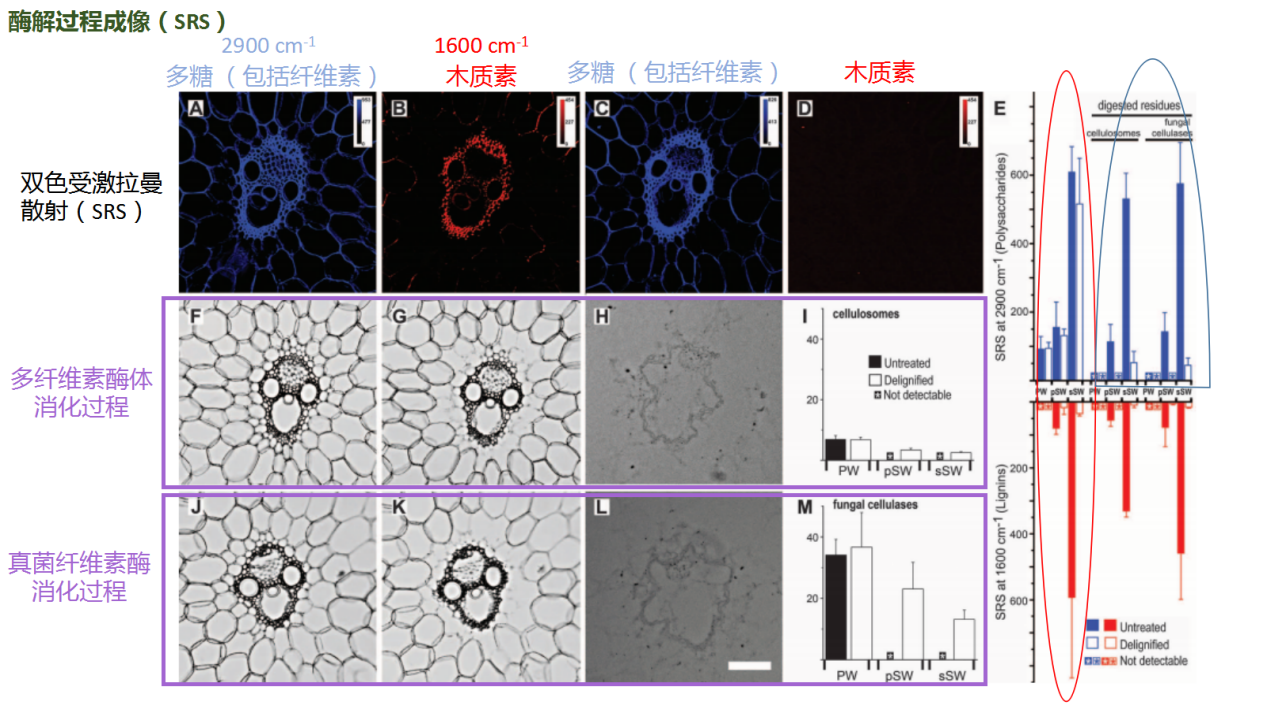
②下图为酶解过程的成像图。
较薄和不太致密的细胞壁被迅速消化,不管是多糖部分还是木质素部分的信号,都在减弱。真菌纤维素酶对未经处理或脱木质素的细胞壁的酶解作用作用比纤维素体快5倍。
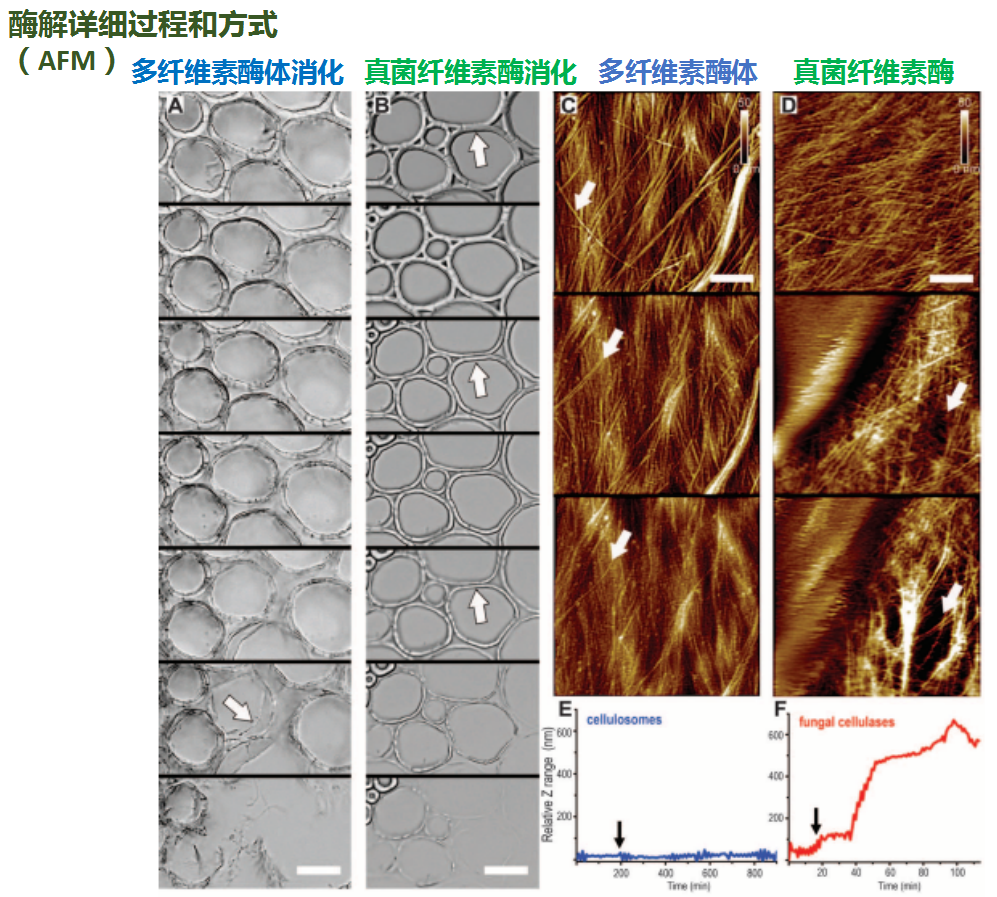
③下图为多纤维素酶体和真菌纤维素酶的消化方式的比较。
纤维素体首先将壁从复合中层分离,然后将壁分成片段,而真菌纤维素酶以均匀的方式溶解(酶解消化)整个壁,消化发生在细胞壁最内侧。在纤维素体的情况下,粗糙度保持不变,而真菌纤维素酶的消化显著增加了粗糙度。较大的纤维素酶体复合物只能穿透较大的壁薄层间隙,相反,真菌纤维素酶的消化率提高,因为它们渗透到微纤维网络的孔结构中。
结论与总结:
综上,这篇文章通过实时成像的使用,对预处理后去木质化的玉米秸秆对不同纤维素多酶体系的吸附(共聚焦激光扫描显微镜(CLSM)、酶解效率(双色受激拉曼散射(SRS)和明场显微镜)、酶解方式(明场显微镜、原子力显微镜(AFM))等几个部分进行分析。结论包括:①小的非复合真菌纤维素酶利用与较大的多酶复合物(纤维素体)有着相当不同的机制来解构细胞壁。②消化主要是通过使酶接近疏水性纤维素表面来促进的。数据支持这样的结论:即理想的预处理应该最大限度地去除木质素,最大限度地减少多糖的修饰,从而保留基本上天然的微纤丝结构。
Contact: ZhouMin
Email:986624183@qq.com