
环境浓度下纳米氧化锌颗粒对水生生态的毒理影响
Title: Do environmental concentrations of zinc oxide nanoparticle pose ecotoxicological risk to aquatic fungi associated with leaf litter decomposition?
Download website:
https://www.sciencedirect.com/science/article/pii/S0043135420303778
Abstract: Ecotoxicological risk of ZnO nanoparticles at environmental levels is a key knowledge gap for predicting how freshwater ecosystems will respond to nanoparticle pollution. A microcosm experiment was conducted to explore the chronic effects of ZnO nanoparticle at environmental concentrations (30, 300, 3000 ng·L-1) on aquatic fungi associated with the decomposing process of poplar leaf litter (45 days). ZnO nanoparticles led to 9-33% increases in fungal biomass after acute exposure (5 days), but 33-50% decreases after chronic exposure (45 days), indicating that the hormetic effect of ZnO nanoparticles at the environmental level may occur during acute exposure. Besides, ZnO nanoparticles had negative effects on microbial enzyme activity, especially on day 10, when the activities of N-acetylglucosaminidase, glycine-aminopeptidase, aryl-sulfatase, polyphenol oxidase, and peroxidase were significantly inhibited. After chronic exposure, the fungal community structure was significantly impacted by ZnO nanoparticles at 300 ng· L-1due to the reduced proportion of Anguillospora, which eventually caused a significant decrease in litter decomposition rate. Therefore, ZnO nanoparticles may pose ecotoxicological effects on aquatic fungi even at a very low concentration and eventually negatively affect freshwater functioning.
Results:
(1) Overall, the litter decayed faster in the microcosms with ZnSO4 after 45-day exposure, which was reflected in the significant increase in decomposition rate compared to the control.
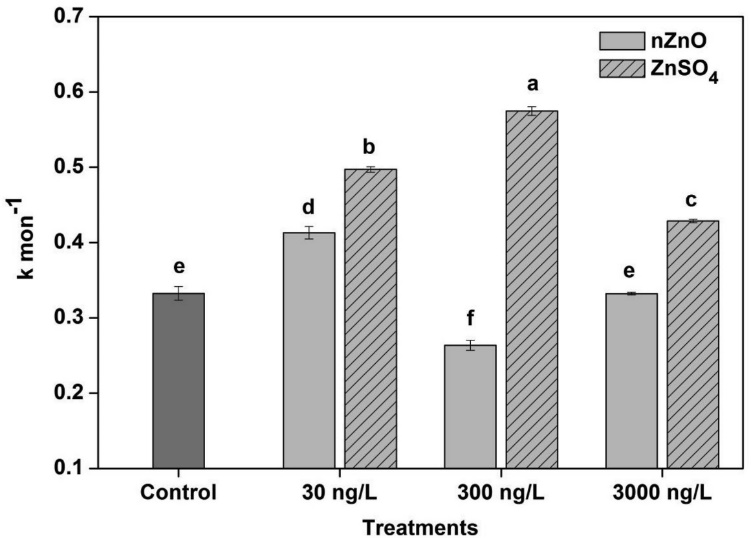
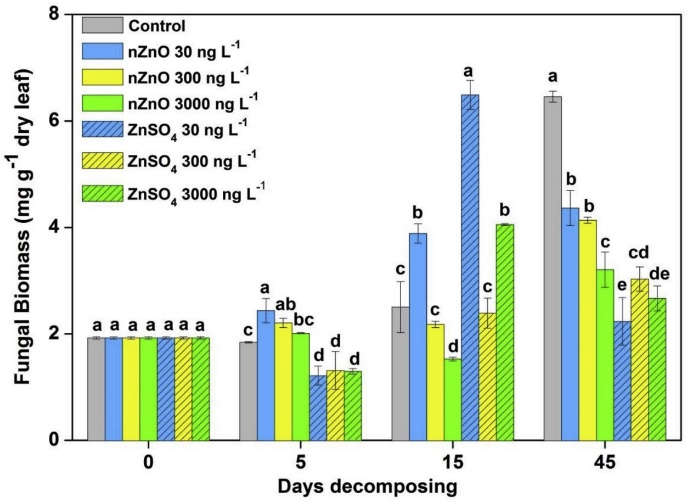
(2) Acute (5 days) and chronic (45 days) exposure of nZnO had opposite effects on fungal biomass.
Aquatic fungi were more sensitive to ZnSO4 than to nZnO after acute exposure (5 days), which was reflected in the significant decreases of fungal biomass.
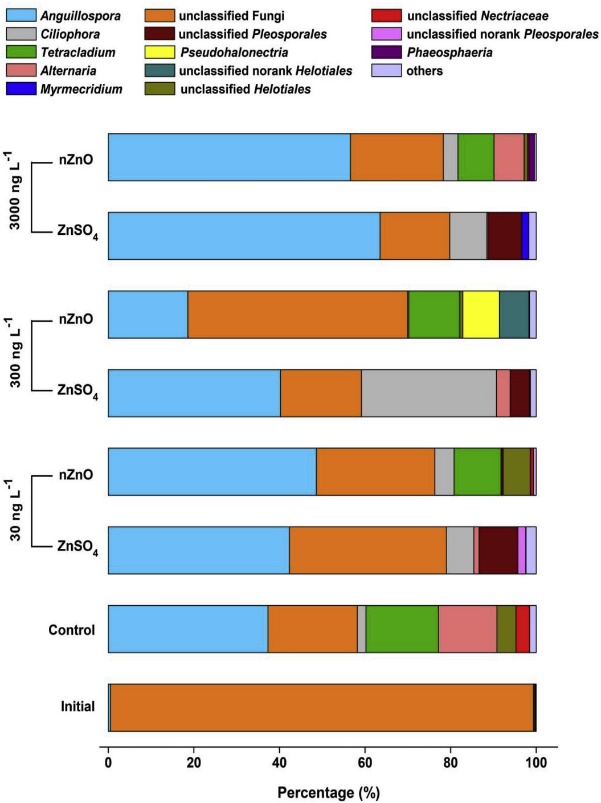
(3) While chronic exposure, regardless of nZnO and ZnSO4 at environmental concentration, did not cause the loss of fungal diversity, instead to increasing the fungal diversity in our work. After 45-day exposure, nZnO at 300·L-1 led to a distinct fungal community on leaves from other microcosms because of the clear changes in community composition.
Conclusion:
In conclusion, the ecotoxicological effect of nZnO on leaf litter decomposition is the comprehensive consequence based on responses of fungal biomass, microbial enzyme activity, as well as fungal community structure.