
在幼树群落中,功能同一性驱动了树种丰富度引起的凋落物产量和森林地面质量的增加
Title:Functional identity drives tree species richness-induced increases in litterfall production and forest floor mass in young tree communities
Download website: https://doi.org/10.1111/nph.19216
Abstract:Forest floor accumulation is a key process that influences ecosystem carbon cycling. Despite evidence suggesting that tree diversity and soil carbon are positively correlated, most soil carbon studies typically omit the response of the forest floor carbon to tree diversity loss.
Here, we evaluated how tree species richness affects forest floor mass and how this effect is
mediated by litterfall production and forest floor decay rate in a tree diversity experiment in a
subtropical forest. We observed that greater tree species richness leads to higher forest floor accumulation at the soil surface through increasing litterfall production – positively linked to functional trait identity (i.e. community-weighted mean functional trait) rather than functional diversity –and unchanged forest floor decay. Interestingly, structural equation modelling revealed that this lack of overall significant tree species richness effect on forest floor decay rate was due to two indirect and opposite effects cancelling each other out. Indeed, tree species richness increased forest floor decay rate through increasing litterfall production while decreasing forest floor decay rate by increasing litter species richness. Our reports of greater organic matter accumulation in the forest floor in species-rich forests suggest that tree diversity may have long-term and important effect on ecosystem carbon cycling and services.
Results:
Conclusions:
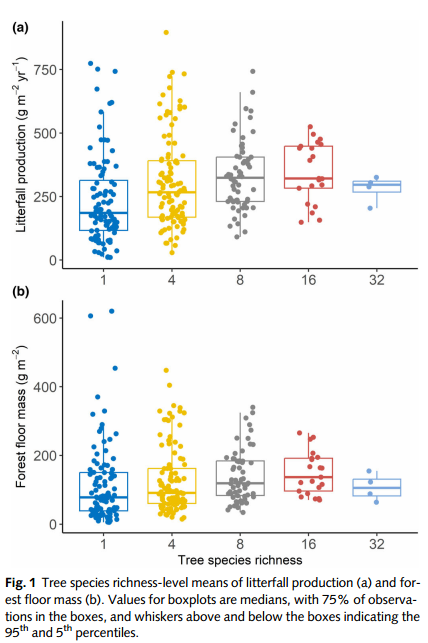
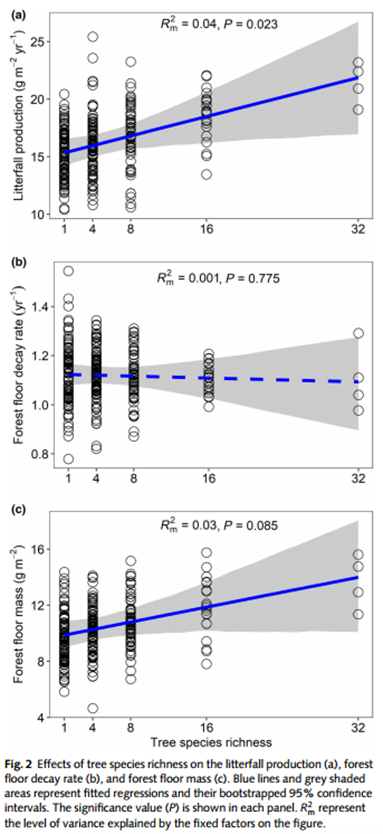
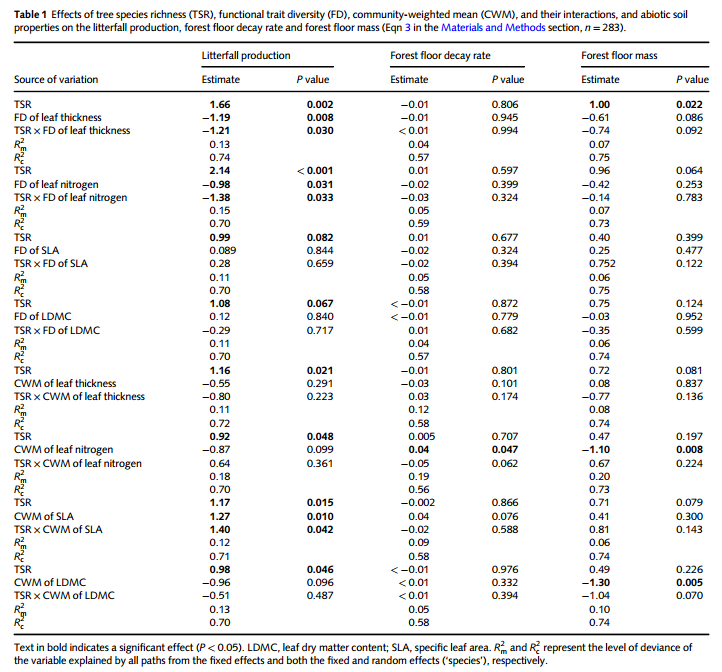
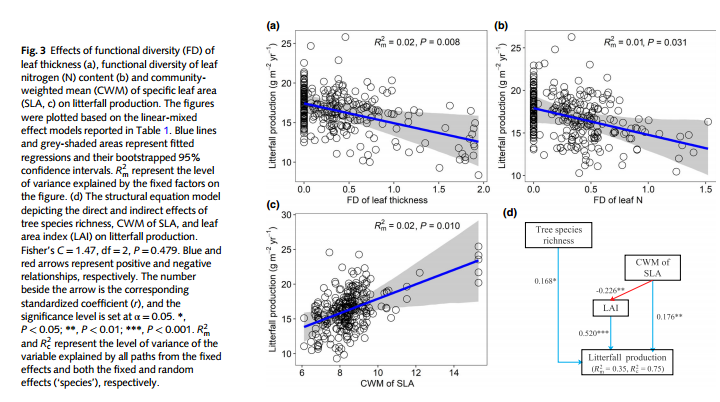
The annual litterfall production at the plot-level during the study period ranged from 10.5 to 896.3 gm-2yr-1 (Fig. 1a). The forest floor mass at the plot-level ranged between 5.5 and 620.5 gm-2yr-1 (Fig. 1b). The monthly total litterfall peaked in March, September and November (Fig. S4). The forest floor decay rate (the decomposition constant (k)) ranged between 0.1 and 3.8 yr-1 across all the study plots. Annual litterfall production significantly increased with tree species richness (R2m = 0.04, P = 0.023, Fig. 2a; Table S3). However, the forest floor decay rate did not change significantly with tree species richness (R2m = 0.001, P = 0.775, Fig. 2b; Table S3).Consequently, the forest floor mass marginally increased with tree species richness (R2m = 0.03, P = 0.085, Fig. 2c; Table S3).We found that annual litterfall production significantly decreased with functional diversities in leaf thickness (R2m = 0.02,P = 0.008) and leaf N content (R2m = 0.01, P = 0.031, Table 1;Fig. 3). Annual litterfall production significantly increased with CWM of SLA (R2m = 0.02, P = 0.010, Fig. 3c). In addition, we found a significant interaction effect between tree species richness and FD of leaf thickness and leaf N, and CWM of SLA (Table 1).On average, litterfall production increased with tree species richness, with a stronger positive effect in forests with a higher CWM of SLA and lower FD of leaf thickness and leaf N (Fig. S5).
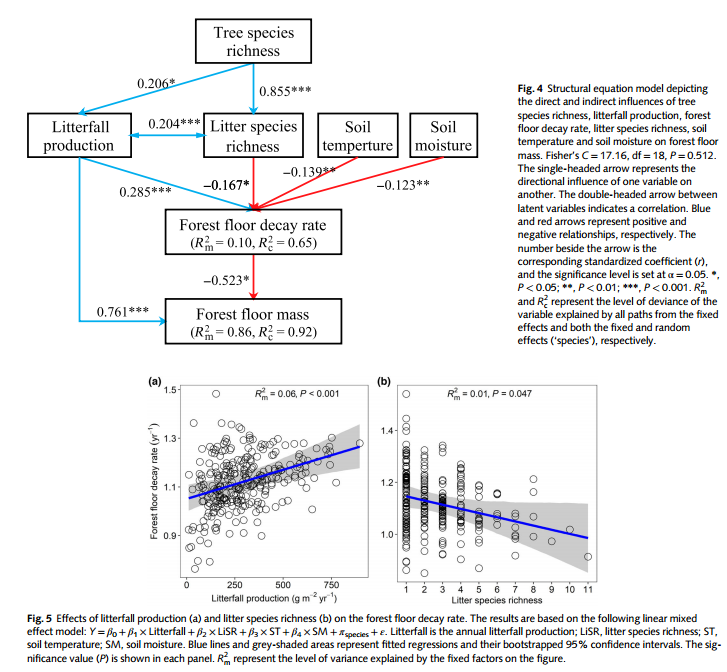
The functional diversity of living leaf and leaf litter traits had no significant effect on forest floor decay rates (Tables 1, S4). We found that the CWM of leaf N content had a significant and positive effect on forest floor decay rate (R2m = 0.01, P = 0.047,Table 1). Our structural equation model showed that on the one hand, tree species richness had a positive and indirect effect on forest floor decay rate via its positive effect on litterfall production (Fig. 4). On the other hand, tree species richness had a negative and indirect effect on forest floor decay rate via its positive effect on litter species richness, which in turn had a negative effect on forest floor decay rate (Fig. 4). In addition, forest floor decay rate significantly increased with increasing litterfall production, and decreased with increasing litter species richness (Fig. 5).
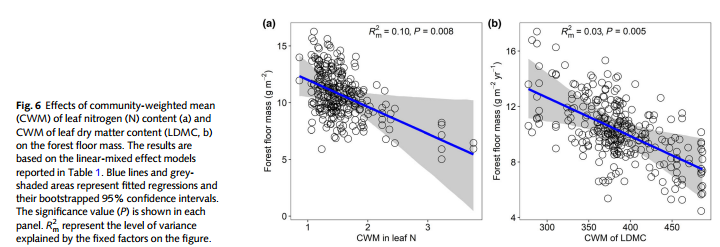
Forest floor mass decreased significantly with CWM of leaf N content (R2m = 0.10, P = 0.008) and leaf DM content(R2m = 0.03, P = 0.005, Fig. 6; Table 1). The structural equation model accounted for 86% of the variation in forest floor mass (Fig. 4) and suggested that tree species richness has a positive and indirect effect on forest floor mass via its positive effect on litterfall production. In addition, we noted that the estimates of fixed effects were consistently similar between models with or without the 32 species mixtures (Figs S6–S10) or without both the 16- and 32-species mixtures (Figs S11–S15).
Contact: Lin Meng