
可降解微塑料对土壤微生物群落结构和功能的影响
Title: The microplastisphere: biodegradable microplastics addition alters soil microbial community structure and function
DOI: https://doi.org/10.1016/j.soilbio.2021.108211
Abstract
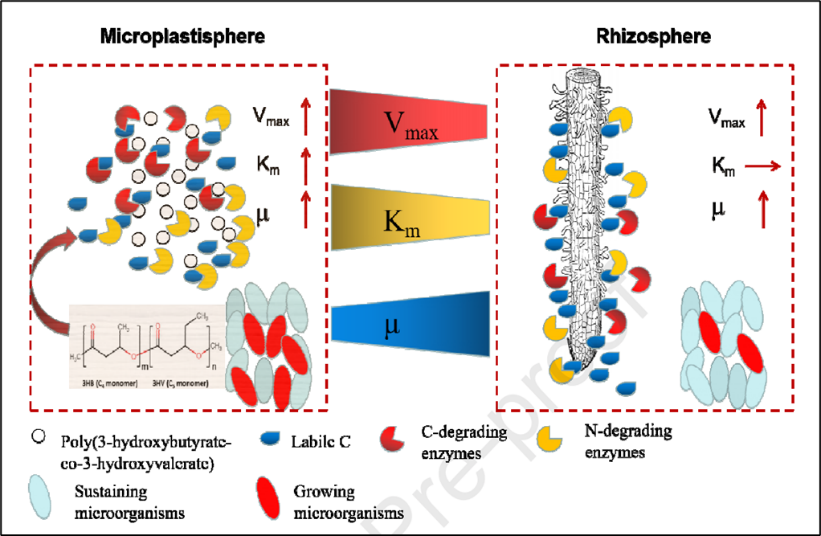
Plastics accumulating in the environment, especially microplastics (defined as particles <5 mm), can lead to a range of problems and potential loss of ecosystem services. Polyhydroxyalkanoates (PHAs) are biodegradable plastics used in mulch films, and in packaging material to minimize plastic waste and to reduce soil pollution. Little is known, however, about the effect of microbioplastics on soil-plant interactions, especially soil microbialcommunity structure and functioning in agroecosystems. For the first time, we combined zymography (to localize enzyme activity hotspots) with substrate-induced growth respiration to investigate the effect of PHA addition on soil microbial community structure, growth, and exoenzyme kinetics in the microplastisphere (i.e. interface between soil and microplastic particles) compared to the rhizosphere and bulk soil. We used a common PHA biopolymer, poly (3-hydroxybutyrate-co-3-hydroxyvalerate) (PHBV) and showed that PHBV was readily used by the microbial community as a source of carbon (C) resulting in an increased specific microbial growth rate and a more active microbial biomass in the microplastisphere in comparison to the bulk soil. Higher β-glucosidase and leucine aminopeptidase activities (0.6-5.0 times higher Vmax) and lower enzyme affinities (1.5-2.0 times higher Km) were also detected in the microplastisphere relative to the rhizosphere. Furthermore, the PHBV addition changed the soil bacterial community at different taxonomical levels and increased the alpha diversity, as well as the relative abundance of Acidobacteria and Verrucomicrobia phyla, compared to the untreated soils. Overall, PHBV addition created soil hotspots where C and nutrient turnover is greatly enhanced, mainly driven by the accelerated microbial biomass and activity. In conclusion, microbioplastics have the potential to alter soil ecological functioning and biogeochemical cycling (e.g., SOM decomposition).
Keywords: enzyme activity; microbial growth; microplastic pollution; soil organic matter; C turnover; sequencing
Methods:
1. Visualize the effect of PHBV addition on soil enzyme activity through soil enzyme spectrum technology. Enzyme detection sequences followed as: β-glucosidase, acid phosphatase, leucine-aminopeptidase activity.
2. Determination of soil respiration + Determination of microbial organic carbon and nitrogen content.
Results
1. The hot spots of soil enzyme activity are mainly concentrated in microplastisphere (i.e. interface between soil and microplastic particles(MPs)).
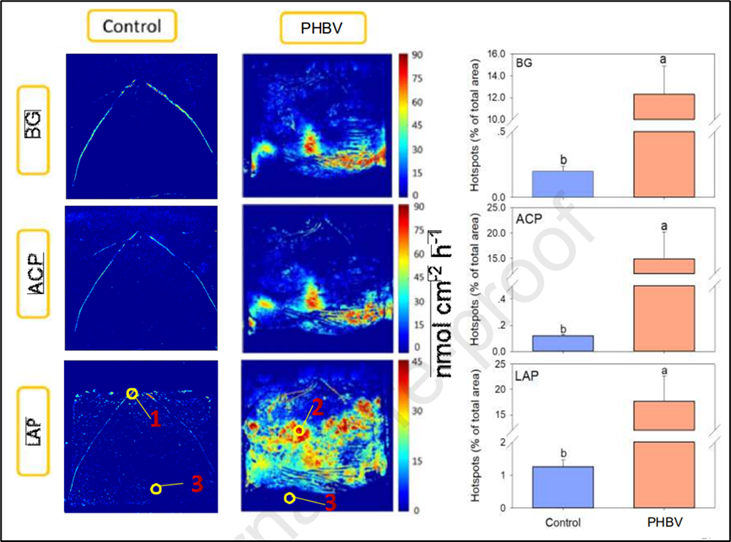
Fig. 1 Zymograms and hotspots of β-glucosidase (BG), acid phosphatase (ACP) and leucine aminopeptidase (LAP) in untreated soil (Control) and soil to which the bioplastic poly(3-hydroxybutyrate-co-3-hydroxyvalerate) (PHBV) was added. The color intensity is proportional to the respective enzyme activity (nmol cm-2 h-1). The zymograms are representative of 4 independent replicates. The corresponding area of hotspots relative to the total area of the rhizobox for each enzyme is shown in the right-hand panel. Values are means (± SE) of four replicates. Different letters show significant differences between treatments (p < 0.05). Here, 1, 2, 3 indicate rhizosphere, microplastisphere, and bulk soil.
2. PHBV addition increases soil enzyme activity, especially its effect on leucine aminopeptidase (LAP).
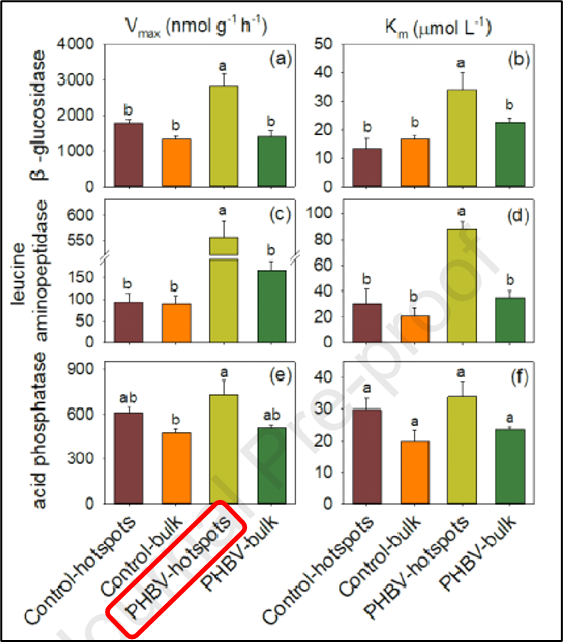
Fig. 2 Potential enzyme activities (Vmax) and substrate affinities (Km) of β-glucosidase (BG), leucine aminopeptidase (LAP), and acid phosphatase (ACP) in bulk and hotspots in untreated soil (Control) and soil to which the bioplastic poly(3-hydroxybutyrate-co-3-hydroxyvalerate) (PHBV) was added. Values are means(± SE) of four replicates. Different letters show significant differences between treatments (p < 0.05).
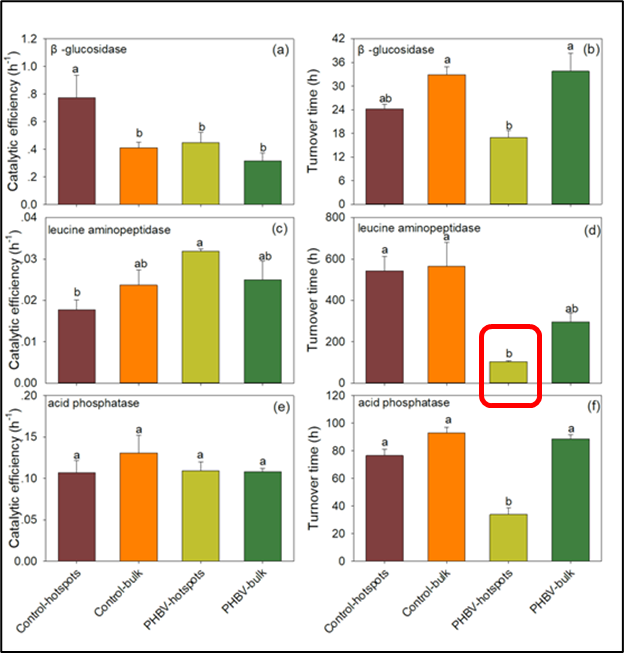
Fig. 3 The catalytic efficiency (ratio of Vmax/Km) (a,b), and turnover time (c,d) of β-glucosidase (BG), leucine aminopeptidase (LAP), and acid phosphate (ACP) in bulk and hotspots in untreated soil (Control) and soil to which the bioplastic poly(3-hydroxybutyrate-co-3-hydroxyvalerate) (PHBV) was added. Values are the average (± SE) of four replicates. Letters indicate significant difference between treatments (p < 0.05).
3. Soil respiration has a clear response to the addition of PHBV, and the microbial community structure after PHBV treatment shows a trend of shifting to K-strategy (i.e. higher biomass, lower specific growth rate(μ)).
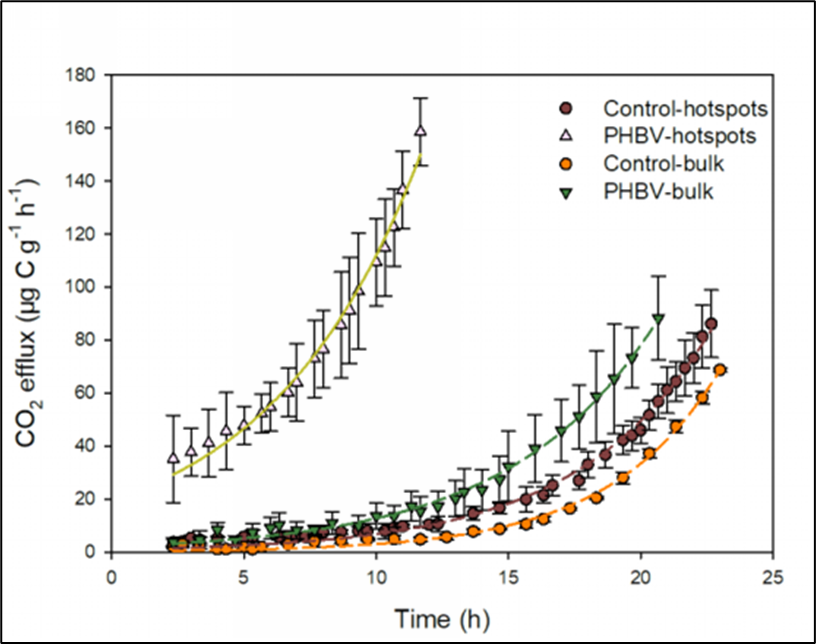
Fig. 4 CO2 efflux after nutrient addition in hotspots and the bulk soil in untreated soil (Control) and soil to which the bioplastic poly(3-hydroxybutyrate-co-3-hydroxyvalerate (PHBV) was added. Values are the average (± SE) of four replicates. Lines were obtained by fitting the model parameters to measured soil respiration rate according to Eqn. (2) for non-limiting growth period after nutrient addition. Through monitoring the electrical conductivity changes of alkaline solution due to ionization of CO2 to carbonate by RABIT, the rate of CO2 production from each sample was measured every 30 min.
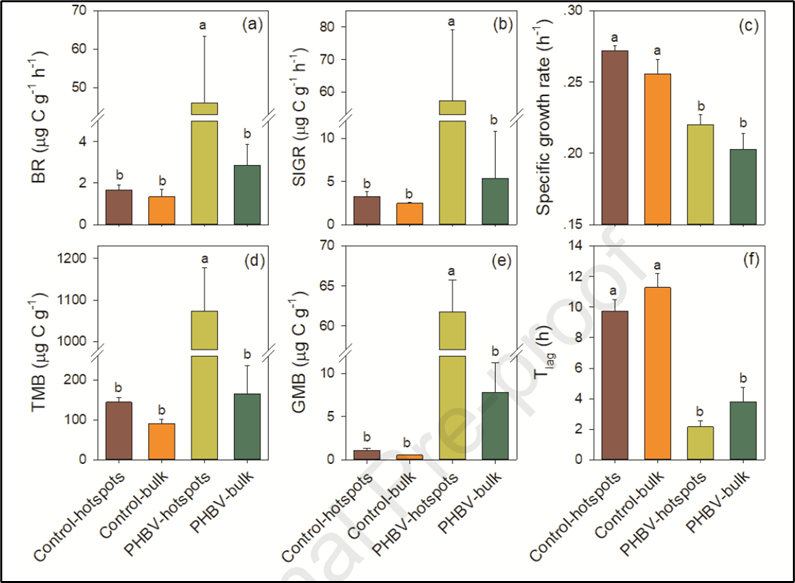
Fig. 5 Basal respiration (BR), substrate-induced growth respiration (SIGR), specific growth rate (μ), total microbial biomass (TMB), the fraction of growing microbial biomass to total microbial biomass (GMB/TMB), and their lag time in bulk and hotspots in untreated soil (Control) and soil to which the bioplastic.
Conclusion
Microplastisphere (soil-MPs interface) is localized and visualized by zymography.
MPs stimulates microbial turnover and nutrient efficiency in microplastisphere.
MPs increases soil enzyme activity and shifts bacterial community to K-strategy.
MPs have the potential to alter soil functioning and biogeochemical cycling.