
气候变化与生物相互作用
Article 1:
Title: Novel trophic interactions under climate change promote alpine plant coexistence
Download website:
https://science.sciencemag.org/content/370/6523/1469
Main contents:
Herbivory and plant defenses exhibit a coupled decline along elevation gradients. However, the current ecological equilibrium could be disrupted under climate change, with a faster upward range shift of animals than plants. Here, we experimentally simulated this upward herbivore range shift by translocating low-elevation herbivore insects to alpine grasslands. We report that the introduction of novel herbivores and increased herbivory disrupted the vertical functional organization of the plant canopy. By feeding preferentially on alpine plants with functional traits matching their low-elevation host plants, herbivores reduced the biomass of dominant alpine plant species and favored encroachment of herbivore-resistant small-stature plant species, inflating species richness. Supplementing a direct effect of temperature, novel biotic interactions represent a neglected but major driver of ecosystem modifications under climate change.
Methods:

位移实验
Results:
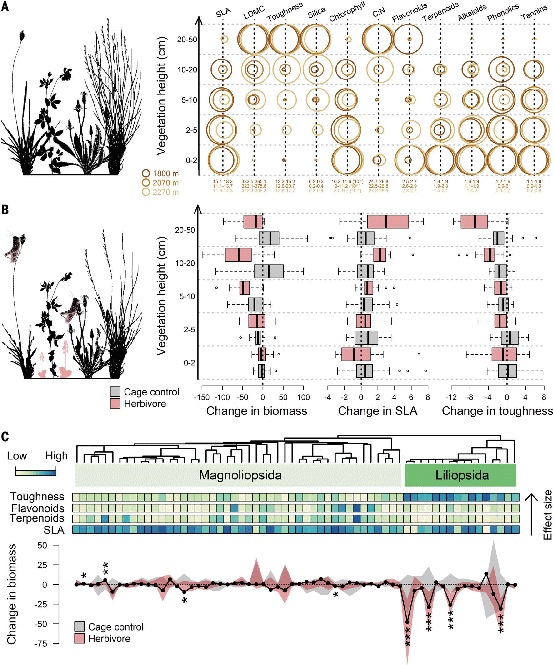
与目前的植物-食草动物相互作用相比,低地定居的草食动物和高山植物之间新的营养相互作用对高山植物群落结构产生了明显的下行效应。
Conclusion:
除了非生物因素的直接影响外,新的营养相互作用和增加的食草动物压力是气候变化下高山生态系统变化的关键驱动力。
Article 2:
Title: Climate warming enhances microbial network complexity and stability
Download website:
https://www.nature.com/articles/s41558-021-00989-9
Abstract:
Unravelling the relationships between network complexity and stability under changing climate is a challenging topic in theoretical ecology that remains understudied in the field of microbial ecology. Here, we examined the effects of long-term experimental warming on the complexity and stability of molecular ecological networks in grassland soil microbial communities. Warming significantly increased network complexity, including network size, connectivity, connectance, average clustering coefficient, relative modularity and number of keystone species, as compared with the ambient control. Molecular ecological networks under warming became significantly more robust, with network stability strongly correlated with network complexity, supporting the central ecological belief that complexity begets stability. Furthermore, warming significantly strengthened the relationships of network structure to community functional potentials and key ecosystem functioning. These results indicate that preserving microbial ‘interactions’ is critical for ecosystem management and for projecting ecological consequences of future climate warming.
Results:
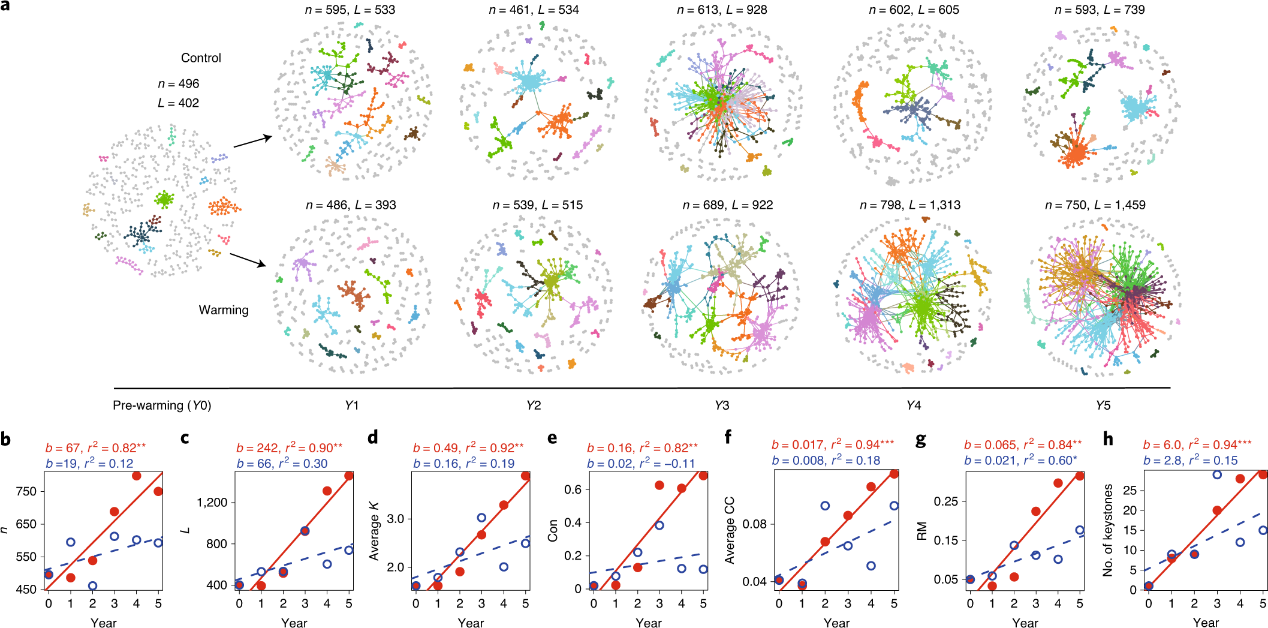
主要观点:
气候变化增强了微生物网络的稳定性。
Contact: Luo Yunchao
E-mail: luoyunchao@outlook.com; luoyunchaolyc@qq.com