
动物对凋落物分解的影响大于凋落物的混合作用
Title:Fauna access outweighs litter mixture mixture effect during leaf litter decomposition.
Download websites:
https://www.sciencedirect.com/science/article/pii/S0048969722072904
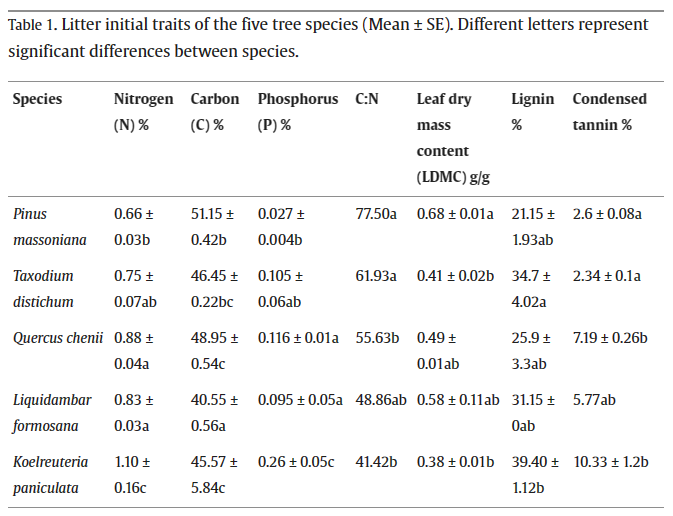
Abstract:Decomposition rates of litter mixtures reflect the combined effects of litter species diversity, litter quality, decomposers, their interactions with each other and with the environment. The outcomes of those interactions remain ambiguous and past studies have reported conflicting results (e.g., litter mixture richness effects). To date, how litter diversity and soil fauna interactions shape litter mixture decomposition remains poorly understood. Through a sixteen month long common garden litter decomposition experiment, we tested these interaction effects using litterbags of three mesh sizes (micromesh, mesomesh, and macromesh) to disentangle the contributions of different fauna groups categorized by their size at Wuhan botanical garden (subtropical climate). We examined the decomposition of five single commonly available species litters and their full 26 mixtures combination spanning from 2 to 5 species. In total, 2325 litterbags were incubated at the setup of the experiment and partly harvested after 1, 3, 6, 9, and 16 months after exposure to evaluate the mass loss and the combined effects of soil fauna and litter diversity. We predicted that litter mixture effects should increase with increased litter quality dissimilarity, and soil fauna should enhance litter (both single species litter and litter mixtures) decomposition rate. Litter mass loss ranged from 26.9 % to 87.3 %. Soil fauna access to litterbags accelerated mass loss by 29.8 % on average. The contribution of soil mesofauna did not differ from that of soil meso- and macrofauna. Incubation duration and its interactions with litter quality dissimilarities together with soil fauna determined the litter mixture effect. Furthermore, the litter mixture effect weakened as the decomposition progresses. Faunal contribution was broadly additive to the positive mixture effect irrespective of litter species richness or litter dissimilarity. This implies that combining the dissimilarity of mixture species and contributions of different soil fauna provides a more comprehensive understanding of mixed litter decomposition.
Results:
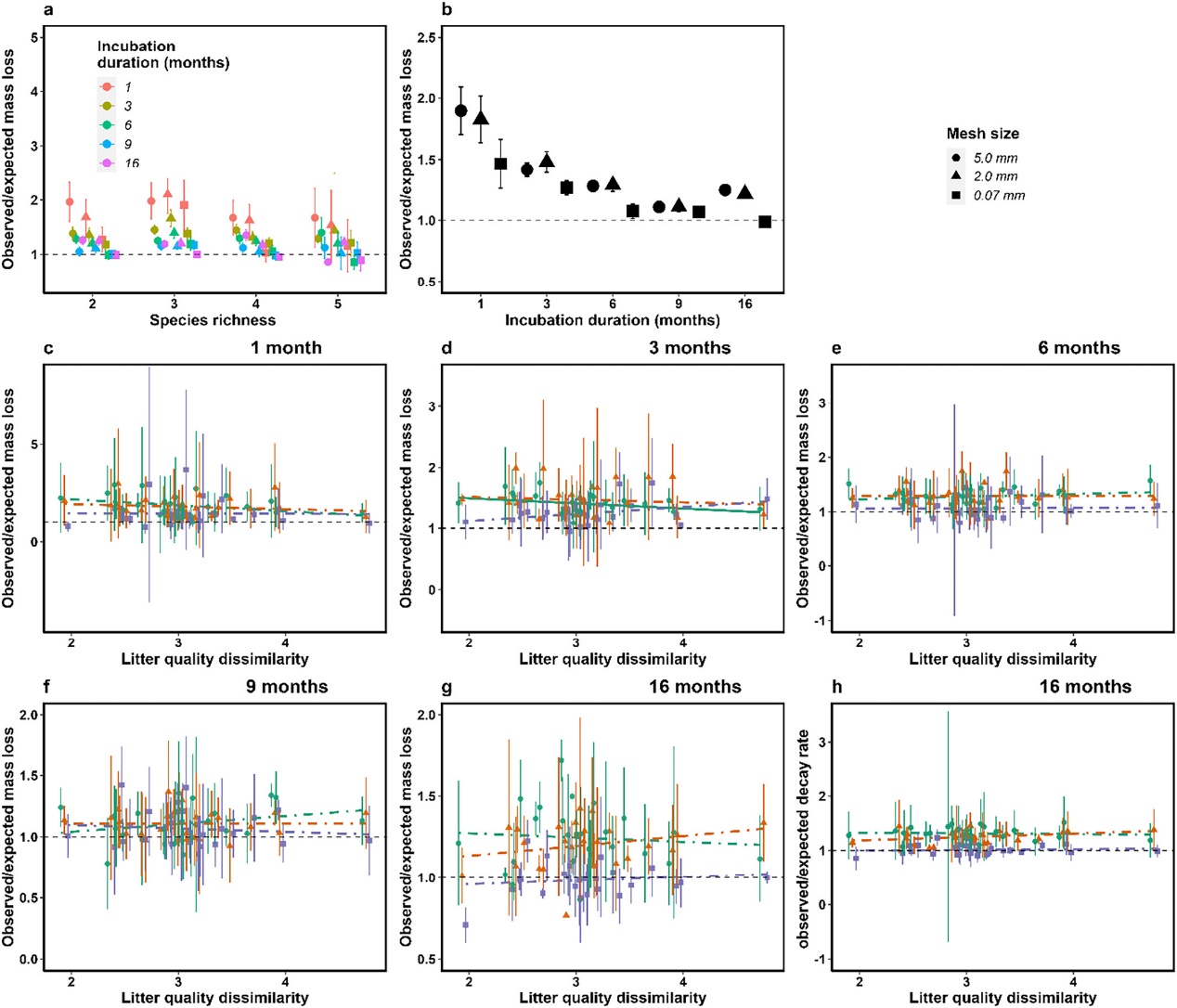
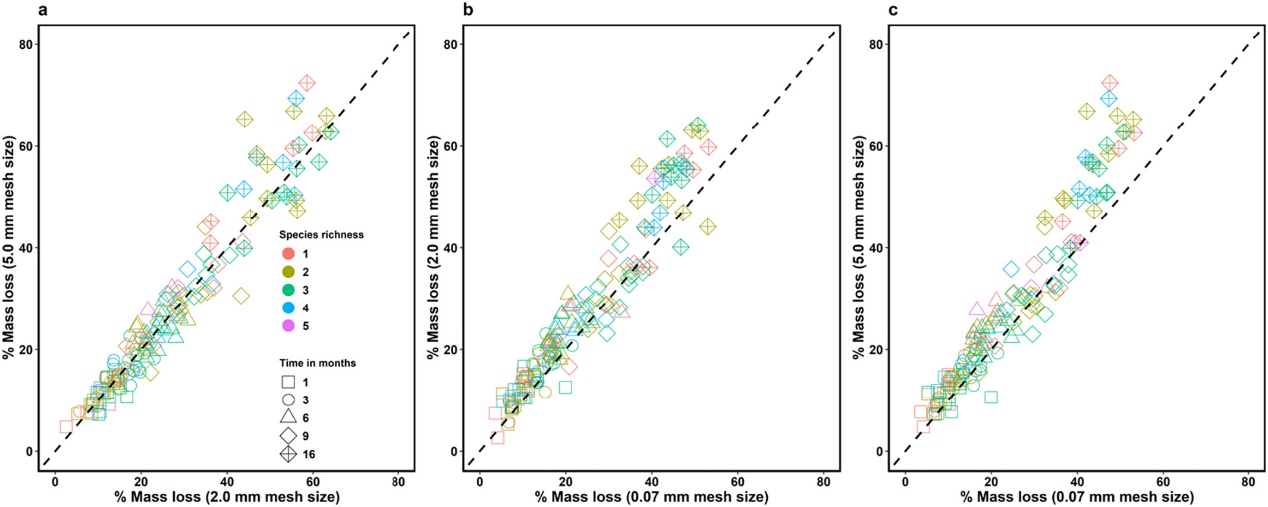
Conclusion:Here, using a common garden experiment with manipulative treatments, we show that soil fauna accelerates the rate of litter decomposition over sixteen months for both single species litter and litter mixtures. Furthermore, decomposition duration and also its interactions with litter quality dissimilarity modulates the litter mixing effect. Species richness in litter mixtures is also shown to accelerate litter decomposition, but there is a three-species limit beyond which further increase in the number of species in the mixture has no impact on decomposition and litter mixing effect. We also demonstrate that species composition rather than species richness holds higher predictive power of litter mixture effects. Our results emphasize the importance of soil fauna, decomposition duration and their interactions in shaping litter mixtures decomposition outcomes. For a better understanding and good predictions in global decomposition models, the soil fauna contribution along with the interactions between species diversity (trait dissimilarities) in controlling litter mixtures decomposition need to be considered.
Contact: Ran Zunian
E-mail:317804398@qq.com