
与液态深层发酵相比,链霉菌TEM 33在固态发酵中具有更高的脂解活性
Title: Streptomyces sp. TEM 33 possesses high lipolytic activity in solid-state fermentation in comparison with submerged fermentation
To link to this article: https://doi.org/10.1080/10826068.2014.970693
Abstract:
Solid-state fermentation (SSF) is a bioprocess that doesn’t need an excess of free water, and it offers potential benefits for microbial cultivation for bioprocesses and product development. In comparing the antibiotic production, few detailed reports could be found with lipolytic enzyme production by Streptomycetes in SSF. Taking this knowledge into consideration, we prefer to purify Actinomycetes species as a new source for lipase production. The lipase-producing strain Streptomyces sp. TEM 33 was isolated from soil and lipase production was managed by solid-state fermentation (SSF) in comparison with submerged fermentation (SmF). Bioprocess-affecting factors like initial moisture content, incubation time, and various carbon and nitrogen additives and the other enzymes secreted into the media were optimized. Lipase activity was measured as 1.74±0.0005 U/g dry substrate (gds) by the p-nitrophenylpalmitate (pNPP) method on day 6 of fermentation with 71.43% final substrate moisture content. In order to understand the metabolic priority in SSF, cellulase and xylanase activity of Streptomyces sp. TEM33 was also measured. The microorganism degrades the wheat bran to its usable form by excreting cellulases and xylanases; then it secretes the lipase that is necessary for degrading the oil in the medium.
Optimization of SSF conditions:
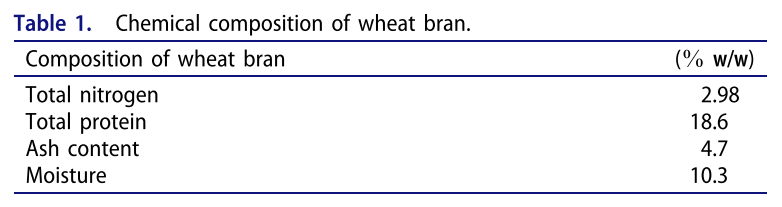
In recent years, several researchers have studied the use of lipid sources on lipase production using techniques of SmF and SSF. Inducers such as Tween 80, soybean, olive oils, babassu oil cake, and coconut and soybean meals have been evaluated for lipase production. In this study the total amounts of nitrogen, protein, ash, and moisture of processed wheat bran were determined as in Table 1 and the proportions of the additives were optimized.
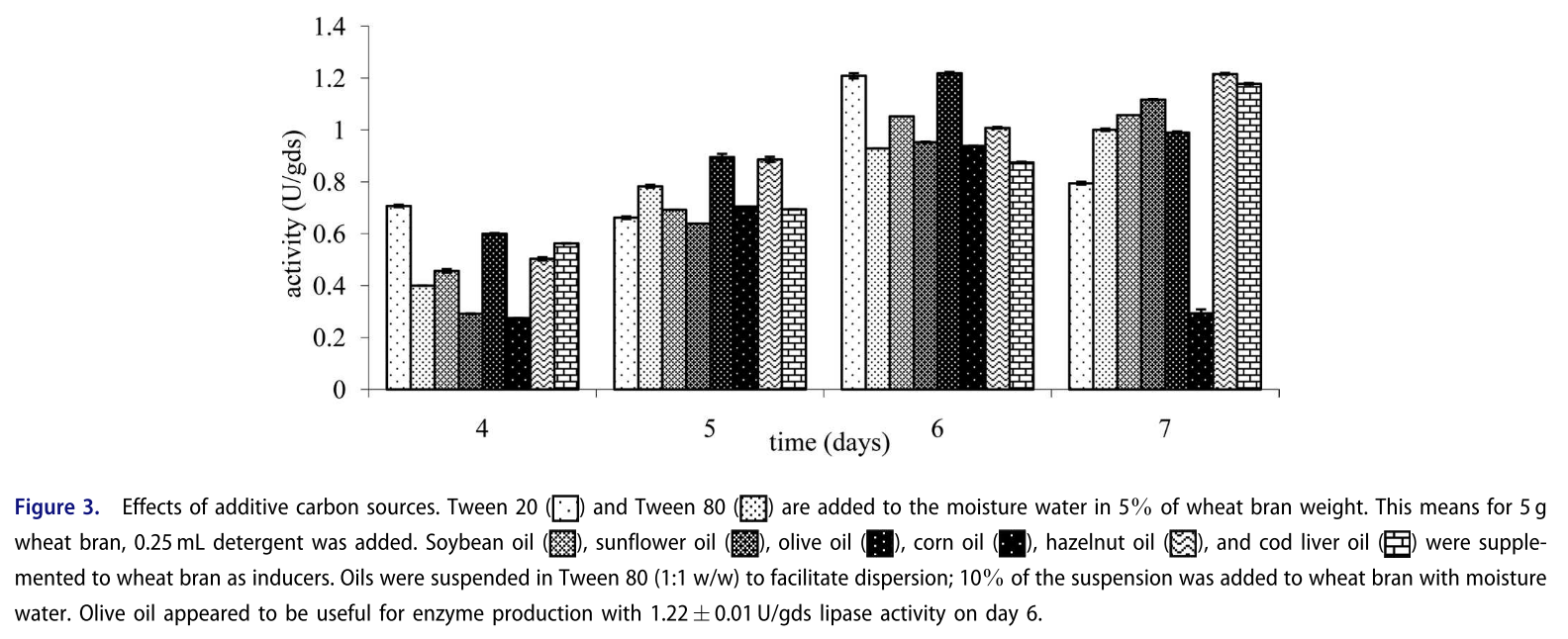
Because lipases are inducible enzymes, if oils were added at the initiation of fermentation, extracellular lipase activity would increase remarkably. Going by this theory, we added different inducers to wheat bran medium. Among six different oils, olive oil appeared to be useful for enzyme production with 1.22±0.01 U/gds lipase activity on day 6 (Figure 3).
The initial content of the moisture in wheat bran was adjusted to different levels: 60%, 66.67%, and 71.43%. The optimum condition of the maximum enzyme production, 1.4±0.01 U/gds, was at the initial moisture content of 71.43% at day 6 of fermentation time.
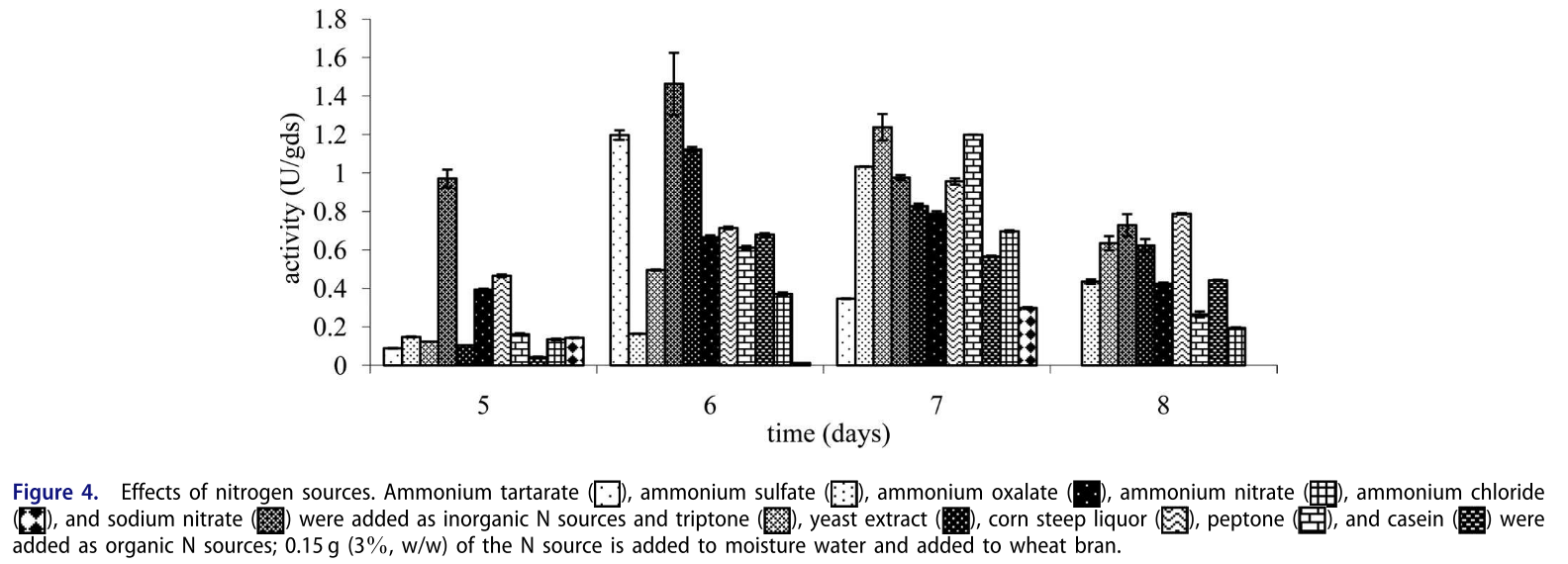
The effects of various organic and inorganic nitrogen sources were studied for optimal lipase production (Figure 4). Among different nitrogen sources tested, NaNO3 was found to be the best for enzyme production, followed by tryptone and peptone with specific activities of 1.46±0.16 U/gds, 1.24±0.07 U/gds, and 1.20±0.0006 U/gds, respectively. Although there are confusions about the effect of nitrogen sources on lipase production, the stimulation effect of the presence of a nitrogen source especially with olive oil on lipase production has been accepted. In this study, it is shown that inorganic nitrogen sources affect the lipase production more than organic nitrogen sources.
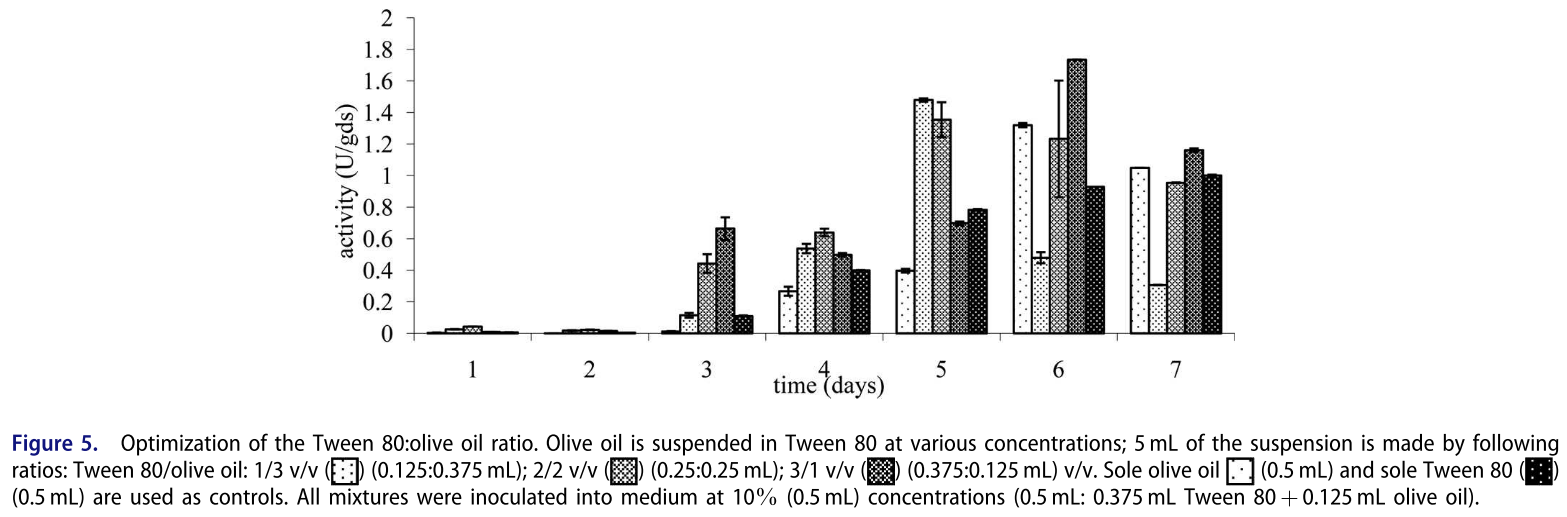
Lipids are hydrophobic organic compounds, so they can dissolve in organic solvents and detergent. Enzymes have effective activity on large surface areas. Various surfactants such as Tween 80, in addition to inducing lipase biosynthesis, can increase cells’ permeability and facilitate the export of cell bound lipase across the cell through its membrane. We have investigated the effects of various levels of detergent (Tween 80)/inducer on lipase activity (Figure 5). The maximum enzyme yield (1.74±0.0005 U/gds) was observed in the medium with olive oil suspend in threefold Tween 80.
Streptomyces sp. TEM33 seems to be suitable for supporting the microbial growth and enzyme production. At 71.43% moisture level and without adjusting the pH as such, it produced 1.4 U/g of substrate lipase. Solubilization of supplements was critical in increasing the enzyme production. Olive oil solubilization with Tween 80 (Tween 80:olive oil, 3:1) increased the production by 1.48-fold, reaching 1.74 U/g of substrate lipase activity.
Other commonly employed agri-wastes have been reported to produce lipase in the range of 0.0186 and 1.084 U/g initial dry weight from Bacillus megaterium and Pseudomonas aeruginosa, respectively.
Xylanase and cellulase activity of Streptomyces sp. TEM 33:
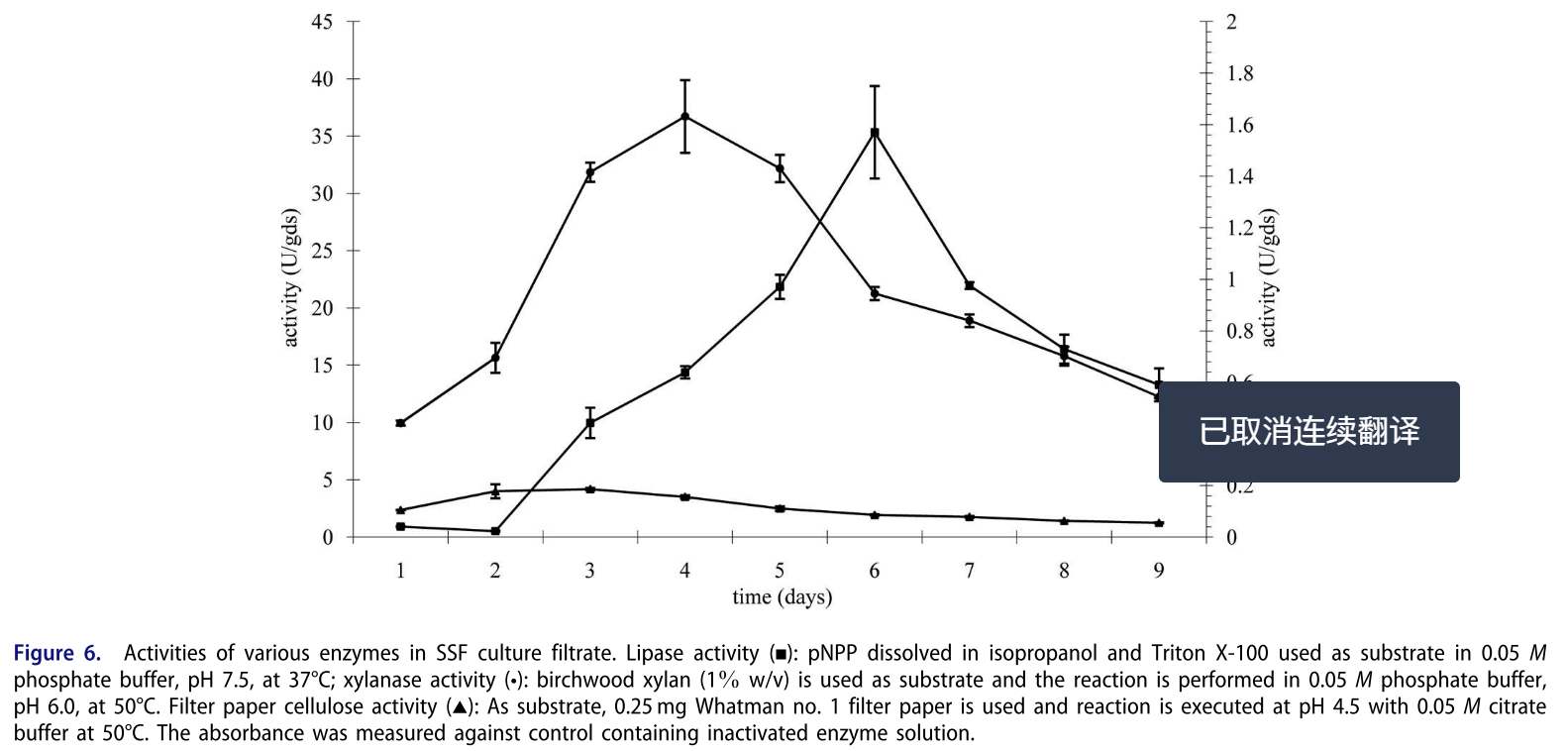
SSF gained interest because of advantages, but little is known about the microbial physiology and metabolism under SSF conditions. Therefore, we have compared different parameters on lipase production. A treatment with xylanases facilitates the chemical extraction of lignin from pulp. This leads to a significant saving of chemicals required for bleaching and for the reduction of the emission of toxic compounds into the environment.[26] Microorganisms secrete cellulosic and hemicellulosic enzymes to degrade the content of medium and to use the N and C contents in own molecules. Actually, Streptomyces species possessed xylanase and cellulose on agricultural by-products like wheat bran that contain cellulose, hemicellulose, and lignin. As can be seen in the figures, Streptomyces sp. TEM 33 secretes xylanase on day 4 (36.72±3.18 U/gds) and cellulase on day 3 (0.19±0.005 U/ gds) of fermentation (Figure 6).
The Streptomyces sp. TEM33 strain is first excreting cellulases and xylanases, so it degrades the wheat bran to its usable form. Then it secretes the lipase, which is necessary for degrading the oil in the medium.
Conclusion:
Solid-state fermentation (SSF) is a developing bioprocess for industrial applications because of its potential in large-scale production of industrial enzymes, biopolymers, pigments, and secondary metabolites with techno-economic feasibility. Taking the low-cost substrate and the production capacity account, it is obvious that lipase production by SSF is much more economical than by SmF. In the present study, the actinomycete Streptomyces sp. TEM33 was isolated as a lipase source. Until now, a wide range of microbial species have been used for lipase production in SSF except Streptomycetes. Thus, as far as we know, this is the first report on Streptomyces sp. lipase production on SSF with a promising amount of enzyme activity.
CONTACT: LI Haidong