
外来入侵驱动生态系统碳循环
Article 1:
Title: Biotic interactions drive ecosystem responses to exotic plant invaders
Download website:
https://science.sciencemag.org/content/368/6494/967
Main contents:
Ecosystem process rates typically increase after plant invasion, but the extent to which this is driven by (i) changes in productivity, (ii) exotic species’ traits, or (iii) novel (non-coevolved) biotic interactions has never been quantified. We created communities varying in exotic plant dominance, plant traits, soil biota, and invertebrate herbivores and measured indicators of carbon cycling. Interactions with soil biota and herbivores were the strongest drivers of exotic plant effects, particularly on measures of soil carbon turnover. Moreover, plant traits related to growth and nutrient acquisition explained differences in the ways that exotic plants interacted with novel biota compared with natives. We conclude that novel biological interactions with exotic species are a more important driver of ecosystem transformation than was previously recognized.
Methods:
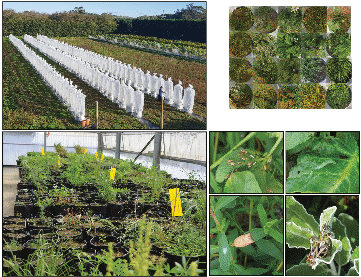
正交实验
Results:
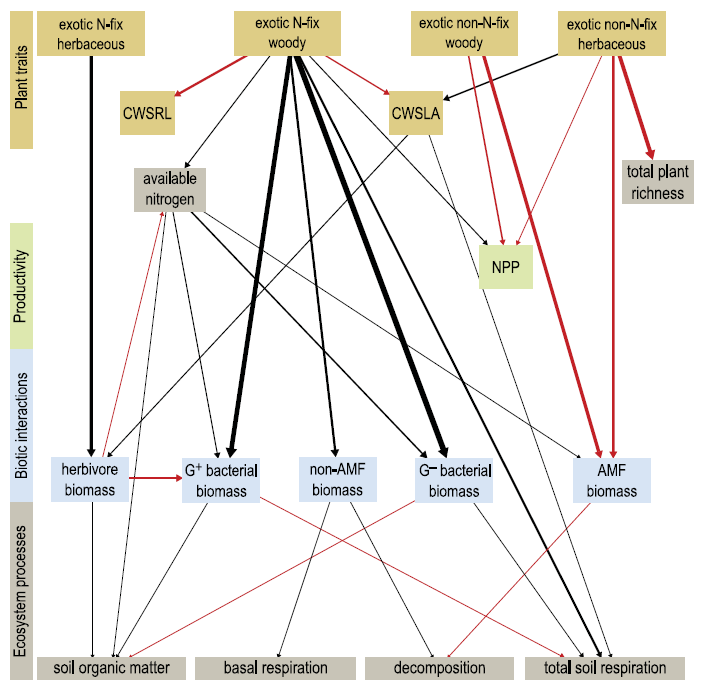
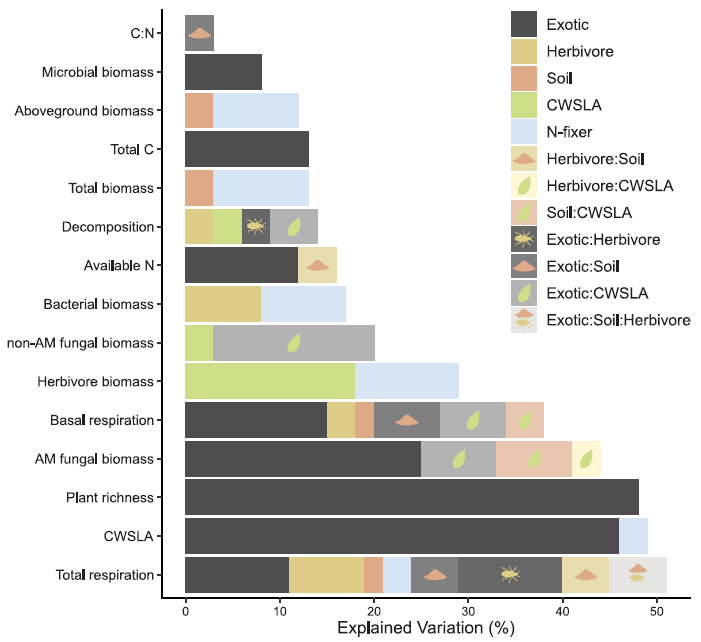
不同因子之间的相互作用
Conclusion:
外来植物带来的新的生物相互作用是生态系统进程重要的驱动因素。
Article 2:
Title: Soil-microorganism-mediated invasional meltdown in plants
Download website:
https://www.nature.com/articles/s41559-020-01311-0
Abstract:
While most alien species fail to establish, some invade native communities and become widespread. Our understanding of invasion success is derived mainly from pairwise interactions between aliens and natives, while interactions among more than two species remain largely unexplored. Here, we experimentally tested whether and how a third plant species, either native or alien, affected the competitive outcomes between alien and native plants through its soil legacy. We first conditioned soil with one of ten species (six natives and four aliens) or without plants. We then grew on these 11 soils five aliens and five natives without competition, or with intra- or interspecific competition. We found that aliens were not more competitive than natives when grown on soil conditioned by other natives or on non-conditioned soil. However, aliens were more competitive than natives on soil conditioned by other aliens (that is, invasional meltdown). Soil conditioning did not change competitive outcomes by affecting the strength of competition between later plants. Instead, soil conditioned by aliens pushed competitive outcomes towards later aliens by affecting the growth of aliens less negatively than that of natives. Microbiome analysis verified this finding, as we showed that the soil-legacy effects of a species on later species were less negative when their fungal endophyte communities were less similar, and that fungal endophyte communities were less similar between two aliens than between aliens and natives. Our study reveals invasional meltdown in multispecies communities and identifies soil microorganisms as a driver of the invasion success of alien plants.
Results:
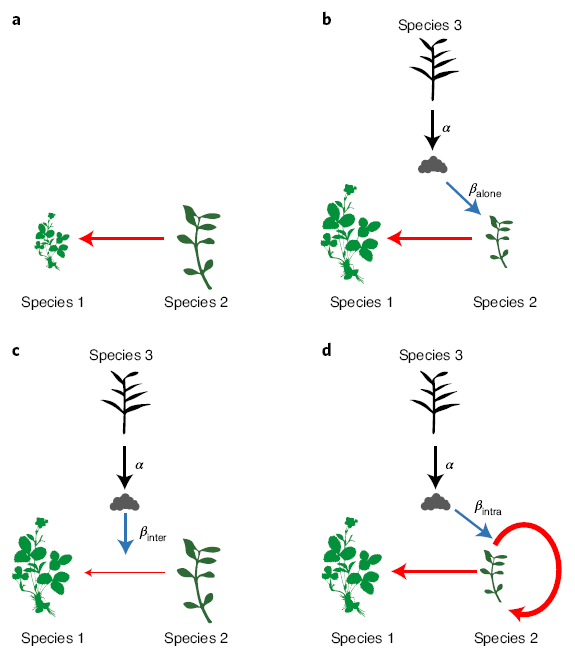
主要观点:
入侵灾难假说(invasional meltdown hypothesis):外来种会互相促进彼此的入侵,从而取代本地种。
Contact: Luo Yunchao
E-mail: luoyunchao@outlook.com; luoyunchaolyc@qq.com