
Title: Quantifying influences of natural and anthropogenic factors on vegetation changes using structural equation modeling: A case study in Jiangsu Province, China
Download website:https://doi.org/10.1016/j.jclepro.2020.124330
Abstract:
Vegetation coverage in highly developed areas has been significantly altered in response to multiple disturbances over recent decades. However, the major driving factor of vegetation coverage change in these areas remains unclear, with climate change and anthropogenic factors playing interactive roles under different soil and terrain conditions. Comprehensively understanding the underlying drivers of vegetation change can provide references for regulating environmental management and prevention of vegetation degradation. In this paper, a structural equation modeling (SEM) method was employed to quantify the effects of fundamental natural environment (i.e.the relative stable variables including soil and topography), climate change and human activity change on vegetation coverage change in Jiangsu province, China from 2000 to 2015. Four variables including land use, population density, road impact and night lights were used to indicate human activities. The results showed that the increase of NDVI smaller than 0.10 covered 39.13% of the study areawhile the decrease of NDVI larger than 0.10 accounted for 20.23%. Areas with NDVI increase mainly distributed in croplands in northern Jiangsu. This could be explained by the increase of crop yield due to the development of modern agriculture. The decrease of NDVI was mainly observed in southern Jiangsu with higher urbanization level and city centers in northern Jiangsu, indicating the effect of rapid urbanization on vegetation degradation. The constructed SEM model suggested that the total effects (influential coefficients) of fundamental natural environment, climate change, and human activity change on NDVI change in Jiangsu were -0.24, 0.17, and -0.74, respectively. Although the fundamental natural environment didn’t have a direct effect on NDVI change, but it had an indirect effect through interactions with human activities. We also constructed SEM models for northern and southern Jiangsu separately, due to their different natural environment and changing patterns of climate change. The results indicated the different driving mechanisms of NDVI change in northern and southern Jiangsu. Furthermore, the results suggested night light as the best indicator of human activity change, followed by the road impact index. We concluded that our study offered a framework to better understand and explain the complex interrelationships behind the spatial temporal change of NDVI.
Main content:
1. Spatial and temporal variations of NDVI in Jiangsu
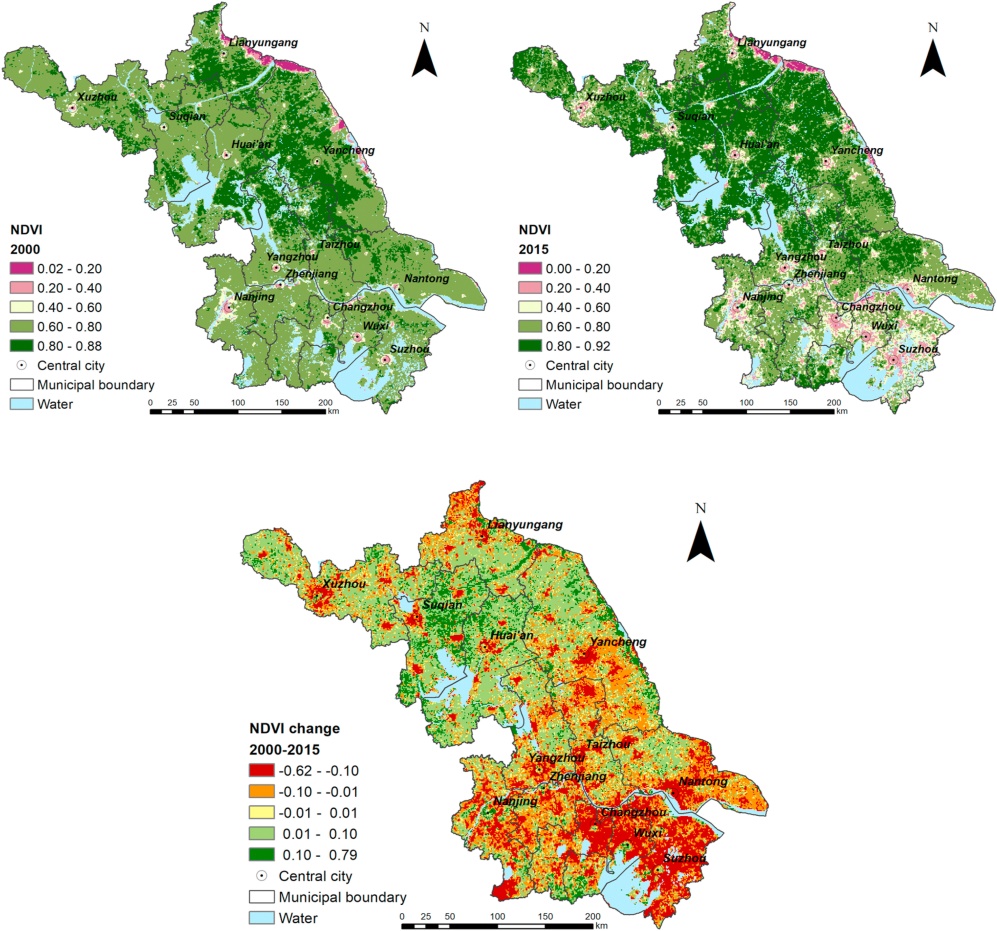
Figure 1. NDVI of Jiangsu Province in 2000 and 2015 and its change
Table 1. NDVI characteristics in Jiangsu and its change from 2000 to 2015

2. The constructed SEM model of NDVI change in Jiangsu Province
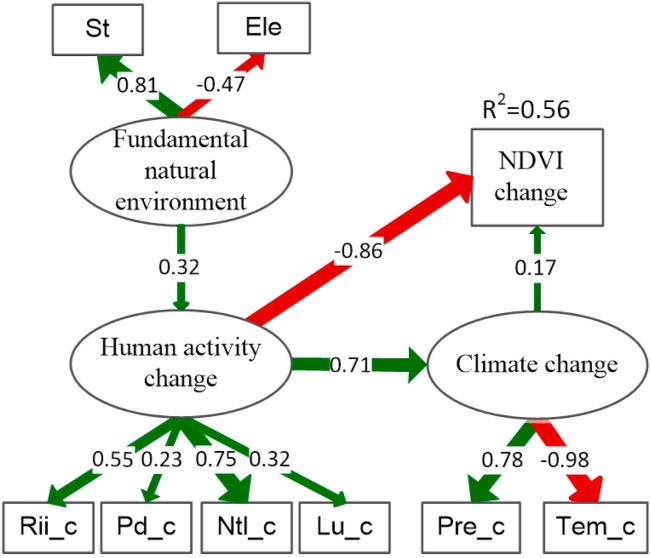
Figure 2. The final graphical fitted SEM model showing the multivariate relationships of NDVI change and its driving factors. The thickness of the arrows was proportional to the standardized path coefficients shown on each arrow. Green lines showed statistically significant positive paths, while red lines represented statistically significant negative paths. Variables in circles were latent variables and variables in boxes were observed variables.
3. The constructed SEM models of NDVI change in northern and southern Jiangsu
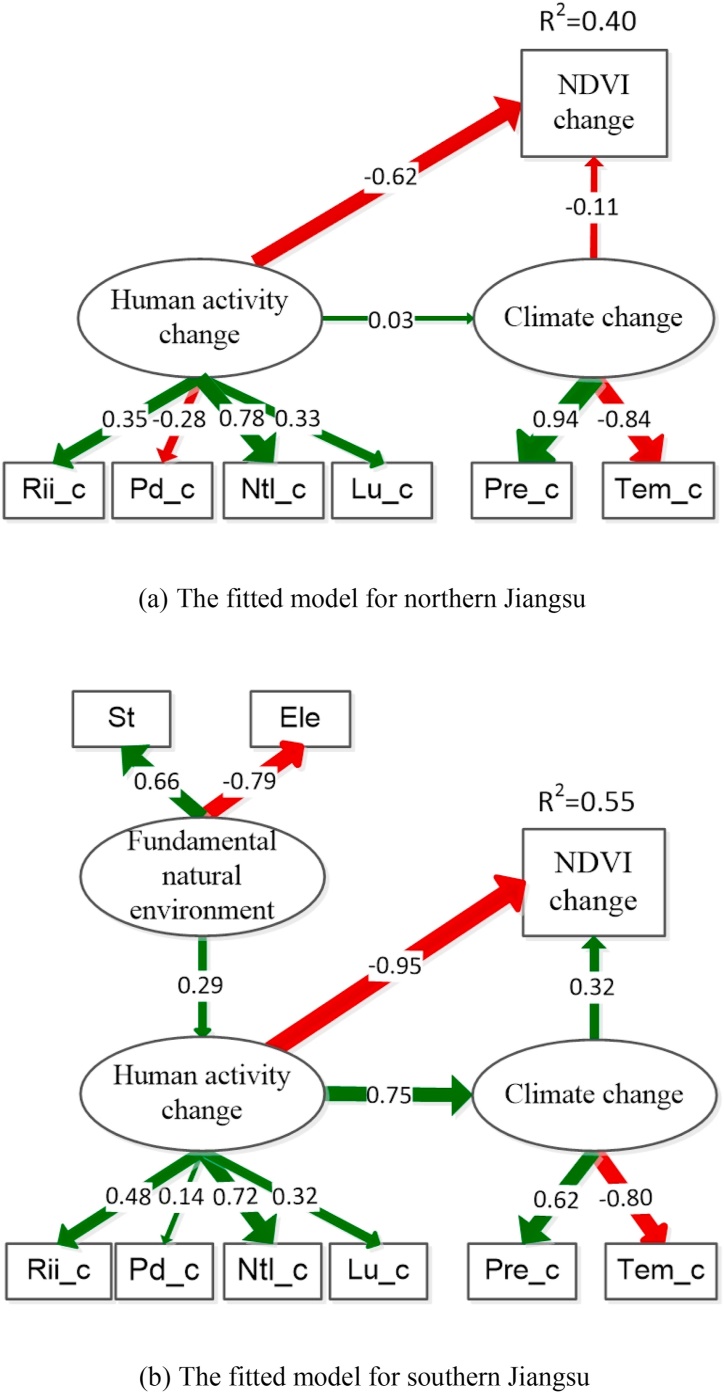
Figure 3. The fitted SEM models for northern and southern Jiangsu
4. Patterns of the coupling between human activity change and NDVI change
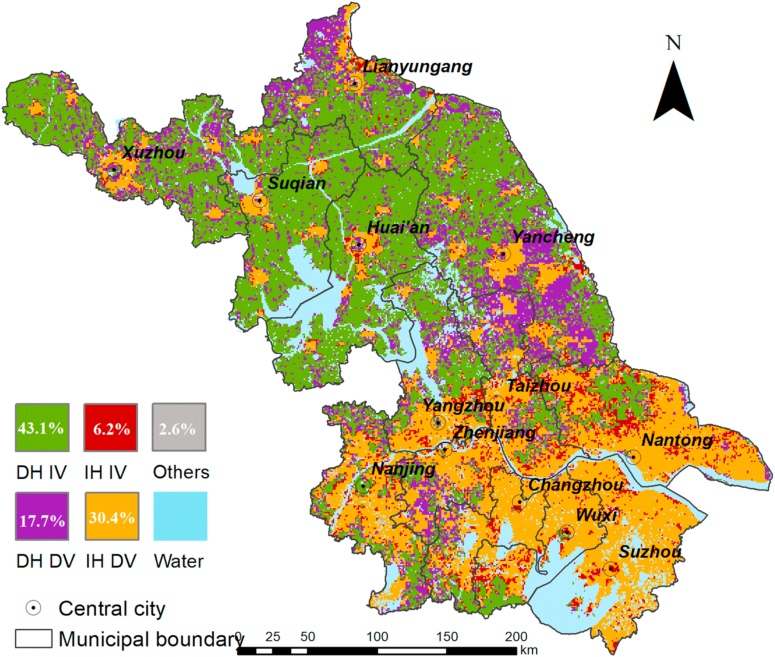
Figure 4. Patterns of the coupling between human activity change and NDVI change, DH: decrease of human activities (value < 0.001), IH: increase of human activities (value ≥ 0.001), DV: decrease of NDVI (value < 0.001), IV: increase of NDVI (value≥ 0.001).
Conclusion:
This study adopted SEM modeling to quantify the influences of the fundamental natural environment (soil and terrain), climate change and anthropogenic drivers on NDVI change in Jiangsu Province from 2000 to 2015. The results showed that the total effects of the fundamental natural environment, climate change, and human activity change on NDVI change in Jiangsu Province were -0.24, 0.17, and -0.74, respectively. The fundamental natural environment indirectly impacted NDVI change through its interactive relationship with human activities. We also constructed SEM models for northern and southern Jiangsu, indicating the different driving mechanisms of NDVI change. This was mainly due to their different natural environment and changing patterns of climate change. Although the effects for the three driving factors were different for northern and southern Jiangsu, human activity change played the most important role in driving NDVI change. Furthermore, the results suggested night light as the best indicator of human activity change in Jiangsu, followed by the road impact index. Soil type was the best indicator for natural environment in Jiangsu.
Our results showed that SEM is supportive of hypotheses on the causal relationships of driving factors on NDVI change. SEM provides a perspective by partitioning direct from indirect effects and thereby revealing a variety of mechanisms behind the NDVI change patterns. Partitioning areas based on their different changing patterns of driving factors for SEM modeling is necessary to better understand the complex mechanisms of NDVI change. We conclude that our study offers a framework to better understand and explain the complex interrelationships behind the spatial temporal change of NDVI. The work of the study can improve monitoring of vegetation degradation as well as land-use planning.