
Title:Enzymatic activity of soils and soil organic matter stabilization as an effect of components released from the decomposition of litter
Download website:https://www.sciencedirect.com/science/article/pii/S0929139320306521
Abstract:
The processes associated with litter decomposition are closely related to nutrient circulation in forest ecosystems. This study attempted to determine the role of nutrients, especially C and N, released by the decomposition of litter of different tree species in enzymatic activity and soil organic matter stabilization. In the study, we attempted to exclude the influence of soil properties, especially texture, on enzymatic activity and soil organic matter stabilization. Four areas covered by ash (Fraxinus excelsior L.), oak (Quercus robur L.), beech (Fagus sylvatica L.) and pine (Pinus sylvestris L.) stands were selected. Throughout the study period, the litter properties of four tree species and the chemical composition of the filtrate released during litter decomposition were determined. The activity of enzymes involved in C, N, P and S cycles, as well as soil organic matter fractions, were recorded. The activity of the enzymes was determined specifically by the carbon substrates released during the process of litter decomposition. A strong correlation between enzymatic activity and the amount of dissolved organic carbon (DOC) released from the decomposing litter was demonstrated. The effect of tree species could be observed in the amount of carbon and nitrogen of the light and heavy fractions of soil organic matter. The lowest C/N ratio in all fractions of organic matter was determined for ash stand soils that were characterized by having the highest amount of the heavy fraction of soil organic matter.
Method:
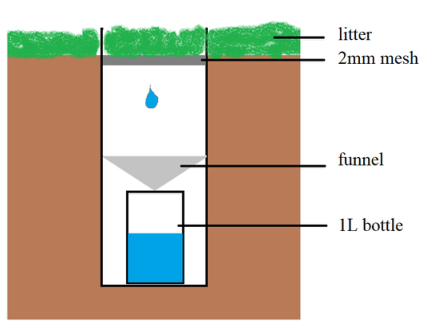
The lysimeters were prepared of polyethylene tubes with a width of 150 mm and a length 500 mm. The polyethylene tube was installed in the soil and stabilized. Litter was placed on the mesh, which was located in the upper part of the polyethylene tube. The plastic funnel was placed above the plastic bottle and filtrate collected in the bottle located in the soil at the depth of 30–50 cm.
Results:
1. Enzymatic activity as a result of decomposing litter of different tree species
Components released during litter decomposition stimulate the activity of extracellular enzymes and dehydrogenases. The activity of the tested enzymes is particularly affected by the carbon substrates released during litter decomposition.

2. Effects of different tree species litter on soil organic matter fractions
The effects of the components released from litter decomposition are visible from the amount of soil organic matter fractions. The carbon and nitrogen content analysis of soil organic matter fractions reveals the importance of tree species.

Conclusion:
Our results demonstrated that organic carbon, nitrogen and other mineral substances released from decaying litter induced changes in soil properties. The enzymatic activities responsible for basic nutrient cycles were enhanced as a result of litter decomposition. A study confirmed that more carbon and nitrogen were released from ash litter compared to oak, beech and pine litter. The study indicates that the analysis of the soil organic matter fraction can be used to assess changes influenced by stand species composition. The influence of tree species observed in the amount of carbon and nitrogen in the light and heavy fractions of soil organic matter. The C/N ratio can be used to assess the quality of organic matter in forest soils as a result of species composition. The soil enzymes, C and N of organic matter fractions are good indicators of litter-induced changes in the soil environment. Inappropriate selection of stand species composition can lead to changes in the basic properties of soils and, consequently, to changes in the activity and diversity of the microbial community. Our results suggest that pine and beech monocultures have the least favourable effect on soil properties, especially in terms of the enzymatic activity and quality of soil organic matter.