
Differentially charged nanoplastics demonstrate distinct accumulation in Arabidopsis thaliana
Title: Differentially charged nanoplastics demonstrate distinct accumulation in Arabidopsis thaliana
Download website:https://doi.org/10.1038/s41565-020-0707-4
Abstract
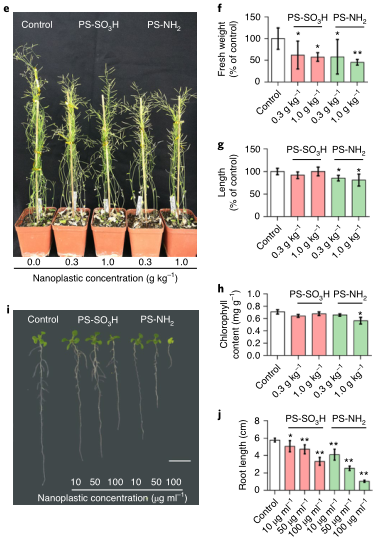
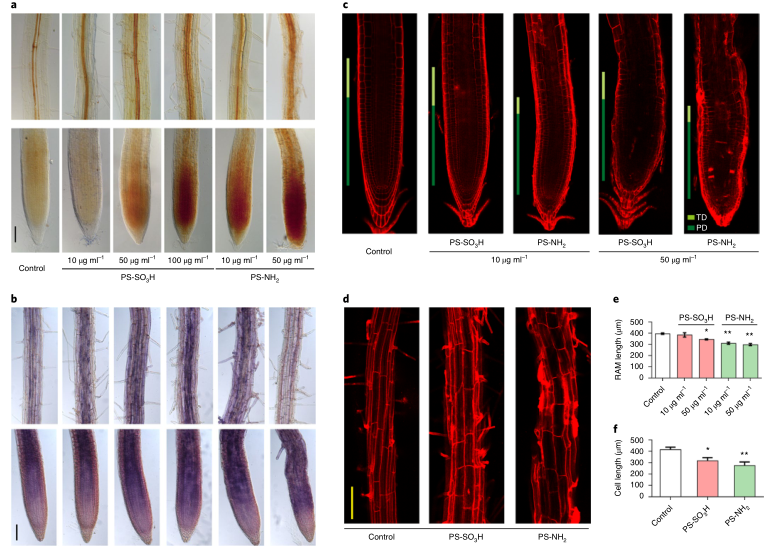
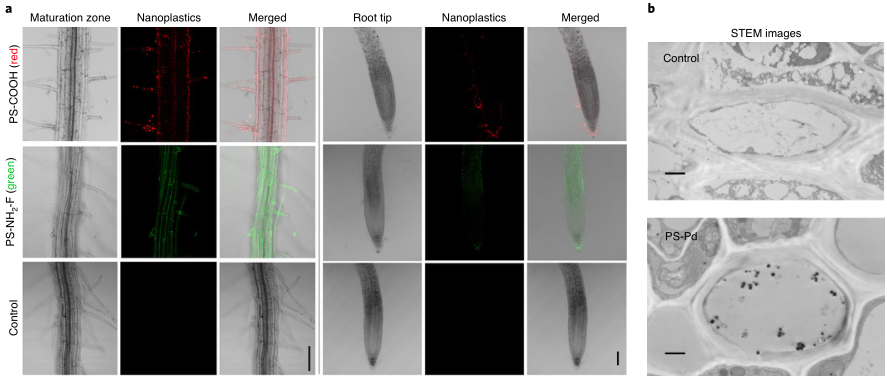
Although the fates of microplastics (0.1–5 mm in size) and nanoplastics (<100 nm) in marine environments are being increasingly well studied, little is known about the behaviour of nanoplastics in terrestrial environments, especially agricultural soils. Previous studies have evaluated the consequences of nanoplastic accumulation in aquatic plants, but there is no direct evidence for the internalization of nanoplastics in terrestrial plants. Here, we show that both positively and negatively charged nanoplastics can accumulate in Arabidopsis thaliana. The aggregation promoted by the growth medium and root exudates limited the uptake of amino-modified polystyrene nanoplastics with positive surface charges. Thus, positively charged nanoplastics accumulated at relatively low levels in the root tips, but these nanoplastics induced a higher accumulation of reactive oxygen species and inhibited plant growth and seedling development more strongly than negatively charged sulfonic-acid-modified nanoplastics. By contrast, the negatively charged nanoplastics were observed frequently in the apoplast and xylem. Our findings provide direct evidence that nanoplastics can accumulate in plants, depending on their surface charge. Plant accumulation of nanoplastics can have both direct ecological effects and implications for agricultural sustainability and food safety.
Results
Conclusion
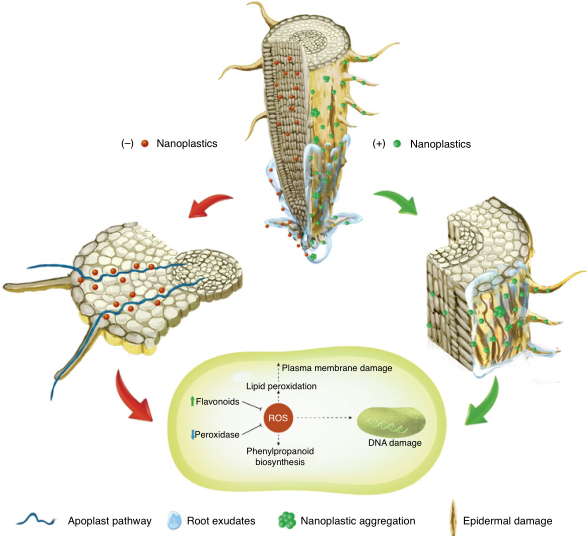
This study represents an observation of nanoplastic internalization in terrestrial plants. Regardless of the surface charge, Arabidopsis can take up and transport nanoplastics with sizes of less than 200 nm. Nonetheless, without further tests, it is difficult to identify the particle size at which nanoplastics in the terrestrial environment could be taken up by plants, because the 200 nm nanoplastics do not fully represent those of less than 70 nm in size. In this study, we mainly demonstrate that the pathway of uptake and transport of nanoplastics in root tissues differed between differentially charged nanoplastics (Fig. 3c). Although positively charged nanoplastics (PS-NH2) had a stronger effect on the roots, their uptake and internalization were lower than those of negatively charged nanoplastics. PS-NH2 stimulated the roots to produce high levels of exudates, which influenced the stability of PS-NH2 and limited its uptake by A. thaliana. The root epidermal damage involved may be caused by the dissolution of residual positive charges in the root exudates and the ability of PS-NH2 to attach to plants owing to electrostatic interactions (which can increase the local concentration of PS-NH2). The adsorption of nanoplastics by root hairs can also affect the transport of water and nutrients, resulting in a decrease in above-ground biomass. The information provided here should help us better understand the behaviour of nanoplastics in terrestrial plants. The possibility of uptake and accumulation of nanoplastics and the subsequent negative physiological effects also merit investigation in other plants, especially in root crops (for example, carrot, turnip and parsnip). Terrestrial plants form the base of many food chains; hence, nanoplastic accumulation in plants might have implications on other trophic levels, which could pose a potential risk to food yield, quality and safety. However, nanoplastics in terrestrial environments are largely derived from the breakdown of macro- and microplastics. Due to weathering and chemical degradation, the physical and chemical properties of these nanoplastics are different from those of the pristine nanoplastics used in this study. The internalization and translocation of aged nanoplastics in terrestrial plants requires further study.
Contact: Liang Jiawen
E-mail: jwliang@smail.nju.edu.cn