
Title: Does light exposure make plant litter more degradable?
Download website:https://link.springer.com/article/10.1007%2Fs11104-010-0342-1
Abstract: Many field experiments have indicated that litter decomposition in semi-arid areas may be partly or fully controlled by photodegradation. We devised a study to test our hypothesis that light exposure makes plant litter more degradable. Dry, senescent, aboveground plant litter from Miscanthus x giganteus was exposed to light including ultraviolet (UV) radiation for various lengths of time from 0 to 289 days. Weight loss was measured after exposure and appeared to be modest and did not increase with time of exposure. The litter of the longest and shortest exposure time as well as controls were then incubated with soil and moisture for 35 days and CO2 and N2O production were measured. The longest exposed litter degraded much faster than any other treatment during incubation with moisture, about twice as fast as the unexposed control. The shortest exposed however, degraded only slightly faster than the unexposed control. This suggests that increasing litter degradability is a more important mechanism for photodegradation than direct light-induced mass loss. N2O production from decomposition of the exposed litter was high in the beginning, suggesting that nitrogen may be released quickly. The mechanism is probably that light exposure leaves the nitrogen in plant litter easily available to microbial utilisation upon wetting. Such a mechanism might play an important role for nutrient cycling in semi-arid areas.
Main content:
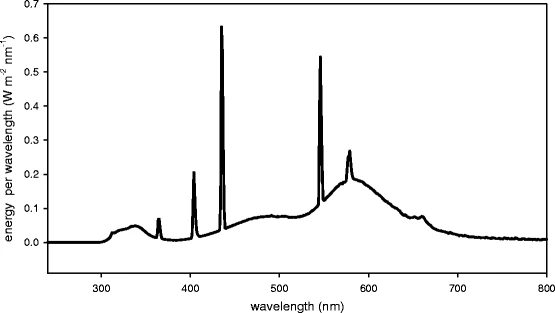
Fig.1 Wavelength distribution of the radiation in the growth chamber. Radiation was constant, so that time in exposure is proportional to total cumulative radiation.
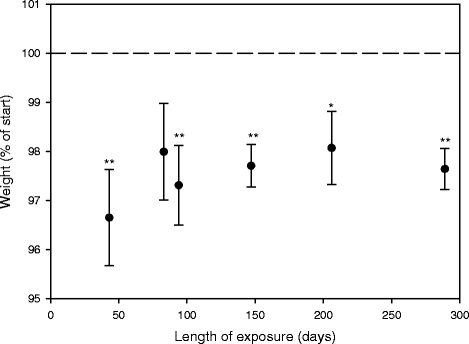
Fig.2 Weight loss during exposure to radiation as a function of length of exposure. Error bars are standard error (n = 12). One star indicates significantly different from start value at 0.05 level, two stars significant at 0.01 level.
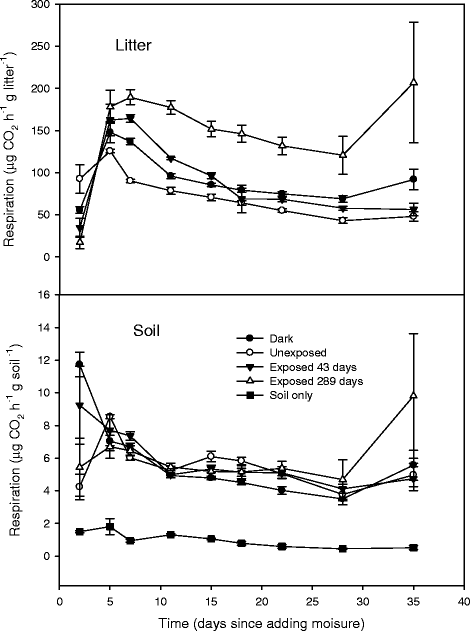
Fig.3 Respiration rate from soil and plant litter as a function time since start of the incubation (moisture addition). Fraction of total respiration from soil and plant is calculated using 13C signatures of the CO2, except for the soil only treatment. Unexposured means samples that have not been in the growth chamber, and dark means kept shaded in the growth chamber for the maximum length of time. Error bars are standard error (n = 4).
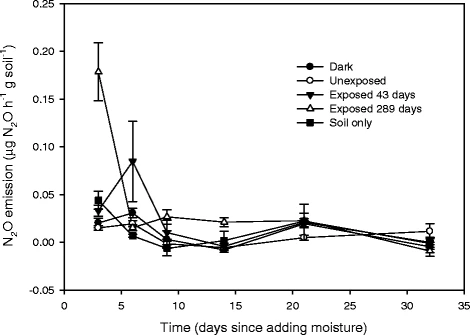
Fig.4 Nitrous oxide emission rate as a function of time since start of the incubation (moisture addition). Unexposured means samples that have not been in the growth chamber, and dark means kept shaded in the growth chamber for the maximum length of time. Error bars are standard error (n = 4).
We conclude that facilitation of microbial degradation is an important mechanism for photodegradation. This facilitation was more important than the direct effect of light on mass loss in our experiment. Photo-exposure probably also makes the nitrogen in the litter much more easily available. Further work should focus on the role of photo-degradation in the nitrogen cycle as well as the carbon cycle.
From:Jiang Han