
Title: Temperate deciduous forests embedded across developed landscapes: Younger forests harbour invasive plants and urban forests maintain native plants.
Download website: https://doi.org/10.1111/1365-2745.13400
Abstract: 1. Temperate deciduous forests in the United States are located in the most densely populated states across the northern and mid-Atlantic east coast. Land development and associated human activities result in small forests that are susceptible to anthropogenic influences, such as urbanization and non-native plant invasion. 2. The overall objective of this study was to assess spatial and temporal drivers of forest vegetation structure and diversity in small forests embedded across developed landscapes. We assessed woody plant composition across spatial gradients (i.e., urbanization and non-native plant invasion) and a temporal gradient (i.e., time since canopy closure) across 38 forests along the east coast of the United States in northern Delaware and southeastern Pennsylvania. 3. Surprisingly, we found the invasion gradient was not related to the urban gradient across our forests. Across all forests, the canopy consisted of native species (98% of all trees), whereas the forest understory was most vulnerable to nonnative plant invasion (65% of all woody plant stems). Greater native species richness in forest canopies and understories with increasing urbanization supports the conclusion that urban forests maintain native species and are not inherently degraded ecosystems. Non-native plant invasion has a strong influence on understory plant communities, and the duration of intact forest canopy had a strong negative correlation with non-native plant invasion suggesting intact forests can resist invasion. 4. Synthesis. This is the first study to compare simultaneously the importance of invasion and urbanization in determining plant community composition in forests embedded across developed landscapes, and to discover that younger forests harbor more invasive plants and urban forests maintain native plants.
Main content:
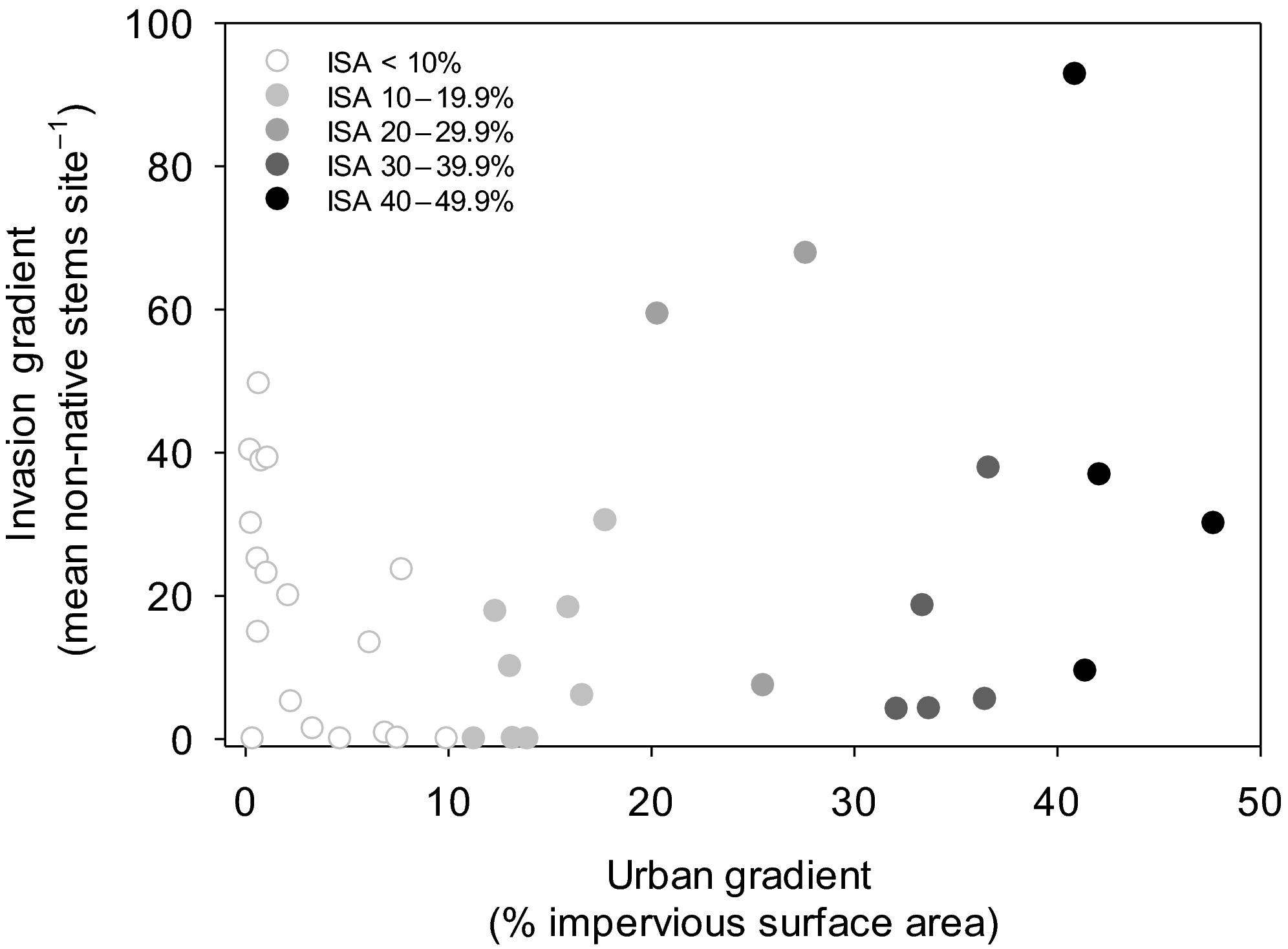
Figure 1 Forest patches (n = 38) are shown with % impervious surface area (ISA) within 1,000-m buffer surrounding each forest (urban gradient) on the x-axis and the mean non-native stems per site (invasion gradient) on the y-axis. There is no relationship between the urban and invasion gradients (r2 = 0.05, p > 0.10).
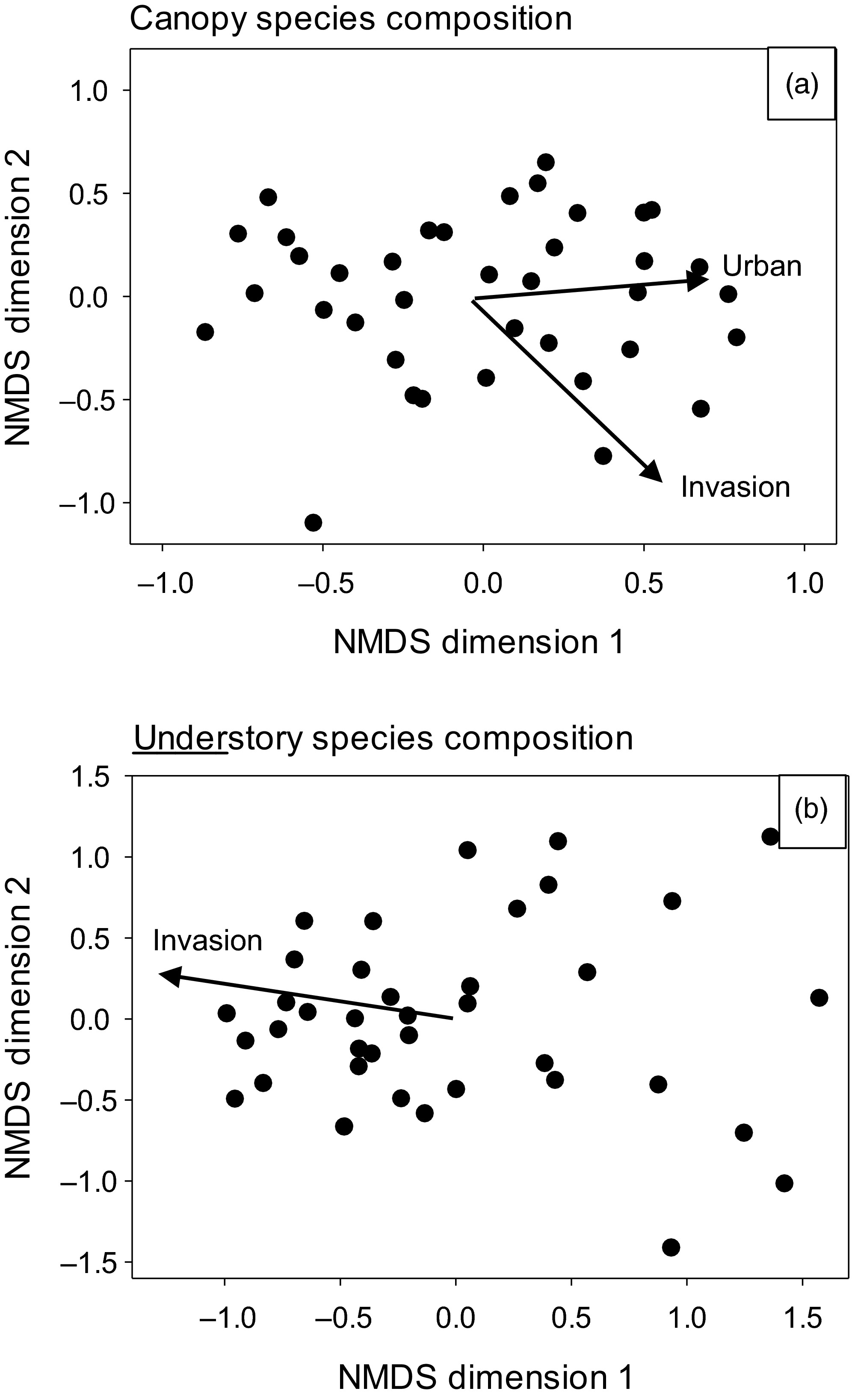
Figure 2 Forest vegetation composition located in 38 small forest patches embedded across developed landscapes are shown in nonmetric multidimensional scaling ordination space. Composition is shown in ordination space for canopy species (a) and understorey species (b), where each point denotes a forest patch. The invasion and urban gradients are shown as vectors on the ordination space using the envfit function in the vegan package.
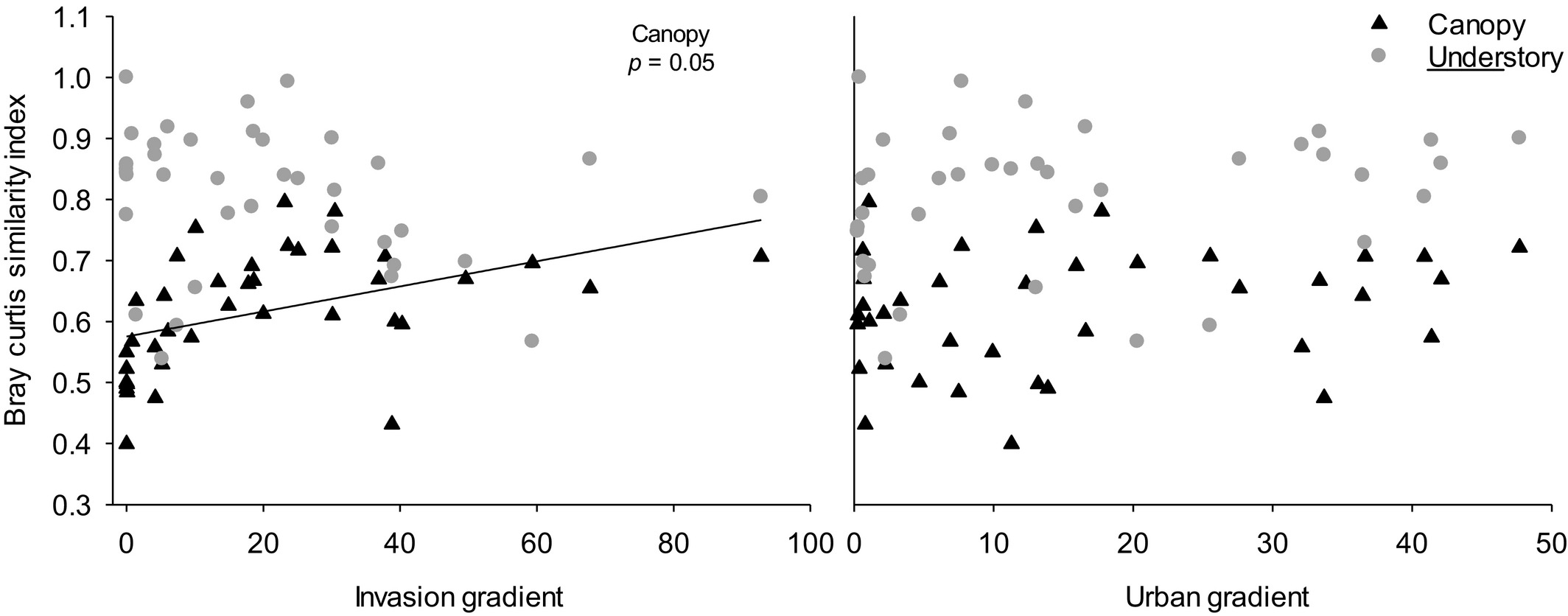
Figure 3 Relationships between compositional homogeneity of sites (measured with Bray–Curtis similarity index) and invasion (mean non-native stems per site) and urban (% impervious surface area surrounding the site) gradients for the canopy (black triangle) and understorey (grey circle) species composition. A higher Bray–Curtis value represents more similar plant community composition within a forest site (i.e. within site homogeneity).
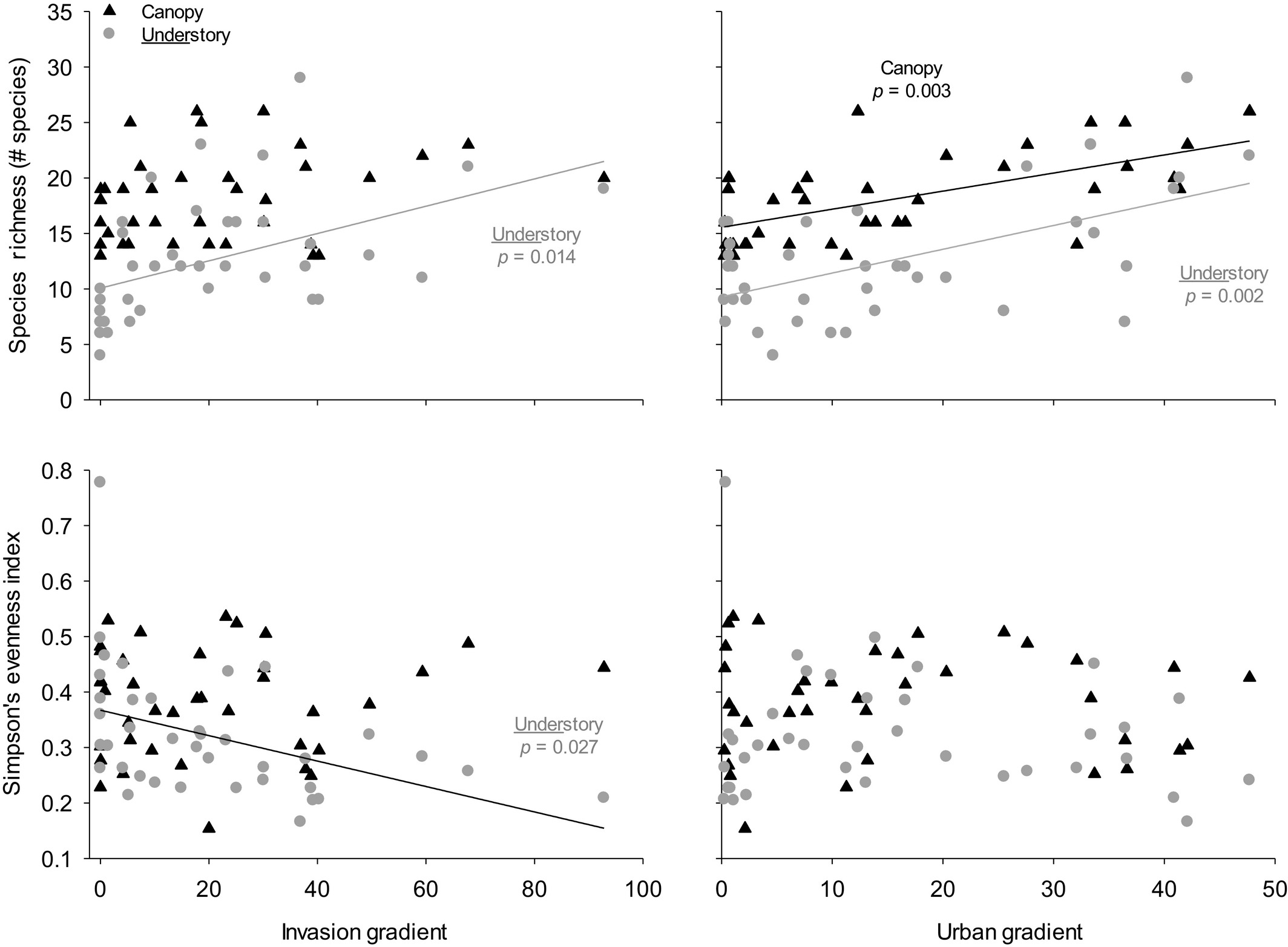
Figure 4 Relationships between canopy (black triangle) and understorey (grey circle) species richness (# species) and Simpson's Evenness index with invasion (mean non-native stems per site) and urban (% impervious surface area surrounding the site) gradients.
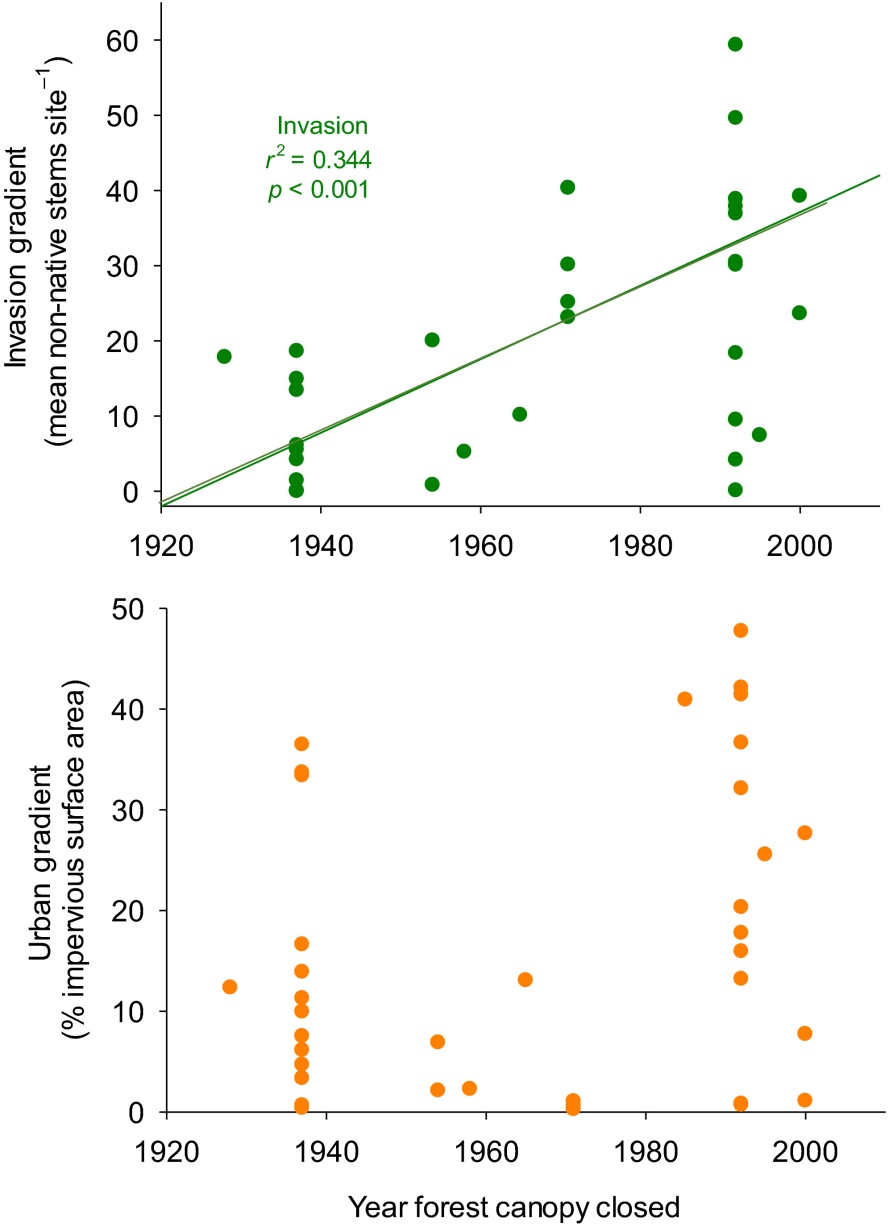
Figure 5 Relationship between the year the forest canopy closed (i.e. first photo in historical aerial photos with intact forest canopy) and invasion (green) and urban (orange) gradients.
Conclusion: Our study is the first to compare simultaneously the importance of invasion and urbanization in determining plant community composition in forests embedded across developed landscapes, and to discover that invasive plants are more abundant in younger forests. In addition, we found greater native species richness in forest canopies and understoreys along an increasing urban gradient, thus challenging the assumption that urban ecosystems are degraded. Future forests may be in jeopardy with continued understorey invasion as few native tree saplings were present in the most invaded forests. Furthermore, the abundance of non-native trees in the more invaded forests indicates forest canopy composition may drastically change over time, unless management practices protect the native trees in these forest ecosystems. In order to ensure persistence of small forests embedded in developed landscapes, stakeholders and land managers need more support for removal of non-native invasive plants from these valuable forests.