
明日叶种子非深层单纯形态生理休眠
Title:Non-deep simple morphophysiological dormancy in seeds of Angelica keiskei (Apiaceae)
Download website: https://doi.org/10.1016/j.scienta.2019.05.039
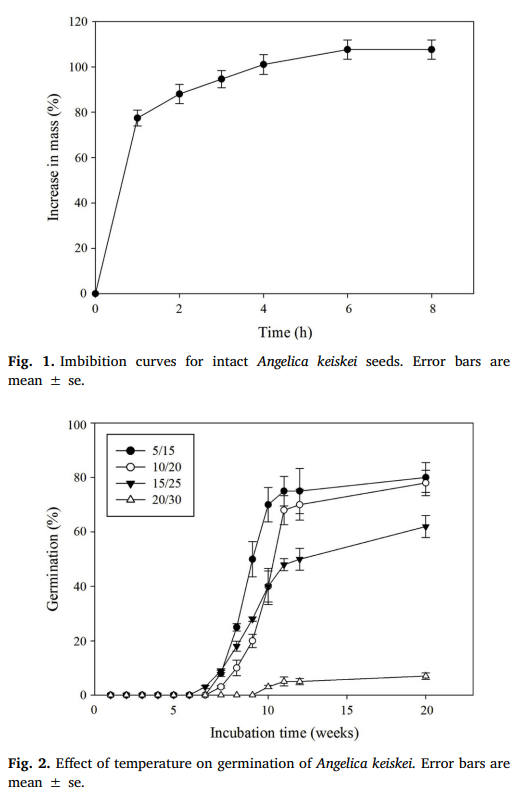
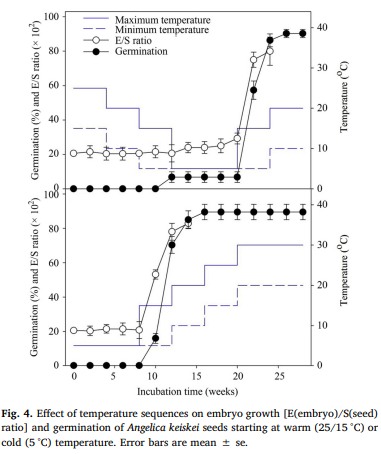
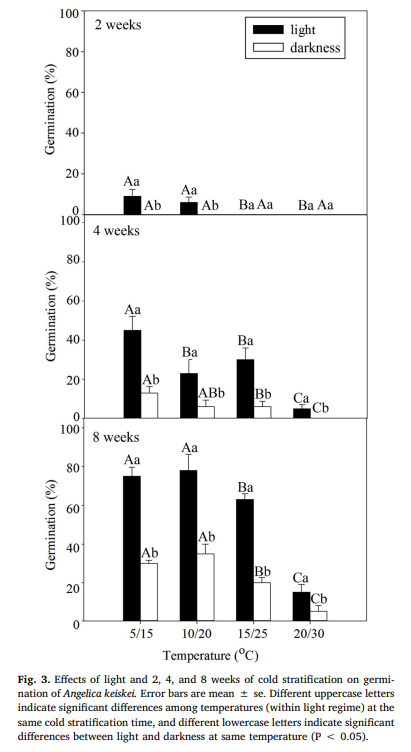
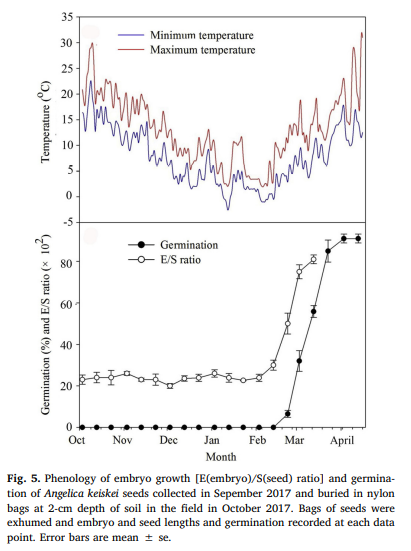
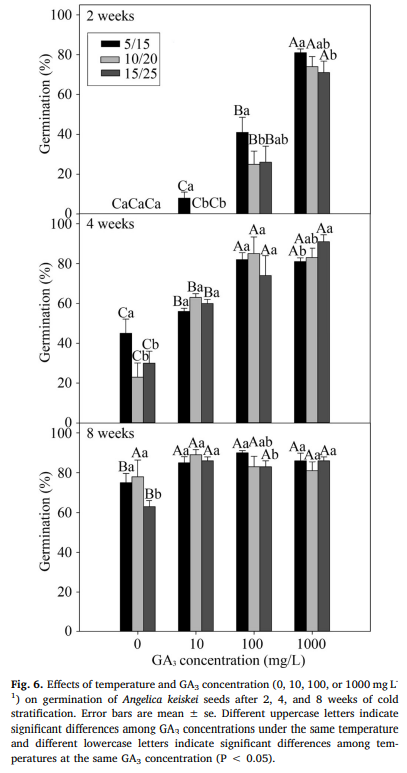
Abstract:Angelica keiskei is a vegetable and medicinal plant with high economic value. Growing demands for market and unprecedented anthropogenic damage to forests has caused severe degeneration of its populations. Moreover, the germination protocol for seeds of A. keiskei is complex, leading to a high cost of propagation and seed wastage. The primary aim of present study was to determine the requirements for seed dormancy break and germination and to characterize the class of seed dormancy in A. keiskei. The effects of temperature, light, cold stratification, dry storage, gibberellic acid (GA3) on dormancy break and germination were tested combined with move-along experiments and a germination phenology study. The results showed that seeds of A. keiskei had embryos that were differentiated but underdeveloped (small) and had physiological dormancy (PD) at maturity in autumn. Before the emergence of radicles, the embryo/seed length ratio increased from 0.20 to 0.85, a 425% increase. Germination of A. keiskei gradually increased following increased amounts of cold stratification. After 8 weeks of cold stratification, seeds germinated to 75, 78, 63 and 14% at 5/15, 10/20, 15/25 and 20/30 °C, respectively, in light. GA3 substituted for cold stratification. After 8 weeks of cold stratification, > 80% of seeds treated with ≥10 mg·L-1 GA3 germinated across the temperature range. In the move-along experiments, little or no embryo growth and germination occurred at 5 °C. However, after breaking PD by cold stratification at 5 °C, the rate of embryo growth increased rapidly at warm temperatures (5/15 °C) and reached the critical length for germination within 2 weeks of incubation. We identified that seeds of A. keiskei exhibited non-deep simple morphophysiological dormancy. Natural cold stratification broke PD during winter and allowed the germination of seeds and the production of seedlings at the start of the growing season.
Methods:
Study area and seed collection
Seed morphology and mass
Imbibition test
Germination test and embryo measurement procedures
Germination and embryo length in fresh seeds
Effect of temperature on dormancy break
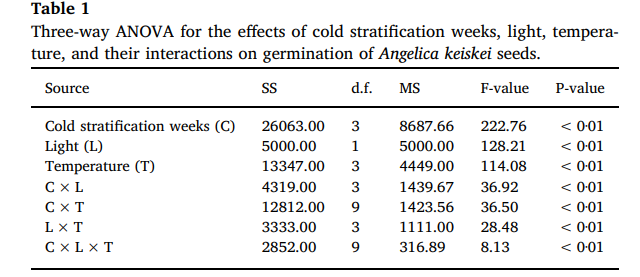
Effects of cold stratification and light on dormancy break
Effect of dry storage (after-ripening) on dormancy break
Move-along experiment
Germination phenology
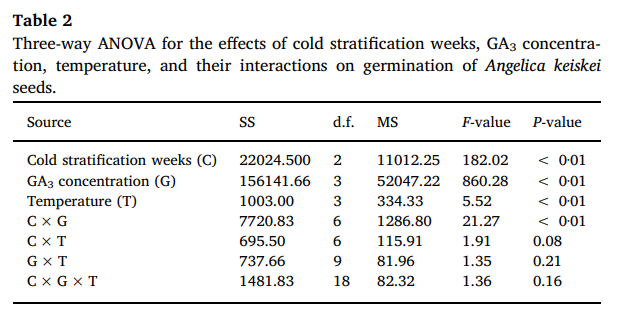
Effects of cold stratification, temperature, and GA3 on dormancy break
Statistical analyses
Results:
Contact: Zhou Zeyan
E-mail:1530654448@qq.com