
真菌菌丝网络中的生态记忆和重新定位决策:对新资源数量和位置的响应
Title: Ecological memory and relocation decisions in fungal mycelia networks: responses to quantity and location of new resources
Download website:https://doi.org/10.1038/s41396-019-0536-3
Abstract:
Saprotrophic cord-forming basidiomycetes, with their mycelial networks at the soil/litter interface on the forest floor, play a major role in wood decomposition and nutrient cycling/relocation. Many studies have investigated foraging behaviour of their mycelium, but there is little information on their intelligence. Here, we investigate the effects of relative size of inoculum wood and new wood resource (bait) on the decision of a mycelium to remain in, or migrate from, inoculum to bait using Phanerochaete velutina as a model. Experiments allowed mycelium to grow from an inoculum across the surface of a soil microcosm where it encountered a new wood bait. After colonisation of the bait, the original inoculum was moved to a tray of fresh soil to determine whether the fungus was still able to grow out. This also allowed us to test the mycelium’s memory of growth direction. When inocula were transferred to new soil, there was regrowth from 67% of the inocula, and a threshold bait size acted as a cue for the mycelium’s decision to migrate for a final time, rather than a threshold of relative size of inoculum: bait. There was greater regrowth from the side that originally faced the new bait, implying memory of growth direction.
Method:
Soil tray microcosm experiments
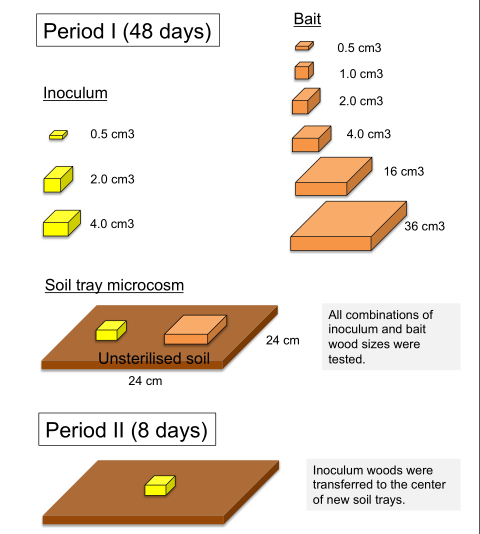
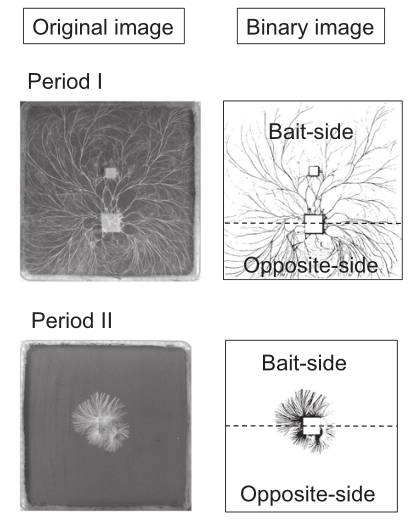
Results and discussion
1.体积大的诱饵更容易引起菌丝的完全迁移。菌丝在定殖到较大接种物上面的同时,需要消化更多的养分。木材是一种低养分的材料,实验中菌丝的养分来源于其所生长的土壤托盘,因此菌丝实生长受到实验所用土壤中养分的限制。
2.体积小的接种物更容易引起菌丝的完全迁移。可能与木材的腐烂率和菌丝与土壤中其它微生物发生竞争作用有关。
3.绒毛原毛平隔菌菌丝的主要生长方向是有记忆的。