
Title: Newly depolymerized large organic N contributes directly toamino acid uptake in young maize plants
Download website:
https://doi.org/10.1111/nph.16070
Summary:
1、The contribution of large molecular size organic nitrogen (N) to plant N uptake is unclear.
2、Soils with and without maize, at three pH levels, were treated with (carbon‐14 and ‐13 (14C, 13C), 15N) triple‐labelled > 100 kDa organic N. After 48 h, soil and maize were sampled for bulk and compound specific isotope analysis to study the turnover in soil and plant 13C and 15N uptake.
3、Mineralization of > 100 kDa organic N increased with higher pH only in soil without maize. The > 100 kDa organic N disappeared rapidly in soils with and without maize, but surprisingly more > 100 kDa organic N derived amino acids remained in soil with than without maize – most likely in the microbial biomass. Total 15N uptake in maize increased with higher soil pH. The organic N uptake was estimated to account for 20–30% of the total 15N uptake. Organic N uptake was confirmed by the presence of 13C‐labelled amino acids in maize roots.
4、The study suggests that the importance of plant organic N uptake increases when N is derived from complex molecules such as proteins compared to studies using single amino acids as N source, and that rhizosphere microorganisms increase anabolic utilization of organic N compared to microorganisms in the bulk soil.
Results:
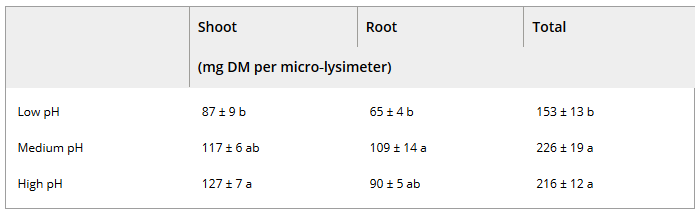
Maize grew better in the soil at medium and high pH than at the low pH level. Maize seedlings at the low soil pH level had significantly lower dry matter yields than maize in the medium and high soil pH levels(Table1).
Table 1. Dry matter yield of maize grown in Jyndevad soils at three pH levels.
2、Mineralization of > 100 kDa organic N with and without maize
The mineralization of the >100 kDa organic N in soil without maize followed first‐order kinetics; 14CO2 could be detected across the pH gradient after just 1 h (Fig. 1a). The accumulated mineralization was significantly higher (P = 0.026) in the high pH soil than the low pH soil (Fig. 1b). Mineralization in the high pH soil was 9.2 ± 0.7% of added 14C as 14CO2 compared to 6.2 ± 0.6% of added in the low pH soil, whereas the medium pH soil had intermediate 14CO2 evolution with 7.0 ± 0.3% of added after 48 h (Fig. 1b). Interestingly, these differences in mineralization across soil pH levels were not detected in the presence of maize, where there were no significant differences between mineralization across the pH gradient (Fig. 1b).
3、13C‐labelled amino acids remaining in soil with and without maize
After 48 h, 6–50% of the bound amino acids added in the > 100 kDa organic N remained with intact C‐skeletons in the soils without maize (Fig. 2). There was a considerable variation in the proportion of individual amino acids remaining in soil across the pH gradient with 13–50%, 16–50% and 6–38% in the low, medium and high pH levels, respectively. Surprisingly, in the presence of maize the general pattern showed significantly higher proportions of individual amino acids remaining in the soil compared to the soil without maize (Fig. 2), with some exceptions. In line with the controls without maize, there also was a considerable variation in the proportion among individual amino acids remaining in the presence of maize, with 19–74%, 19–78% and 18–66% of the added 13C in individual amino acids remaining in the low, medium and high pH level soils, respectively.
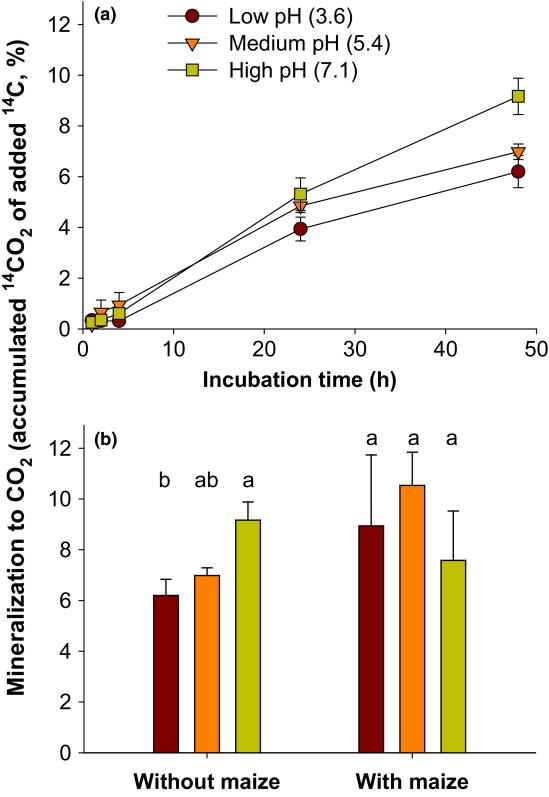
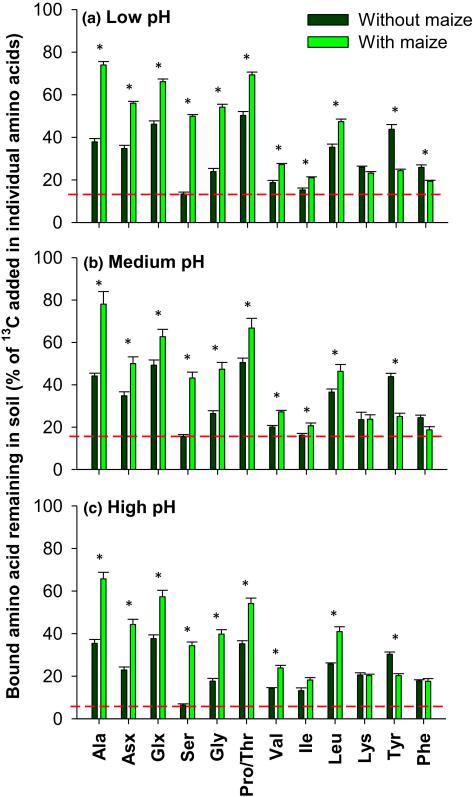
Figure 1. Mineralization of > 100 kDa organic nitrogen (N) to 14CO2 in Jyndevad soils. (a) Temporal development of mineralization and (b) accumulated mineralization after 48 h soil without and with maize. Statistical differences among soil pH levels in accumulated 14CO2 after 48 h are indicated by different letters above the bars (mean±SE, n = 4).
Figure 2.Bound amino acids from added >100 kDa organic nitrogen (N) remaining in Jyndevad soils after 48 h without and with maize in soil at (a) low pH, (b) medium pH and (c) high pH. Significant differences between unplanted soil and soil with maize in 13C remaining for individual amino acids are marked by an asterisk above the bars (mean ± SE, n = 4). The amino acids: asparagine and aspartate (Asx), glutamine and glutamate (Glx), and Proline and Threonine (Pro/Thr) elute together in the gas chromatography combustion isotope ratio mass spectrometry (GC‐C‐IRMS) analysis of acid‐hydrolyzed samples. The red dashed line indicates the lowest proportion of an individual amino acid remaining in soil without maize.
4、Bulk 13C and 15N uptake in maize
The uptake of 15N was significantly greater than the uptake of 13C across the soil pH gradient (P < 0.001) (Fig. 3). The total uptake of 15N ranged from 6.5% to 12.0% of 15N added in the > 100 kDa organic N (Fig. 3c) with the 15N equally distributed among the roots and the shoots (Fig. 3a,b). The net‐uptake of 13C 48 h after addition of the > 100 kDa organic N was significantly higher in roots (1.4–2.2% of 13C added) than in shoots (0.4–0.5% of 13C added) (P < 0.001). Although the net‐uptake of 13C in roots tended to be lower in the low pH soils there were no significant differences across the soil pH gradient (Fig. 3b). On a whole‐plant percentage basis, the 13C : 15N uptake ratio was 28±5%, 20±1% and 22±4% in the low, medium and high pH soil, respectively with no significant differences in the 13C : 15N uptake ratio across the soil pH gradient (P > 0.20).
5、Presence of 13C‐labelled amino acids in maize
The presence of individual 13C‐labelled amino acids varied significantly in maize roots at all three soil pH levels (Fig. 4). The presence ranged from 0% to 1.7% of the 13C added with the > 100 kDa organic N across soils; with no significant effects of soil pH level on the presence of individual 13C‐labelled amino acids. The presence of individual amino acids had a similar pattern across the soil pH gradient where glutamine/glutamate, proline/threonine and leucine had the highest proportions in maize roots, with ≤2% of added, whereas lysine had the lowest proportion throughout. The pattern of amino acid presence in maize roots resembled the pattern of neither amino acids remaining in the soil nor amino acids lost from the soil. The average amount of 13C‐labelled amino acids in maize roots was 0.5–0.6% of the added. Thus, the 13C in the root amino acids corresponded to one third of the bulk 13C recovered.
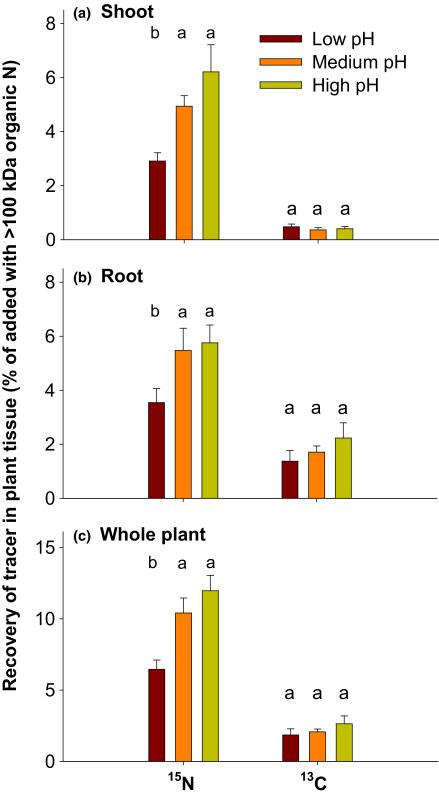
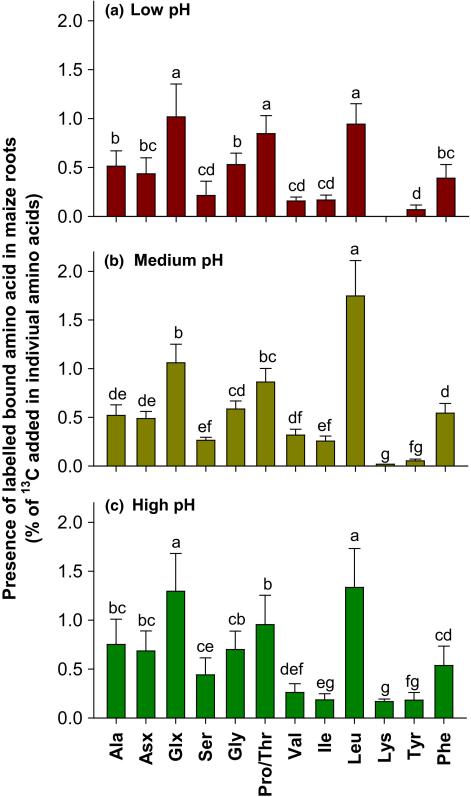
Figure 3. Bulk uptake of 13C and 15N from > 100 kDa organic nitrogen (N) 48 h after addition in maize (a) shoots, (b) roots, and (c) the whole plant. Significant differences in uptake among soils with different pH are marked by different letters above the bars (mean ± SE, n = 4).
Figure 4. Presence of 13C‐labelled bound amino acids from added > 100 kDa organic nitrogen (N) in maize roots after 48 h in Jyndevad soils in soil with (a) low pH, (b) medium pH and (c) high pH. Significant differences between presence among individual amino acids within each soil pH level are marked by different letters above the bars (mean±SE, n = 4). The amino acids: asparagine and aspartate (Asx), glutamine and glutamate (Glx), and Proline and Threonine (Pro/Thr) elute together in the gas chromatography combustion isotope ratio mass spectrometry (GC‐C‐IRMS) analysis of the acid‐hydrolyzed samples.
Conclusion:
when N is added to a plant–soil system in large molecular sizes, the potential for intact organic N uptake is at least at the same level or higher than when organic N is added as individual amino acids. There is a potentially greater contribution of protein derived organic N for plant N uptake.
Contact: LiangJiawen
E-mail: jwliang@smail.nju.edu.cn