Title: The micromorphology of Trichoderma reesei analyzed in cultivations on lactose and solid lignocellulosic substrate, and its relationship with cellulase production
题目:乳糖和固体木质纤维素底物培养物中里氏木霉的微观形态及其与纤维素酶产量的关系
Abstract
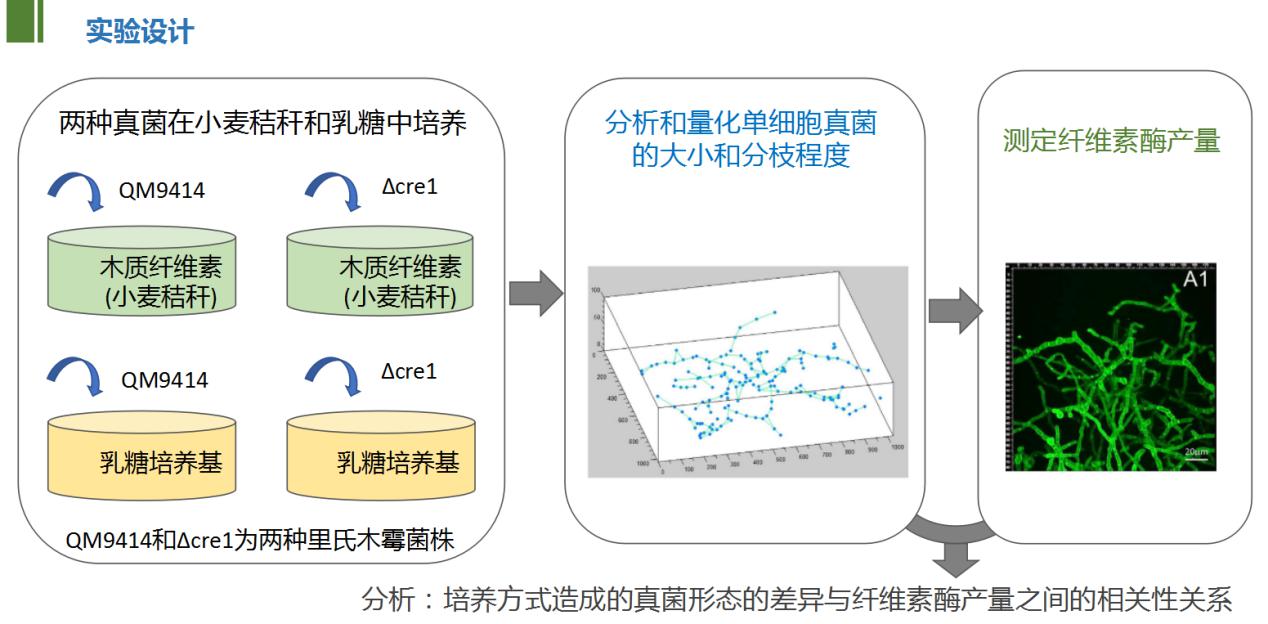
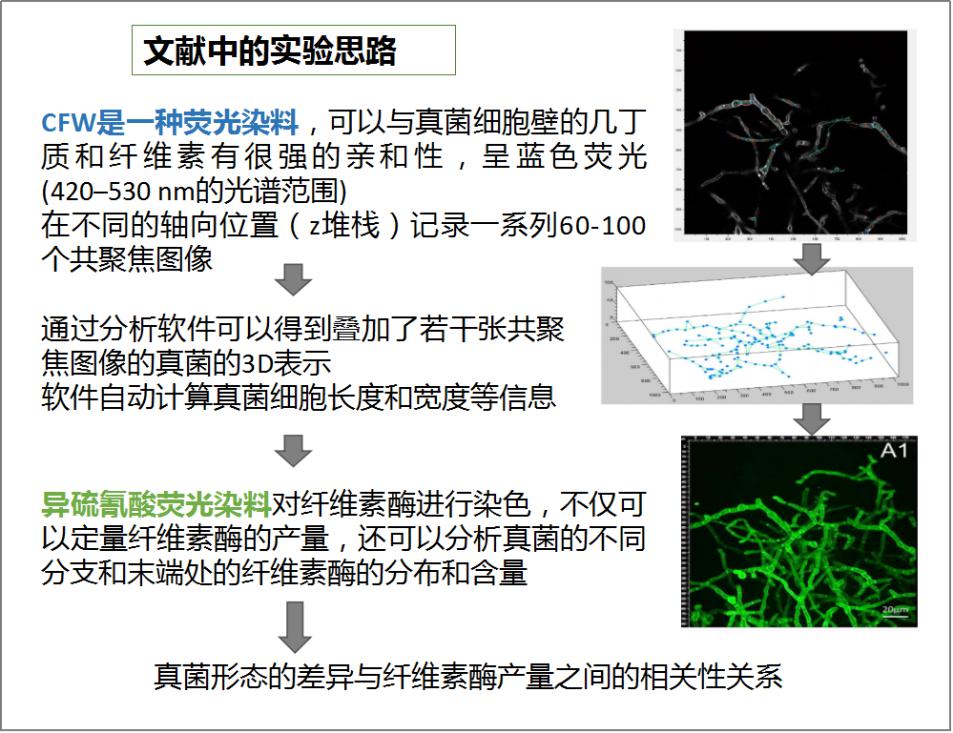
Background: Trichoderma reesei is the principal producer of cellulolytic enzymes. Because of the strong influence on the enzyme production, the morphology of the filamentous fungi is a key parameter for process optimization. For cost-effective production of cellulolytic enzymes, the cultivation of T. reesei is performed on lignocellulosic waste streams. These insoluble substrates prevent the application of the conventional light microscopy for the analysis of fungal morphology. Here, we present a novel method for the micromorphological analysis based on confocal laser scanning microscopy (CLSM) and the computer-aided image analysis. This method enabled the quantification of the dimensions of the single cell (intercalary length and cell width) and the degree of branching in cultivations on the industrially relevant substrates wheat straw and lactose. The micromorphology of two T. reesei strains, QM9414 and a carbon catabolite derepressed cre1 knockout mutant (Δcre1), was analyzed in dependence of substrate, inoculation
method, and agitation velocity.
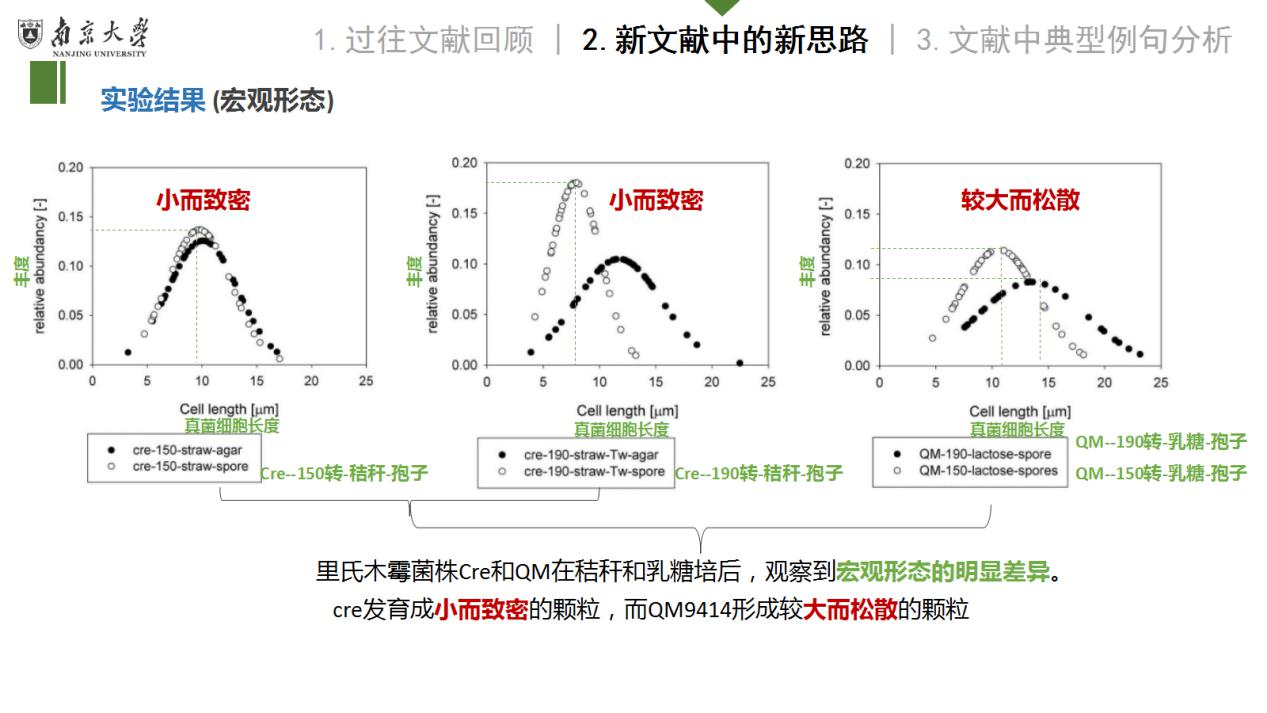
Results: Trichoderma reesei strain Δcre1 formed shorter cells (10.09 µm) on average and developed more ramified mycelia (0.36 branches/cell) than strain QM9414 (12.03 µm, 0.22 branches/cell). Cultivated on wheat straw, the average cell length of QM9414 (10.87 µm) and Δcre1 (9.74 µm) was 10 and 21 % shorter as compared to reference cultivations on lactose. When inoculation was done with spores as compared to hyphal biomass, cell lengths of QM9414 (10.97 µm) and Δcre1 (9.10 µm) were on average about 20 % shorter. Strain performance was evaluated in protein concentration and total cellulase activity, which varied between 0.69 and 2.31 FPU/mL for Δcre1 and between 0.84 and 1.64 FPU/mL for QM9414. The cell length exhibited slightly negative correlation with the protein (regression coefficient -0.04 g/(L µm), R2 0.33) and the cellulase (−0.30 FPU/(mL µm), R2 0.53) production.
Conclusions: The dimensions of the single cell of T. reesei were dependent on strain background, substrate used and process conditions applied. Micromorphological changes were correlated semi-quantitatively with the efficiency of enzyme production. In providing a process analytical tool for enzyme production by T. reesei on lignocellulosic substrate, this study has relevance for the characterization and optimization of a critical step in the overall saccharification process.
Keywords: Trichoderma reesei, Morphology, Cellulase production, Lignocellulose, Wheat straw, Lactose
研究背景:
生物精炼工艺的商业可行性取决于纤维素分解酶的成本。为了成功利用木质纤维素作为碳源,因此有必要加强酶的生产过程。基于快速的生物量生长和分泌大量蛋白质的能力,丝状真菌里氏木霉已成为纤维素分解酶的主要生产者。
真菌复杂形态对纤维素酶生产力影响,真菌的宏观形态可大致分为颗粒和自由分散的菌丝体,微观形态包括细胞和菌丝大小,分支程度和尖端总数。已有研究表明:真菌微观形态与其纤维素酶的生产力相关。
研究背景:
研究方法:
实验结果1:
实验结果2:
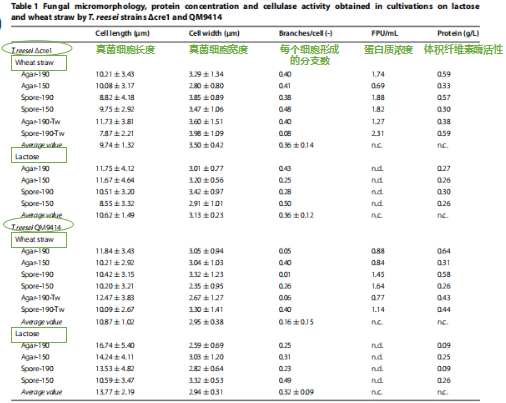
当在小麦秸秆上培养时。在相同的培养条件下,里氏木霉菌株Cre总是比QM产生更高的体积纤维素酶活性。在乳糖上培养时,两种菌株仅产生基础量的纤维素酶,并且所得的体积活性未达到蛋白质浓度测定的较低检测限。因此,未观察到菌株QM和Cre之间的显着变化。
实验结果3:
①接种方法进一步影响分枝程度:与琼脂接种培养对照相比,QM和Cre菌株平均每个细胞形成5和8%以上的分支。
②接种方法影响产酶量:当小麦秸秆栽培接种孢子时,QM和Cre菌株平均产生1.4和2FPU/mL的纤维素酶。比对照组(琼脂组)分别高出1.7倍和1.4
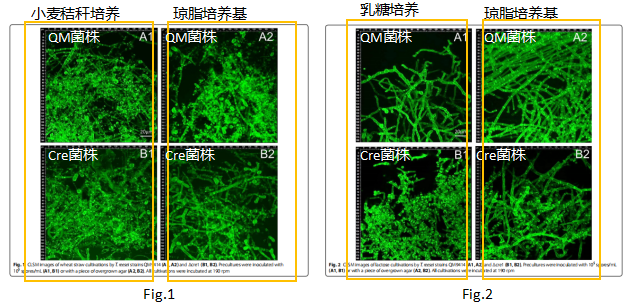
③由图可以看出,蛋白质分泌主要发生在顶端隔室的尖端。因此,较高的分支度和新鲜形成的尖端的相应增加可能导致观察到的酶产量增加。