
Title:Plant-derived coumarins shape the composition of an Arabidopsis synthetic root microbiome
https://doi.org/10.1073/pnas.1820691116
Abstract: We explore the role of specialized metabolites in dictating which bacteria reside in the rhizosphere. We employed a reduced synthetic community (SynCom) of Arabidopsis thaliana root-isolated bacteria to detect community shifts that occur in the absence of the secreted small-molecule phytoalexins, flavonoids, and coumarins. We find that lack of coumarin biosynthesis in f6′h1 mutant plant lines causes a shift in the root microbial community specifically under iron deficiency. We demonstrate a potential role for iron-mobilizing coumarins in sculpting the A. thaliana root bacterial community by inhibiting the proliferation of a relatively abundant Pseudomonas species via a redox-mediated mechanism. This work establishes a systematic approach enabling elucidation of specific mechanisms by which plant-derived molecules mediate microbial community composition. Our findings expand on the function of conditionally exuded specialized metabolites and suggest avenues to effectively engineer the rhizosphere with the aim of improving crop growth in iron-limited alkaline soils, which make up a third of the world’s arable soils.
Materials and Methods
1. SynCom was designed using strains that (i) span the range of taxonomic diversity found at the A. thaliana root, (ii) can be individually tracked by 16S rRNA gene amplicon analysis, and (iii) proliferate in nutrient-rich media (21).
2. Tested mutant plants deficient in flavonoids (tt5), tryptophan-derived defense metabolites (cyp79Bb2/b3), methionine-derived defense metabolites (myb28), and coumarins (f6′h1).
3. Plant growth conditions
13 days after planting, the seedling roots were washed with 1x PBS and the medium was replaced with 3 mL of either iron sufficient (replete) 1xMS (100 µM Fe-EDTA) or iron-deficient (no added iron) 1xMS inoculated with the SynCom.
4. Root inoculation and harvest
5. DNA extraction and CFU counts
6. 16S rRNA amplicon generation and sequencing
7. Processing and statistical analysis of 16S rRNA counts
Results
1. A Distinct Root Microbiome Profile Is Observed for A. thaliana Using a Hydroponics-Based Gnotobiotic Setup.
The growth media surrounding 13-d-old axenically grown seedlings were inoculated to a final composite OD600 of 0.005–0.01. After a further 7–8 d of growth, a 101- to 102-fold increase in total microbial abundance in the hydroponic media was observed, as determined by colony-forming units compared with the starting inoculum and unplanted controls (SI Appendix, Fig. S2). The 16S rRNA gene profiling revealed differential relative abundances between SynCom members in the root compared with the starting inoculum. Furthermore, strains that poorly colonized the A. thaliana root in monoassociation studies were similarly present at low relative abundances following analysis of 16S rRNA amplicon sequences (SI Appendix, Fig. S3). We observed variability in root colonization by some members between experimental batches with independently cultured and assembled SynComs. This was particularly the case for the strains Sphingopyxis sp. Root1497, Microbacterium sp. Root166, and Streptomyces sp. Root1310. Notably, the Proteobacteria, such as Rhizobium sp. Root149, Pseudomonas sp. Root329, and Sinorhizobium sp. Root1312, were consistently enriched at the root, while many Actinobacteria and Firmicutes isolates were not.
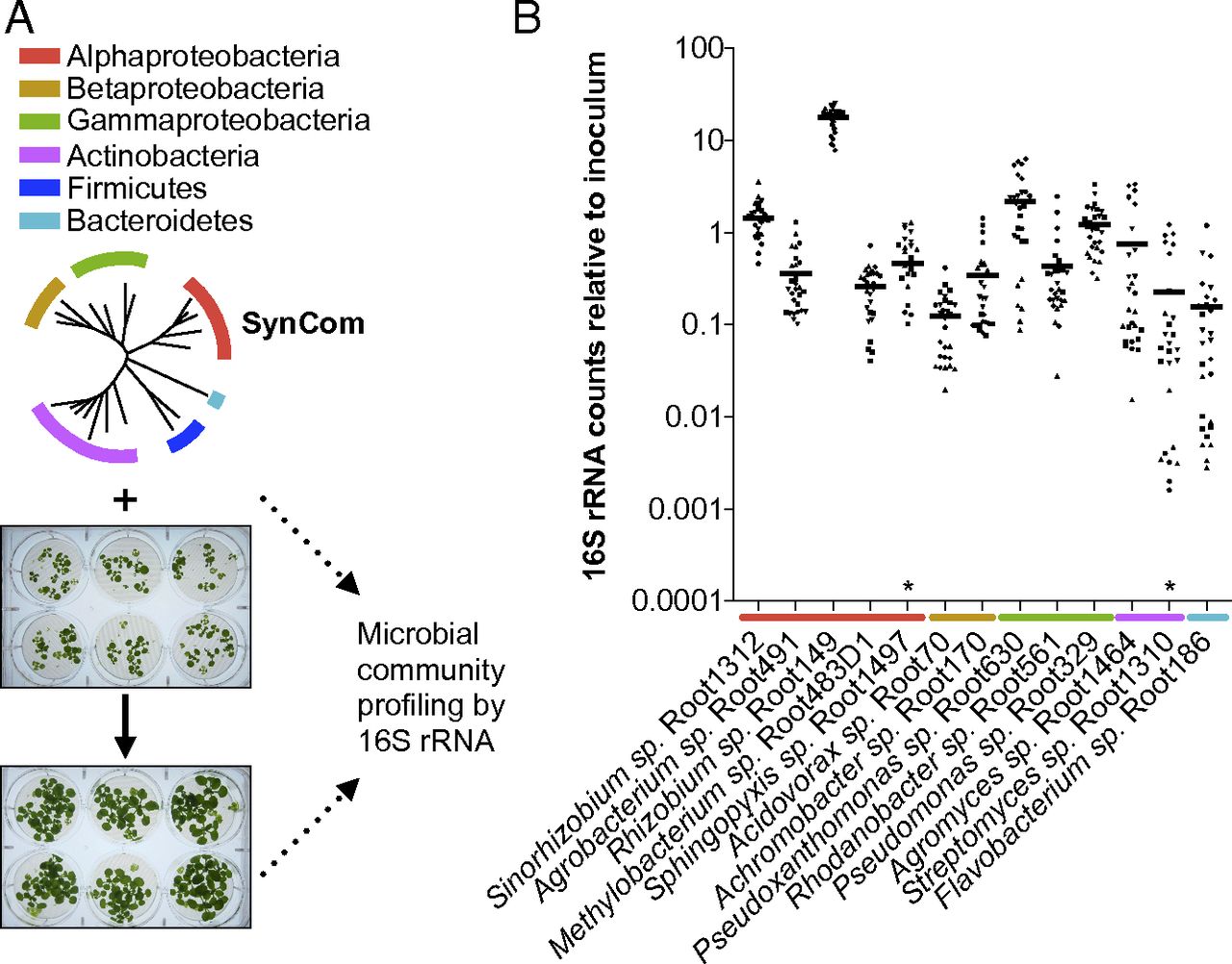
Fig. 1.
The gnotobiotic platform used to investigate the effect of plant specialized metabolism on root microbiome composition. (A) The media surrounding hydroponically grown 13-d-old A. thaliana seedlings was inoculated with a 22-member SynCom. The microbial community profile at the 20-d-old root was assessed by 16S rRNA along with the starting inoculum. (B) Scatter plot with averages of prominent SynCom members’ abundance at the root relative to the starting inoculum as determined by 16S rRNA amplicon count profiling.
2. Strain Abundances at the Roots of Arabidopsis Mutants Deficient in Specialized Metabolite Biosynthesis.
We tested plant lines disrupted for cytochrome P450 79B2 (CYP79B2) and cytochrome P450 79B3 (CYP79B3), known to initiate the indole glucosinolate and camalexin biosynthetic pathways (24); MYB28, the positive transcriptional regulator of aliphatic glucosinolates (25); chalcone isomerase (tt5), the committed step toward flavonoid biosynthesis (23); and feruloyl-coenzyme A ortho-hydroxylase 1 (F6′H1), the committed step toward oxidized coumarin biosynthesis (14) (Fig. 2A). We employed analysis of similarity (ANOSIM) on Bray–Curtis dissimilarity matrices to assess significance of community composition shifts across mutant genotypes. Overall, no significant changes in the microbial composition of cyp79b2/b3, tt5, myb28, or f6′h1 compared with wild type in replete conditions were observed (here defined as P < 0.01 in ANOSIM).

Fig. 2.
Root microbial community composition across A. thaliana gene disruption lines deficient in major specialized metabolites. (A) Schematic of A. thaliana metabolism highlighting major pathways toward root-exuded specialized metabolites. (B) Scatter plot of strain Z scores comparing each plant genotype with wild type in replete conditions.
3. A Shift in Community Composition Is Observed for Plant Lines Lacking Coumarin Biosynthesis When Grown Under Iron Deficiency.
While there was no significant shift in microbial community profile between wild type and f6′h1-1 in nutrient-replete conditions, we observed community profiles distinct from wild type in iron-deficient conditions in two of the three experiments (ANOSIM, P < 0.01). Inspection at the strain level revealed a consistent increase in the relative abundance of Pseudomonas sp. Root329 compared with wild type in replete media (Fig. 2B) and compared with wild type in iron-deficient media (as determined by Z-score analysis; Fig. 3B)
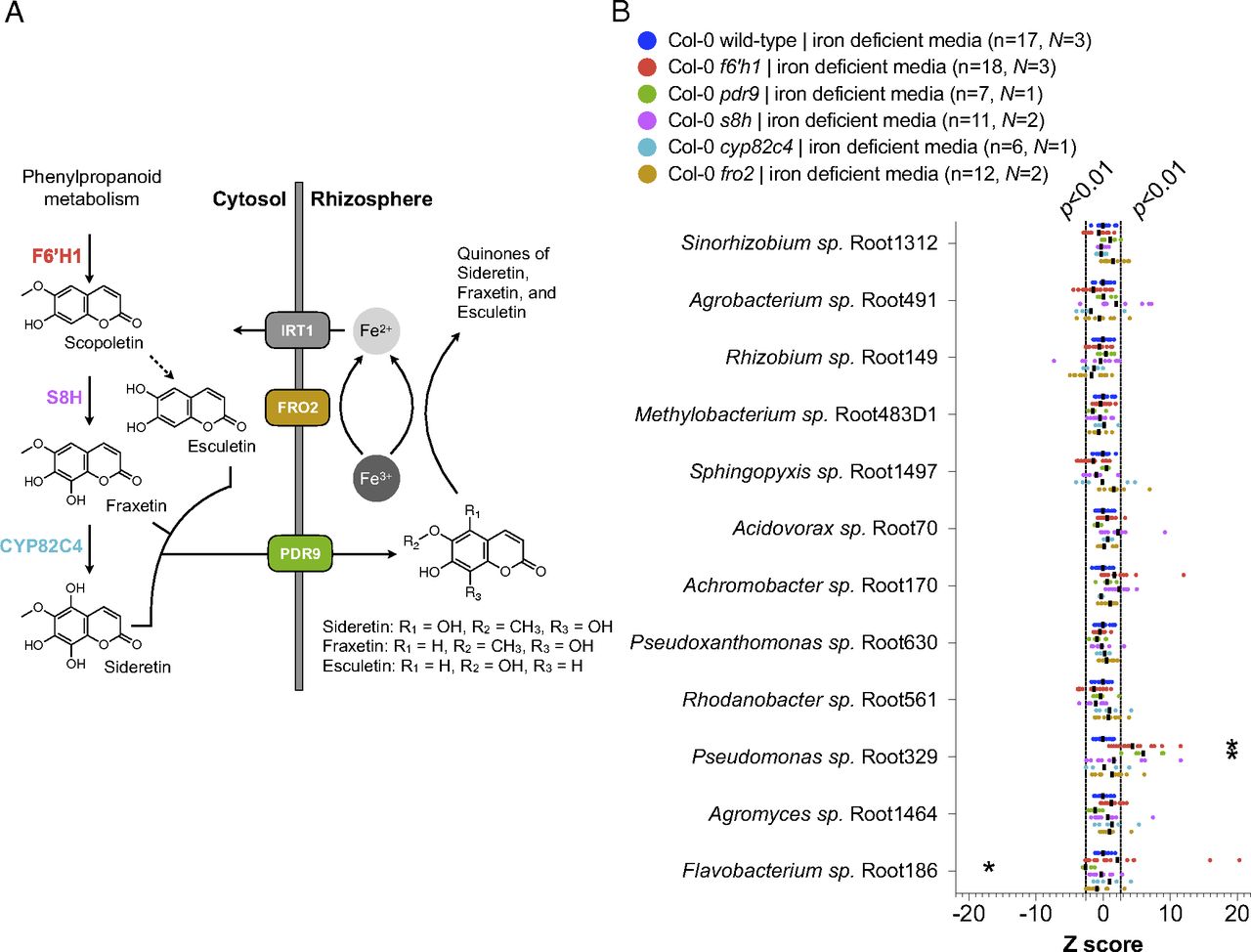
Fig. 3.
Root-exuded coumarins shift the microbial community profile at the root. (A) Schematic of the A. thaliana iron homeostasis genetic repertoire, including genes involved in oxidized coumarin biosynthesis and release. (B) Scatter plot of strain Z scores comparing each plant genotype with wild type in iron-deficient conditions.
4. An f6′h1-Dependent Increase in Abundance of Pseudomonas sp. Root329 Is Consistent and Robust Across Different SynCom Compositions.
5. Pseudomonas sp. Root329 Growth Is Inhibited by Iron-Mobilizing Coumarins in Vitro.
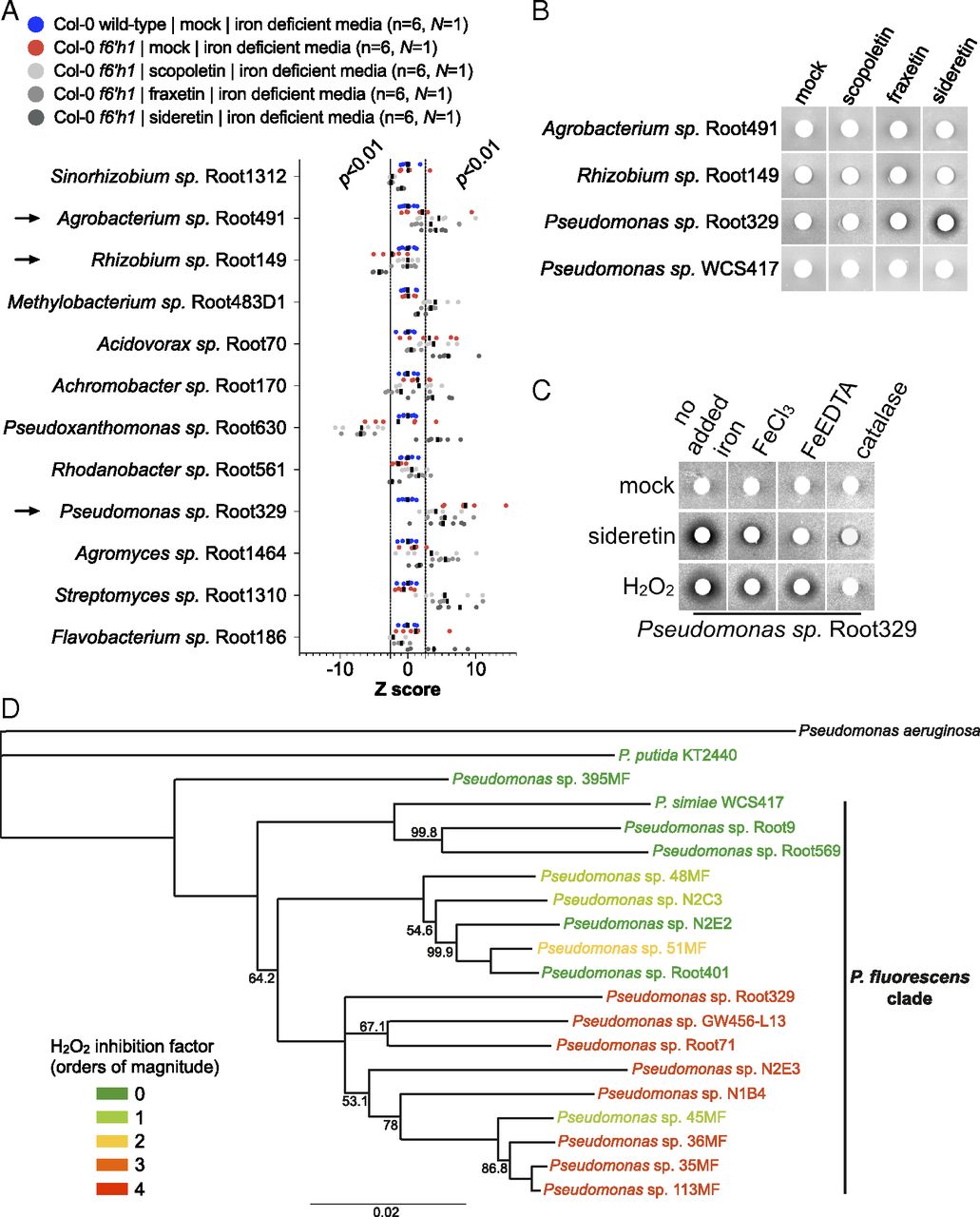
Fig. 4.
Purified coumarins partially shift the microbial community to the composition found in wild-type plants, and specifically inhibit the growth of the differentially abundant Pseudomonas sp. Root329 isolate via an ROS-mediated mechanism.(A) Addition of 100 μM purified oxidized coumarins to the growth media of f6′h1 lines partially phenocopies wild-type community composition.(B) Assays of bacterial growth inhibition surrounding 5-mm filter discs (white circles) infused with dimethyl sulfoxide (DMSO; control) or 10 mM scopoletin, fraxetin, or sideretin (all in 10% DMSO).(C) Bacterial growth surrounding filter discs infused with DMSO (control), sideretin, or hydrogen peroxide at 5 mM (all in 10% DMSO). (D) Degree of growth inhibition following H2O2 challenge observed for a range of pseudomonads of varied origin.
To determine if F6′H1-dependent coumarins directly impact the growth of bacterial isolates that comprise the SynCom, we analyzed the sensitivity of the major coumarin-responsive root-proliferating SynCom members to chemically-pure samples of scopoletin, fraxetin, and sideretin in vitro. Notably, severe growth inhibition of Pseudomonas sp. Root329 by the predominant wild-type coumarin sideretin, and moderate inhibition by fraxetin were observed using a halo inhibition assay.
Discussion
We demonstrate here the promise of employing genetic disruption mutants and SynComs to identify the specific molecular players that sculpt the rhizosphere microbiome. In particular, the ability to track individual members of SynComs facilitates subsequent investigations of the underlying molecular mechanism in vitro. A better understanding of the molecular mechanisms required for bacterial colonization of the root and rhizosphere will facilitate efforts toward engineering host-beneficial microbial consortia. Our finding that proliferation of specific microbial strains is affected by iron-mobilizing coumarins can be used to effectively engineer the rhizosphere to improve crop growth in alkaline soils, which make up a third of the world’s arable soils.
from He Weihua