
捕食者参与的功能相互作用
Article 1:
Title: Predators Accelerate Nutrient Cycling in a Bromeliad Ecosystem
Download website:
https://science.sciencemag.org/content/314/5801/963
Main contents:
Conventional ecological theory predicts that predators affect nutrient cycling by decreasing the abundance or activity of prey. By using a predator-detritivore-detritus food chain in bromeliads, we show that predators can increase nutrient cycling by a previously undescribed, but broadly applicable, mechanism: reducing nutrient export by prey emigration. Contrary to expectations, predation on detritivores increases detrital nitrogen uptake by bromeliads. Predation reduces detritivore emergence and hence export of nitrogen from the system. Detritivores therefore benefit their host plant, but only when predators are present. More generally, our results show that predator loss or extinction can dramatically and unexpectedly affect ecosystem functioning.
Results:
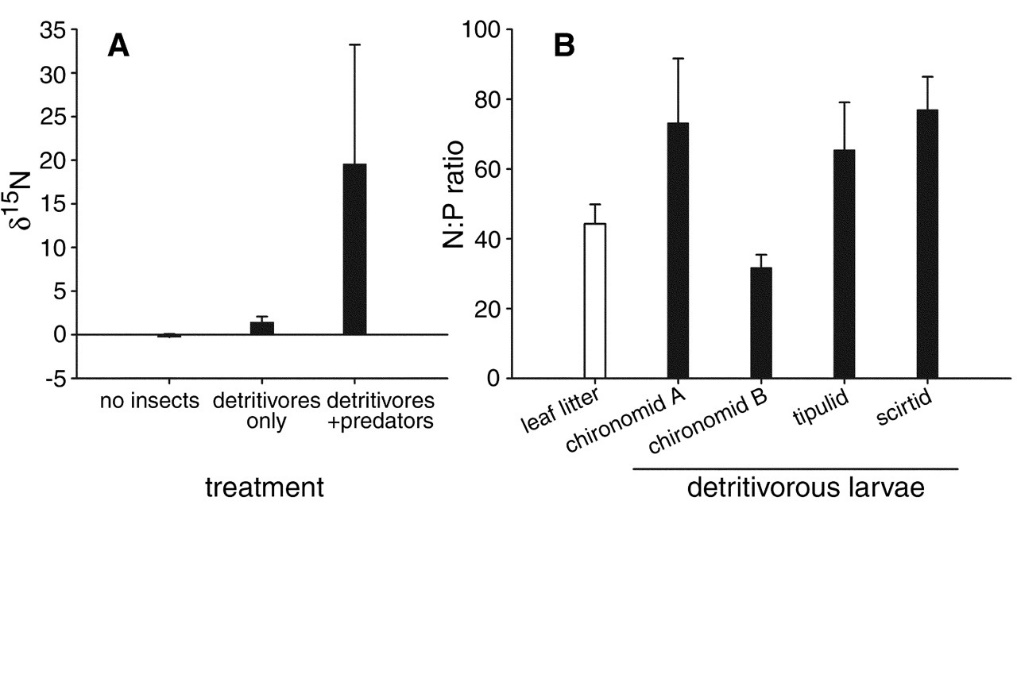
(A) δ15N in new bromeliad leaves for plants containing no insects, detritivore insects only, or detritivore and predatory insects (mean ± SEM). Bonferroni-corrected t test (detritivores alone versus control, z = 0.478 and P = 0.63; detritivores plus predators versus detritivores alone, z = 2.36 and P = 0.018). (B) Comparison of N:P ratios (by atom) for detritivore larvae and for leaf litter (mean ± SEM). Larger detritivores (chironomid A, scirtids, and tipulids) have N:P ratios higher than that of leaf litter [F1, 20 = 5.05, P = 0.04 for linear contrast following significant analysis of variance (F4,20 = 3.66, P = 0.02)]. Chironomid B is a smaller detritivore that accounts for only a small proportion of detritivore biomass in bromeliads.
N转移分析:

Article 2:
Title: Field exclusion of large soil predators impacts lower trophic levels and decreases leaf‐litter decomposition in dry forests
Download website:
https://besjournals.onlinelibrary.wiley.com/doi/full/10.1111/1365-2656.13101
Abstract:
1、Shifts in densities of apex predators may indirectly affect fundamental ecosystem processes, such as decomposition, by altering patterns of cascading effects propagating through lower trophic levels. These top–down effects may interact with anthropogenic impacts, such as climate change, in largely unknown ways.
2、We investigated how changes in densities of large predatory arthropods in forest leaf‐litter communities altered lower trophic levels and litter decomposition. We conducted our experiment in soil communities that had experienced different levels of long‐term average precipitation. We hypothesized that altering abundances of apex predators would have stronger effects on soil communities inhabiting dry forests, due to lower secondary productivity and greater resource overexploitation by lower trophic levels compared to wet forests.
3、We experimentally manipulated abundances of the largest arthropod predators (apex predators) in field mesocosms replicated in the leaf‐litter community of Iberian beech forests that differed in long‐term mean annual precipitation by 25% (three dry forests with MAP < 1,250 mm and four wet forests with MAP > 1,400 mm). After one year, we assessed abundances of soil fauna in lower trophic levels and indirect impacts on leaf‐litter decomposition using litter of understorey hazel, Corylus avellana.
4、Reducing densities of large predators had a consistently negative effect on final abundances of the different trophic groups and several taxa within each group. Moreover, large predatory arthropods strongly impacted litter decomposition, and their effect interacted with the long‐term annual rainfall experienced by the soil community. In the dry forests, a 50% reduction in the densities of apex predators was associated with a 50% reduction in decomposition. In wet forests, the same reduction in densities of apex soil predators did not alter the rate of litter decomposition.
5、Our results suggest that predators may facilitate lower trophic levels by indirectly reducing competition and resource overexploitation, cascading effects that may be more pronounced in drier forests where conditions have selected for greater competitive ability and more rapid resource utilization. These findings thus provide insights into the functioning of soil invertebrate communities and their role in decomposition, as well as potential consequences of soil community responses to climate change.
Results:
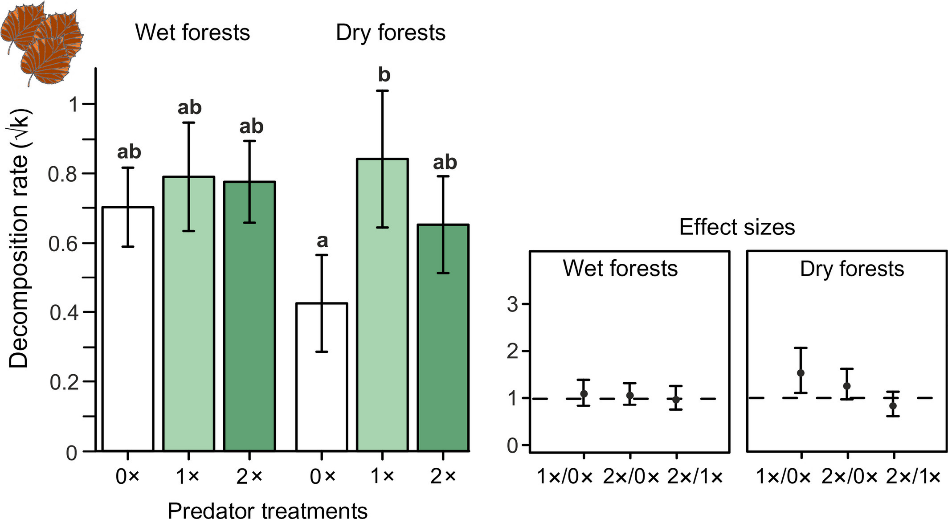
Higher densities of apex predators accelerated decomposition in the dry forests but had no impact in wet forests.

创新点:
只操纵顶端捕食者,而不是整个捕食者营养级全部去除。
Contact: Luo Yunchao