
沉水凋落物上微生物的来源:来源于叶片本身还是从水中定殖?
Title: Microbes on decomposing litter in streams: entering on the leaf or colonizing in the water?
Download website:https://www.nature.com/articles/s41396-021-01114-6?utm_source=xmol&utm_medium=affiliate&utm_content=meta
Abstract:
When leaves fall in rivers, microbial decomposition commences within hours. Microbial assemblages comprising hundreds of species of fungi and bacteria can vary with stream conditions, leaf litter species, and decomposition stage. In terrestrial ecosystems, fungi and bacteria that enter soils with dead leaves often play prominent roles in decomposition, but their role in aquatic decomposition is less known. Here, we test whether fungi and bacteria that enter streams on senesced leaves are growing during decomposition and compare their abundances and growth to bacteria and fungi that colonize leaves in the water. We employ quantitative stable isotope probing to identify growing microbes across four leaf litter species and two decomposition times. We find that most of the growing fungal species on decomposing leaves enter the water with the leaf, whereas most growing bacteria colonize from the water column. Results indicate that the majority of bacteria found on litter are growing, whereas the majority of fungi are dormant. Both bacterial and fungal assemblages differed with leaf type on the dried leaves and throughout decomposition. This research demonstrates the importance of fungal species that enter with the leaf on aquatic decomposition and the prominence of bacteria that colonize decomposing leaves in the water.
Method:
We characterized the microbial assemblages on dried leaf litter of four common riparian tree species using bacterial 16S rRNA gene and fungal ITS sequencing and used18O-H2O qSIP to quantify the growth rates of bacteria and fungi on submersed litter at two time periods.
Results:
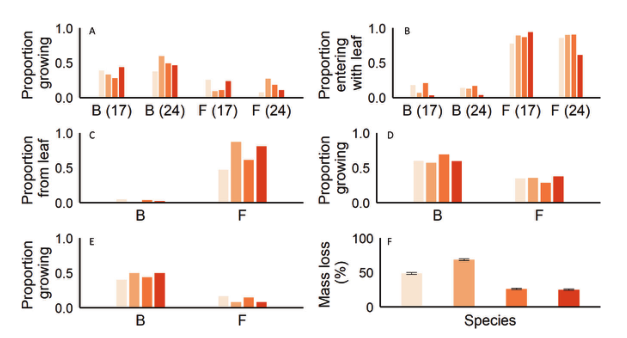
Fig. 2 Comparisons of fungal (F) and bacterial (B) growth, relative abundance, and rates of decomposition among litter species. A The number of taxa growing on decomposing leaves as a function of the total number of taxa on the decomposing leaves after 17 and 24 days. B The relative abundance of growing bacteria and fungi on submersed litter relative to the total abundance of bacteria and fungi after 17 and 24 days. Bacterial taxa and abundances were calculated based on 16S rRNA gene copy number and fungal species abundances were calculated based on ITS region copy number. C The proportion of growing taxa that entered on the leaves relative to the total number of growing taxa on each leaf type. D The number of growing taxa that entered on the leaves relative to the total number of taxa that entered on the leaves. E The number of growing taxa that colonized from the stream relative to the total number of taxa that colonized from the stream. F Differences in litter mass loss after 24 days of decomposition were significantly different. Error bars represent standard error.
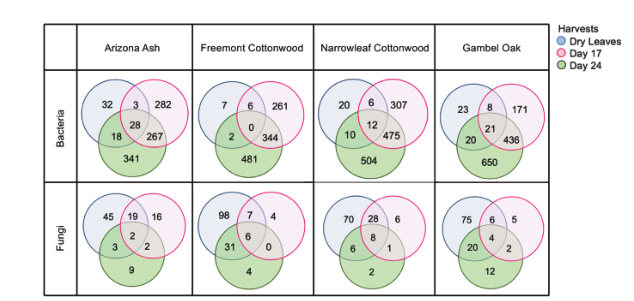
Fig. 3 Venn diagrams of bacterial and fungal taxa that entered with the dried leaves and that were growing in submersed leaf litter after 17 or 24 days for four leaf species. Diagrams include all taxa found on the dried leaves for each species, and all taxa that were growing in any of the individual replicates of the respective leaf species. Blue circles encompass taxa that entered with the leaves, pink circles encompass taxa growing on day 17 and green circles encompass taxa growing on day 24. Growing taxa were identified using qSIP .
(1) We observed, as other terrestrial studies have, that fungal taxa associated with the phyllosphere constitute a significant share of the fungal community during leaf decomposition.
(2) This study also demonstrates differences in litter colonization and growth between bacteria and fungi. Most bacterial taxa colonized decomposing leaves in the water and formed new cells.
(3) Initial differences in microbiomes across plant species were retained in the aquatic environment and played a role in structuring the microbiome on decomposing litter particularly for fungi.
Conclusion:
This study advances the field by demonstrating that most of the growing fungi on submersed leaves have a terrestrial life stage and enter the water with the leaf. This research confirms and expands upon observations of the prevalence of terrestrial fungi on submersed litter. Fungal species are more responsive to stages of decomposition than bacteria and switch from dormancy to growth as conditions change. In contrast, most bacteria colonized from the water column with the number of actively dividing species increasing with time. Bacteria were less sensitive to decomposition stage and grew regardless of litter type. Molecular databases for aquatic microbes are increasing rapidly and will be instrumental in discerning the ecological interactions between microbes in different environments. Future studies using isotope-enabled genomics will allow ecologists to understand how microbiomes transcend ecosystem boundaries and impact biogeochemical cycling in both terrestrial and aquatic ecosystems