
城市化和森林规模对欧洲山毛榉凋落叶早期分解的联合效应
Title:Ecosystem functioning in cities: Combined effects of rbanization and forest size on early-stage leaf litter decomposition of European beech (Fagus sylvaticaL.)
Download website:http://dx.doi.org/10.1016/j.ufug.2017.10.009
Abstract:Environmental changes associated with rbanization can affect the functioning of ecosystem processes. In cities, forests are among the most frequent types of green areas and provide a wide range of ecosystem services including air cleaning, decomposition of leaf litter and recreation. The European beech (Fagus sylvatica) is a frequent and widespread deciduous tree in temperate forests in Central Europe. In this study, we examined the effects of rbanization on decomposition processes ofF. Sylvaticaleaves in different-sized forests in the urban region of Basel, Switzerland. We used rbanization litterbags (mesh size: 2 mm) withF. Sylvaticaleaves to assess the impact of degree of rbanization (indicated by the percentage cover of sealed area in the surroundings) and forest size on the early stage of leaf litter decomposition and seasonal microbial activity. We found combined effects of degree of rbanization and forest size on the decomposition rate of leaf litter (klitter). Large forests showed the highestklitterin areas with sparse settlements and the lowestklitterin densely settled areas, whereas the opposite pattern was recorded for small and medium-sized forests. This indicates that abiotic and biotic forest characteristics of forests of similar size differently influencedklitterdepending on the degree of rbanization. Moisture content of litter was the best predictor of microbial activity, followed by forest size. We assume that factors acting at the landscape scale such as the degree of rbanization might be too coarse to detect any differences in microbial activity. Our results revealed that even small urban forests contribute to this important ecosystem function. As decomposers are at the bottom of the food chain, management actions that support the biological activity in soil might be also beneficial for species at higher trophic ranks.
Main content:
Litter mass loss and decomposition rate
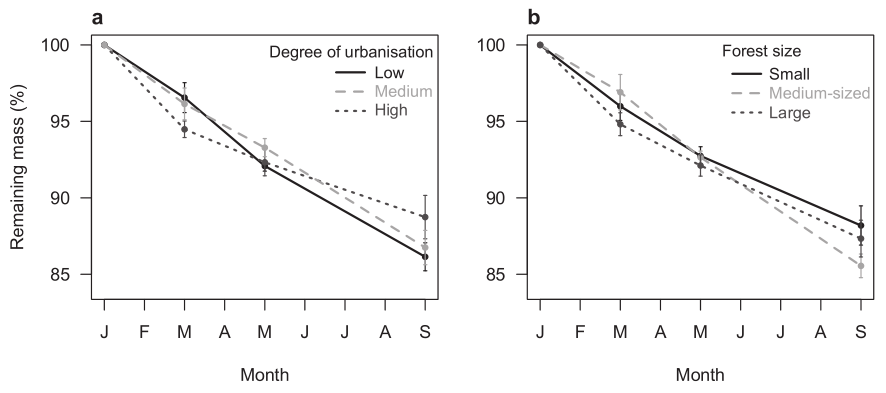
Fig. 1.The mass of initial litter remaining after 2, 4 and 8 months of incubation (mean ± SE) in forests located in areas with different degree of urbanisation(a), and in forests of different size (b).
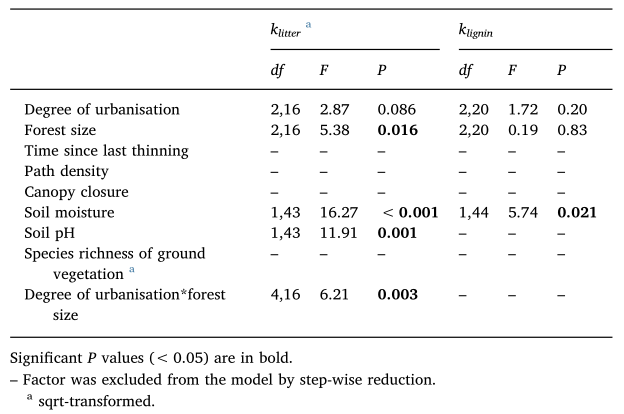
Table 1. Results of LME analyses testing the effects of the degree of urbanisation, forest size, forest management (time since last thinning), recreational pressure (indicated by path density), canopy closure, soil characteristics (moisture, pH) and species richness of ground vegetation on the decomposition rate of litter (klitter) and lignin (klignin).
2.Microbial activity
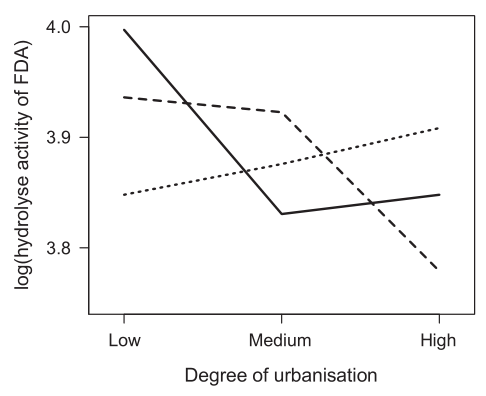
Fig. 2.Microbial activity (expressed as the hydrolyse activity of FDA) in small (solid line), medium-sized (dashed line) and large (dotted line) forests located in areas with different degree of urbanisation.
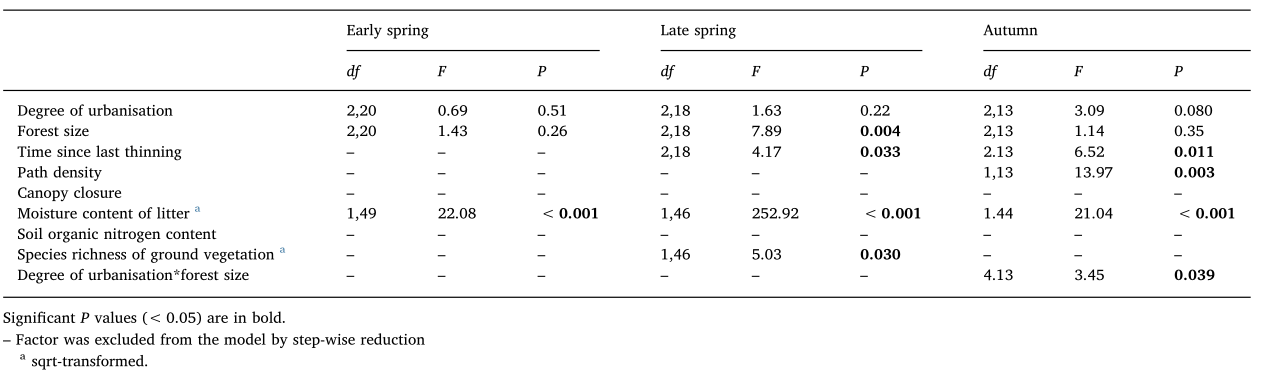
Table 2. Results of LME analyses testing the effects of the degree of urbanisation, forest size, forest management (time since last thinning), disturbance (indicated by path density), canopy closure, litter moisture content, soil organic nitrogen content and species richness of ground vegetation on the microbial activity (log-transformed) at the three sampling dates (early spring, late spring, autumn–after 2, 4, 8 months of incubation, respectively)
Conclusion:Our study revealed combined effects of the degree of urbanisation and forest size on the decomposition rate ofF. sylvaticain the early stage of decomposition. Thisfinding highlights that even small urban forests can contribute to local plant diversity and important ecosystem functions including the decomposition of leaf litter. We, therefore, recommend that urban planners also consider small forests in their concepts of green area management. Our results also showed that moisture contents of soil and litter were important determinants in the decomposition processes of leaf litter. Therefore, locally adapted management strategies to protect the leaf litter layer from various types of disturbances (recreational use, thinning) and to reduce depth-of-edge influence can promote biological activity in soil. As primary products in temperate forests enter food webs mainly as dead organic matter, maintaining the diversity and feeding activity of decomposers may also be beneficial for species at higher trophic levels.