
Microbial diversity and ecosystem multifunctionality
Biodiversity contributes to the functioning of ecosystems by controlling both the rate and the variance of ecosystem processes, making understanding the consequences of biodiversity loss crucial to ecosystem management. Elucidating the likely impacts of belowground biodiversity loss is particularly important, as soil taxa play key roles in nearly every biogeochemical process that makes Earth an inhabitable planet. However, the general relationship between soil biodiversity and ecosystem functioning remains largely unknown because positive, negative, and neutral effects of soil diversity on ecosystem processes are reported. Similarly idiosyncratic responses of individual ecosystem processes to loss of plant diversity prompted consideration of how biodiversity loss simultaneously affects multiple ecosystem processes, termed “ecosystem multifunctionality”.
Article 1:
Title: Soil bacterial taxonomic diversity is critical to maintaining the plant productivity
Download website:
https://www.sciencedirect.com/science/article/pii/S0160412020309922
Main contents:

Fig. 1 Graphical abstract.
Soil microbial communities play a central role in driving multiple ecosystem functions and ecological processes that are key to maintaining the plant productivity. However, we lack sound evidence for the linkage between soil microbial diversity and plant productivity, which hinders our ability to predict the consequences of microbial diversity loss for food security under the context of global environmental change. Here, we used the dilution-toextinction approach to test the consequences of soil microbial diversity loss for the aboveground plant biomass in a glasshouse experiment. Compared with original soils, the bacterial alpha-diversity (Observed operational taxonomic units and Shannon index) significantly decreased in treatments with serially diluted inoculum. Principal coordinates analysis showed that the overall bacterial community compositions (beta-diversity) in original soils were clearly separated from the treatments with serially diluted inoculum. The aboveground biomass of lettuce harvested from the original soils was significantly higher than that from the sterilized soils regardless of the inoculation. The ordinary least squares regression model showed a significant linear relationship between the plant biomass and bacterial alpha-diversity, indicating that reduction in soil microbial diversity could result in a significant decline in the biomass of lettuce. No significant correlation was observed between plant biomass and soil processes including soil basal respiration and denitrification rates. Structural equation models suggested that the effects of soil microbial diversity on the plant biomass were maintained even when simultaneously accounting for other drivers (soil properties and biological processes). Our study provides experimental evidence that soil microbial diversity is important to the maintenance of the plant productivity and suggests that the functional redundancy in soil microbial communities may be overestimated especially in the agroecological system.

Fig. 2 Impacts of dilution on soil bacterial diversity and community compositions. Alpha-diversity including Observed OTUs (A) and Shannon index (B); Beta-diversity indicated by principal coordinate analysis (PCoA) based on Bray-Curtis distances (C); Linear discriminant analysis (LDA) indicating differences of taxa between treatments (D). Original soil (OS), sterilized soil without inoculum (SS), D2 (10−2 g inoculum per g of sterile soil), D4 (10−4 g inoculum per g of sterile soil), and D8 (10−8 g inoculum per g of sterile soil).
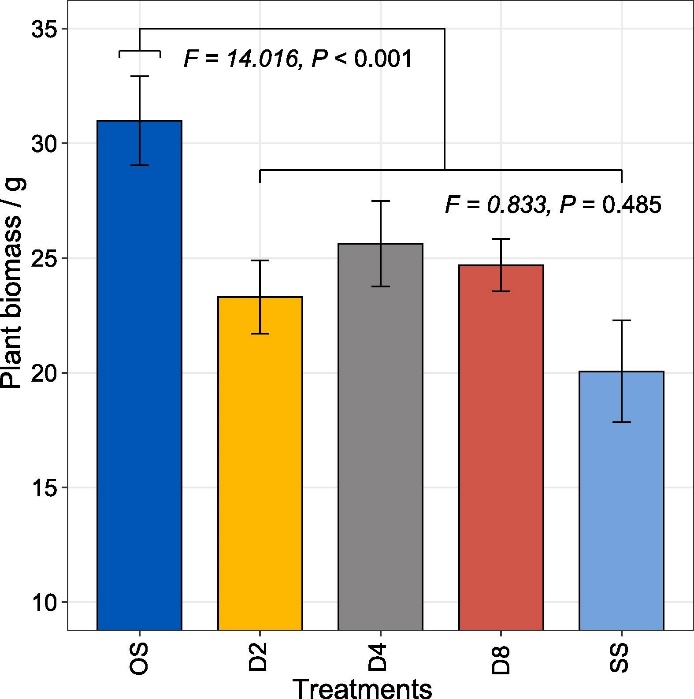
Fig.3Impacts of dilution on plant biomass. Original soil (OS), sterilized soil without inoculum (SS), D2 (10−2 g inoculum per g of sterile soil), D4 (10−4 g inoculum per g of sterile soil), and D8 (10−8 g inoculum per g of sterile soil).
Conclusion:
Altogether, our findings indicate that dilution affects the soil microbial community assembly processes and significantly reduces the microbial taxonomic diversity, which results in different impacts on soil functions. We provide evidence for the positive relationship between bacterial diversity and plant biomass, and emphasize the necessity to develop approaches to conserve soil microbial diversity under the context of global environmental drivers such as fertilization, land-use
changes, nitrogen deposition and climate change. By comparison with previous works, our results further suggest that the bacterial diversity soil functions relationship could be abiotic factor dependent. A better understanding of how abiotic factors shape the bacterial diversity functions relationship will open another way for conservation of microbial diversity and sustainable management of agricultural productivity.
Article 2:
Title: Losses in microbial functional diversity reduce the rate of key soil processes
Download website:
https://www.sciencedirect.com/science/article/pii/S0038071719301427
Main contents:
The consequences of microbial functional diversity loss on key ecosystem processes remain debatable due to lack of firm evidence from observational or manipulative experiments for a link between microbial functional diversity and specialized ecosystem functions. Here, we conducted a microcosm experiment to test for a link between multiple microbial functional diversity (nitrifiers, methanotrophs and denitrifiers) and corresponding specialized soil functions (nitrate availability, methane, and nitrous oxide flux) using the dilution-to-extinction approach. We found that reductions in functional microbial diversity led to declines in the rates of specialized soil processes. Additionally, partial correlations provided statistical evidence that the correlations between microbial functional diversity and specialized functions were maintained after accounting for functional gene abundance (qPCR data) and substrate availability. Our analyses further suggested little redundancy in the relationship between microbial functional diversity and specialized ecosystem functions. Our work provides experimental evidence that microbial functional diversity is critical and directly linked to maintaining the rates of specialized soil processes in terrestrial ecosystems.

Fig.1 Correlations between microbial functional diversity [as determined by T-RFLP analysis of functional genes pmoA, amoA and nosZ)] and their specialized functions. Different colours represent different dilutions darker to light (DX-D10). DC represents the original soil (not included in statistical analyses).
Article 3:
Title: Fungal-bacterial diversity and microbiome complexity predict ecosystem functioning
Download website:
https://www.nature.com/articles/s41467-019-12798-y
Main contents:
The soil microbiome is highly diverse and comprises up to one quarter of Earth’s diversity. Yet, how such a diverse and functionally complex microbiome influences ecosystem functioning remains unclear. Here we manipulated the soil microbiome in experimental grassland ecosystems and observed that microbiome diversity and microbial network complexity positively influenced multiple ecosystem functions related to nutrient cycling (e.g. multifunctionality). Grassland microcosms with poorly developed microbial networks and reduced microbial richness had the lowest multifunctionality due to fewer taxa present that support the same function (redundancy) and lower diversity of taxa that support different functions (reduced functional uniqueness). Moreover, different microbial taxa explained different ecosystem functions pointing to the significance of functional diversity in microbial communities. These findings indicate the importance of microbial interactions within and among fungal and bacterial communities for enhancing ecosystem performance and demonstrate that the extinction of complex ecological associations belowground can impair ecosystem functioning.
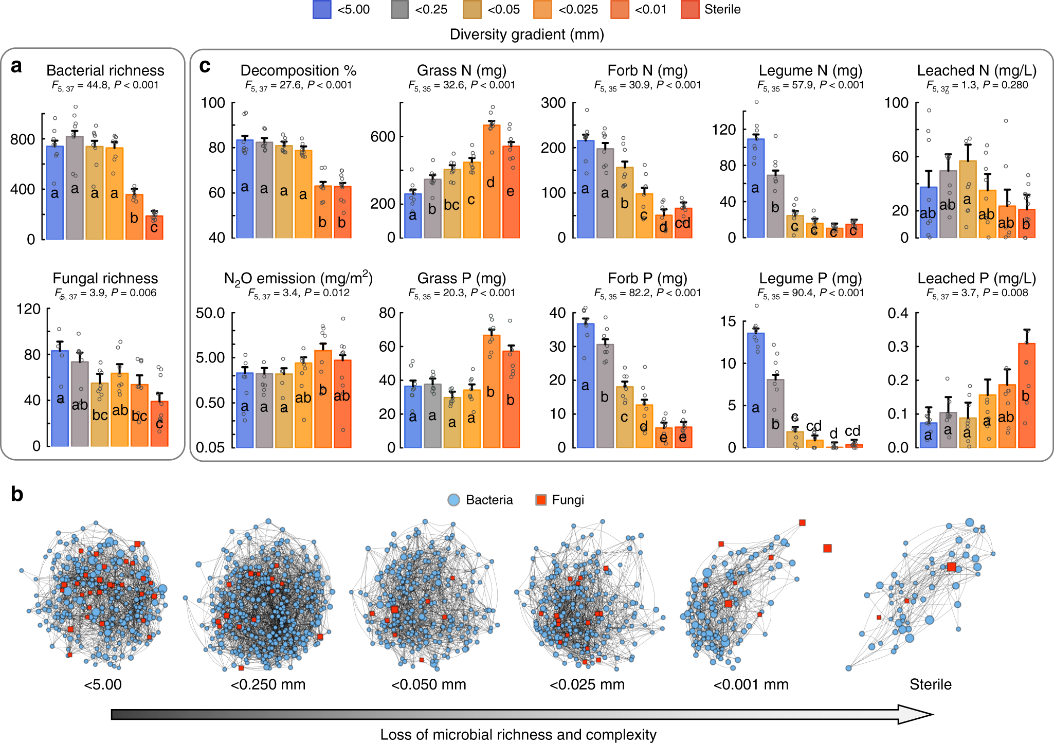
Fig.1 Soil microbial community composition and ecosystem functioning with progressive simplification of the soil biome. The soil diversity gradient was established by filtering inoculum through different meshes: ≤5; ≤0.25; ≤0.05, ≤0.025, ≤0.001 mm, or adding sterilized soil inoculum. Shown are (a) the mean richness of bacterial and fungal OTUs and (b) the microbial association networks where blue circles indicate individual bacterial operational taxonomic units (OTUs), red square nodes indicate individual fungal OTUs and lines indicate interlinkage between OTUs. For visual clarity, only OTUs that were detected to be present in 75% of all replicates within each treatment level are illustrated. Networks are based on subsets of a meta-network matrix where subset matrices were generated using only OTUs present within a treatment. Connectedness within the meta-network was 2.2% (70,830 links out of 3, 290, 596 possible links). Larger nodes indicate the OTU was relatively more abundant within that particular treatment. C The mean of ecosystem functions related to nutrient cycling for each of the soil community treatments. Error bars in a and c are standard errors and different letters indicate significant differences (Tukey HSD) between treatments (n = 8 for each treatment level with n = 10 for the sterile treatment, except for plant nutrients where n = 8)

Fig.2 Relationship between microbial association network complexity and multifunctionality. A Illustrates OTUs that were detected to predict a common ecosystem function (i.e. taxa with coefficients that are related to increased plant nutrient uptake and decomposition or reduce nutrient loss). Nodes (OTUs) and links are colored by the functions with which they are most strongly associated (Note: ‘functional complexity’ is defined as the ratio of the total number of links). Node size indicates the OTU was relatively more abundant within that particular treatment. For visual clarity, only OTUs that were detected to be present in 75% of all replicates of each treatment level are illustrated. Shown in (b) are the relationships between multifunctionality and the overall association network complexity (shown in Fig. 1b) among fungi–fungi, bacteria–bacteria, fung-bacteria and among all fungi and bacteria. The same is shown in (c) except only considering the links among taxa that support a function (shown in a). Significance is indicated by *P < 0.05, **P < 0.01, ***P < 0.001 for each linear regression.
Contact: Cao Tingting
E-mail: 1274467369@qq.com