
跨陆地-水生生态系统边界的凋落物移动路径影响溪流中凋落分解
主要观点:凋落物在输入溪流之前的陆地暴露阶段会影响其后在溪流中的分解动态。
Article 1:
Title: Litter movement pathways across terrestrial–aquatic ecosystem boundaries affect litter colonization and decomposition in streams
Download website: https://besjournals.onlinelibrary.wiley.com/doi/10.1111/1365-2435.13356
Abstract:
1. Streams and their riparian zones are connected by spatial flows of organic matter and constitute a model example of a meta-ecosystem. Fluxes of leaf litter from the riparian zone to the stream are a major energy source in stream food webs. Leaf litter can enter the stream vertically, falling from the tree and into the stream, or laterally, washing into the stream after a period of exposure in the terrestrial ecosystem. The latter can contribute up to 23% to the total amount of litterfall entering streams.
2. To determine if decomposition, microbial and invertebrate colonization of lateral litter inputs are similar to those of vertical inputs, we assessed leaf decomposition of alder, poplar and a 1:1 mixture of the two species in three scenarios across a gradient of terrestrial: aquatic exposures.
Method:
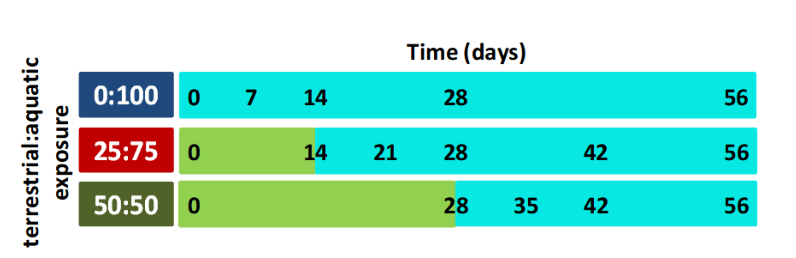
Sampling in stream (0:100) was carried out after 7, 14, 28 and 56 days of immersion. Sampling in the terrestrial environment occurred after 14 (25:75) and 28 days (50:50) of exposure; three groups of leaf bags were transported to the laboratory to determine litter dry mass remaining and litter colonization in the terrestrial environment. The other groups were gently transferred to the riffle area of the stream and sampled after 7, 14, 28 and 42 days (25:75) or after 7, 14 and 28 days of immersion (50:50) so that all treatments had a total decomposition period of 56 days.
Results:
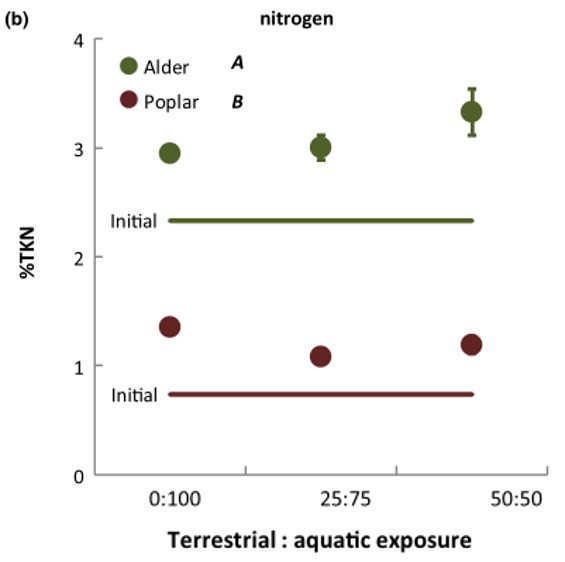
Conclusion:
(1) leaf litter decomposition conformed to the exponential negative model regardless of the exposure scenario, thus confirming our first hypothesis.
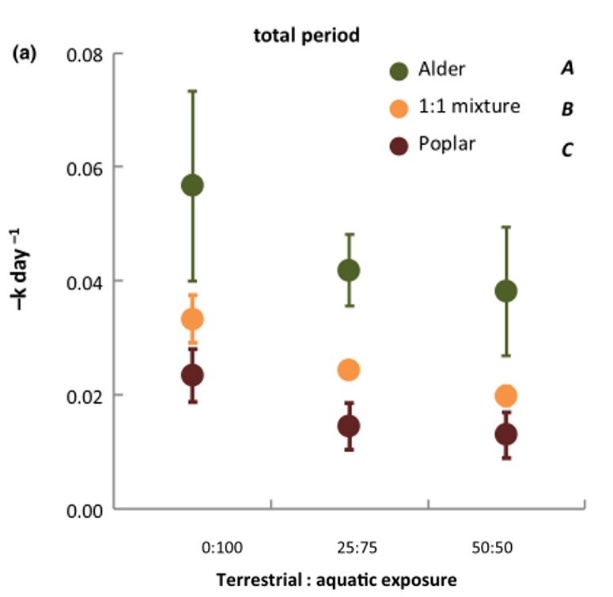
(2) the decomposition rates of leaf litter decreased with the increase in the period of terrestrial exposure, thus supporting our second hypothesis.
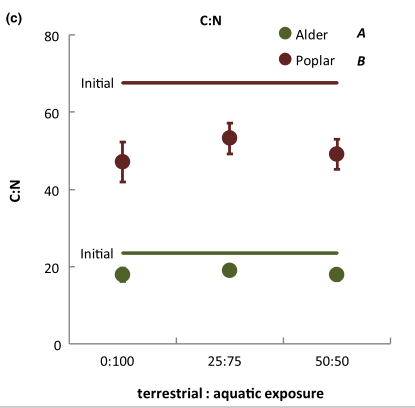
(3) the effect of exposure on in-stream decomposition rates depended on litter type, with decomposition rates of the softer and N-richer leaf litter increasing and decomposition rates of harder and N-poor leaf litter decreasing with increasing terrestrial exposure, thus rejecting our third hypothesis.
Article 2:
Title: Floodplain Preconditioning of Leaf Litter Modulates the Subsidy of Terrestrial C and Nutrients in Fluvial Ecosystems.
Download website:https://link.springer.com/article/10.1007/s10021-020-00508-5
Main contents:
Our objective was to analyse how contrasting environmental conditions (at both regional and local scales) during floodplain preconditioning affect the chemical composition of leaf litter and its leachates, and in turn, how this influences their biodegradability and subsequent processing by microbial and invertebrate consumers in rivers.

Conclusion:
Our results highlight the necessity of continuing to investigate the effect of floodplain preconditioning on the processing of organic matter in rivers to gain a realistic understanding of the C fluxes between terrestrial and aquatic ecosystems. However, we recognize that the global effect of exposure of leaf litter in floodplains on river ecosystem functioning would depend on the proportion of leaf litter that enters rivers from floodplains in relation to leaf litter entering directly to rivers (lateral vs. vertical inputs). Furthermore, results from this work should be also considered for the study of C cycling in intermittent rivers (see del Campo and others 2019; Mora-Go ´mez and others 2019), where coarse organic matter can be exposed in dry riverbeds for long time periods. The expected increase of flow intermittency due to global change could lead to a higher accumulation of leaf and woody litter on dry riverbeds for longer periods of preconditioning (Datry and others 2018), and potentially affecting their aquatic decomposition after flow resumption.