
Title:Rhizosphere microbiome assemblage is affected by plant development
Doi:10.1038/ismej.2013.196
Abstract:There is a concerted understanding of the ability of root exudates to influence the structure of rhizosphere microbial communities. However, our knowledge of the connection between plant development, root exudation and microbiome assemblage is limited. Here, we analyzed the structure of the rhizospheric bacterial community associated with Arabidopsis at four time points corresponding to distinct stages of plant development: seedling, vegetative, bolting and flowering. Overall, there were no significant differences in bacterial community structure, but we observed that the microbial community at the seedling stage was distinct from the other developmental time points. These results suggested that the plant can select a subset of microbes at different stages of development, presumably for specific functions. Accordingly, metatranscriptomics analysis of the rhizosphere microbiome revealed that 81 unique transcripts were significantly (P<0.05) expressed at different stages of plant development. We surmise that plants secrete blends of compounds and specific phytochemicals in the root exudates that are differentially produced at distinct stages of development to help orchestrate rhizosphere microbiome assemblage.
Experimental procedures:
Step 1. Soil experiment
Soil from the Michigan Extension Station, Benton Harbor, MI.
Six replicate pots were maintained for each of the four developmental time points, and one 7-day-old seedling was transplanted to each pot. Individual plants were grown until the following stages were reached: seedling (17 days), vegetative (24 days), bolting (31 days) or flowering (38 days).
Step 2. Extraction of microbial DNA from soil
Rhizosphere soils for each of the time point’s six biological replicates (24 samples; 4 time points) were collected by gently removing the plants from the pots and obtaining the soil attached to the roots. Total RNA was extracted from the soil using the PowerSoil total RNA isolation kit. Total DNA was subsequently extracted using the RNA PowerSoil DNA Elution Accessory Kit.
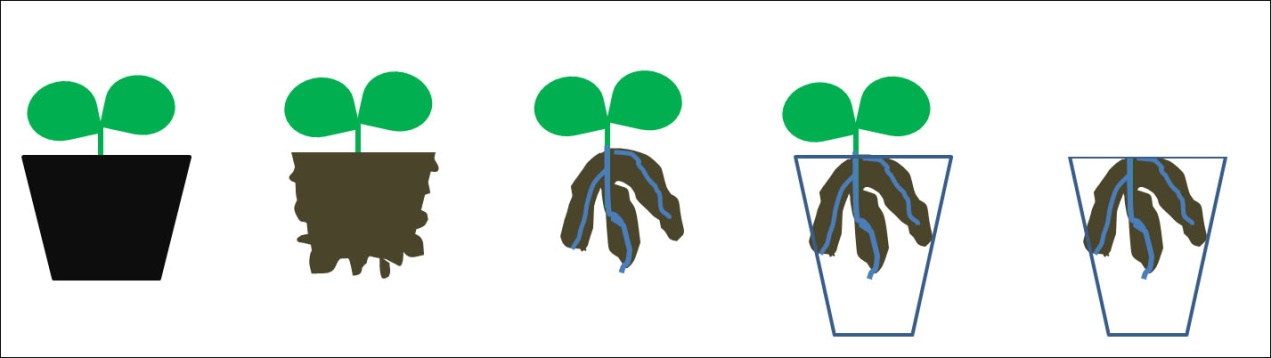
Step 3. 16S rRNA sequencing analysis
Sequence reads were processed using Mothur v. 1.25.1.
Principal component analysis (PCA) and significant features were identified for all treatments using METAGENassist The Vegan package for R was used for community dissimilarity calculations (Bray–Curtis index) and principal coordinate analysis (PCoA).
Step 4. Metatranscriptomics analysis
Root exudation was collected after 3 days of constant secretion (10, 17, 24 or 31 days) where solutions were filtered using nylon filters.
Step 5. Root exudation
Step 6. Statistical analyses
Result:
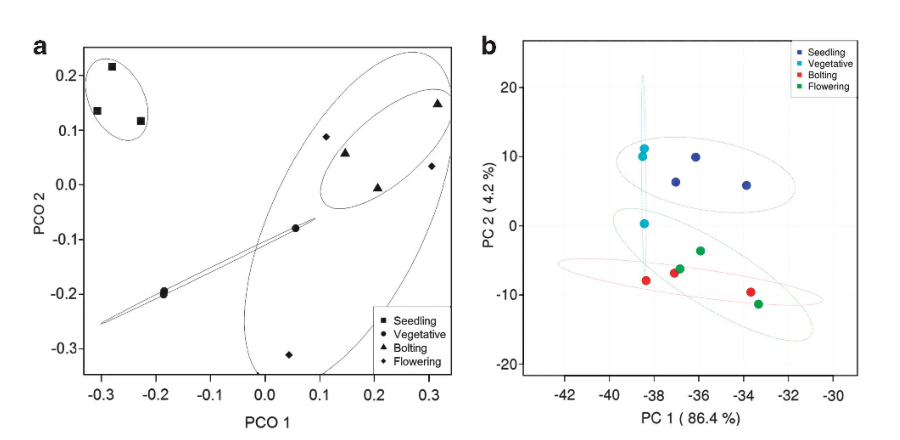
Fig. 1. Multivariate analyses of the rhizosphere microbial community through plant development analyzed by 454 pyrosequencing. (a) Principal Coordinate Analysis (PCoA) for the visualization of pairwise community dissimilarity (Bray–Curtis index) of the rhizosphere microbial community at each plant developmental stage (seedling, vegetative, bolting and flowering). 95% confidence ellipses are shown around each developmental stage. (b) Principal Component Analysis (PCA) of the rhizosphere microbial community at each plant developmental stage. 95% confidence ellipses are shown around each developmental stage.
Table 1 Observed species richness (Sobs), Shannon diversity and evenness of the OTU soil microbial community for each plant developmental time point
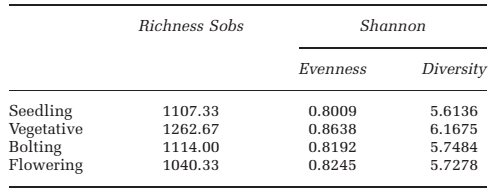
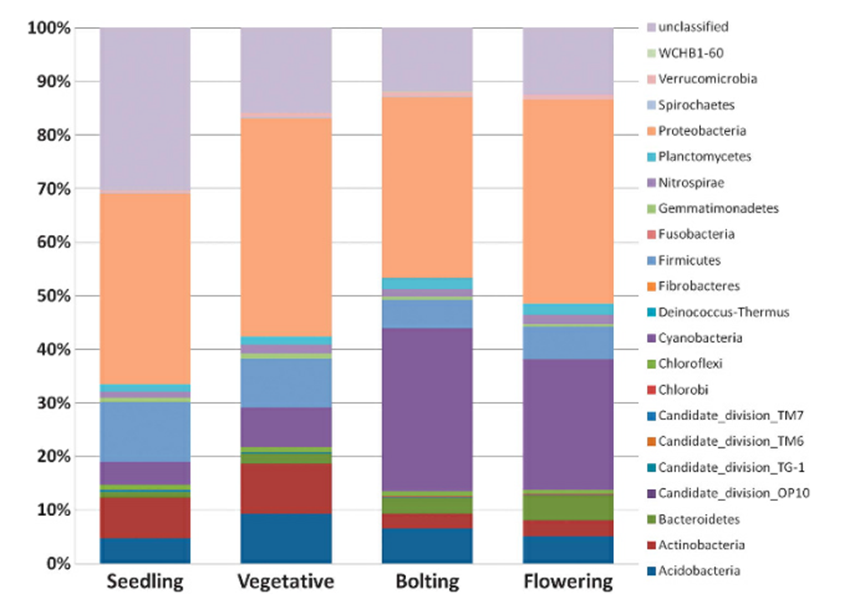
Fig. 2. Relative abundance (%) of the major bacterial phyla present in the rhizosphere microbial community at each plant developmental stage.
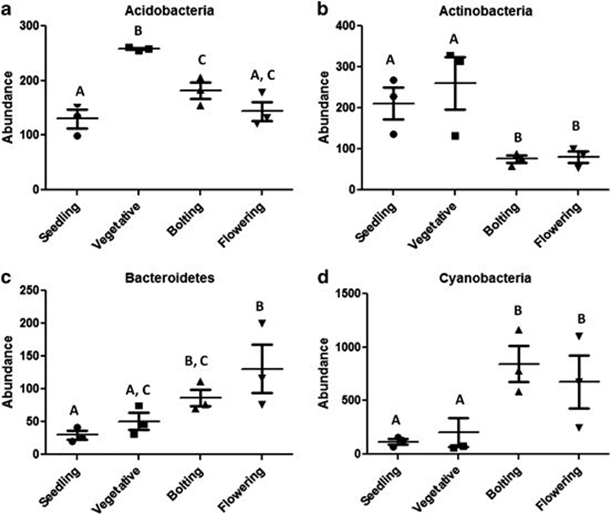
Fig. 3. Bacterial phyla that significantly (P<0.05) change with plant development. (a) Acidobacteria, (b) Actinobacteria, (c) Bacteroidetes and (d) Cyanobacteria. The bars with different letters are significantly different (ANOVA Tukey post-hoc P<0.05) from one another. Each point represents one repetition and graphs show mean±SE.
Table 2 Pearson correlation analysis of the OTUs classified as Acidobacteria, Actinobacteria, Bacteroidetes or Cyanobacteria with the compounds released as root exudates.
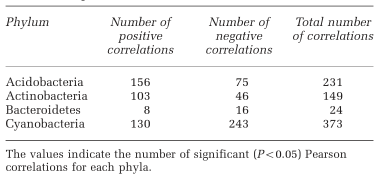
Table 3 Pearson correlations analysis of the OTUs classified as Acidobacteria, Actinobacteria, Bacteroidetes or Cyanobacteria with the group of compounds released as root exudates
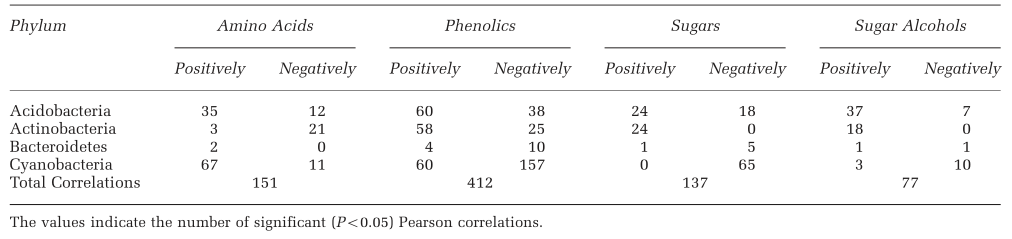
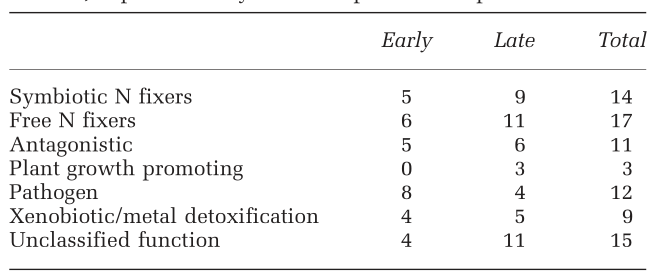
Table 4 Taxonomic assignments of the differentially expressed(81) transcripts were categorized based on their activity andwhether the corresponding transcript were significantly (t-test P<0.05) expressed early or late in plant development
Discussion:
More transcripts were significantly expressed at late plant developmental time points and this may be indicative of the soil microbial community selecting specific functions throughout plant development.
Root exudates are presumably able to modulate the expression of specific functional genes without altering the bacterial taxonomic composition of the rhizosphere. Further studies pinpointing which phenolic compounds are involved in coordinating these microbial interactions are needed.
Conclusions:
The conclusions of this study could be summarized as follows: (1) the plant maintains a core rhizosphere microbiome; (2) this core microbiome is likely to express different functions at different stages of plant development; (3) the plant can enhance the expression of a subset of microbial functions at specific times that the core microbiome is not currently expressing; (4) the plant can select a subset of microbes at different stages of development presumably for specific functions that the core microbiome can’t express and (5) the plant secretes blends of compounds and specific phytochemicals in the root exudates that are differentially produced at distinct stages of plant growth to help orchestrate the activities described in 1, 2, 3 , 4.
贺微华