
Article 1
Title: Global patterns and drivers of ecosystem functioning in rivers and riparian zones
Download website: https://advances.sciencemag.org/content/5/1/eaav0486
Abstract:
River ecosystems receive and process vast quantities of terrestrial organic carbon, the fate of which depends strongly on microbial activity. Variation in and controls of processing rates, however, are poorly characterized at the global scale. In response, we used a peer-sourced research network and a highly standardized carbon processing assay to conduct a global-scale field experiment in greater than 1000 river and riparian sites. We found that Earth’s biomes have distinct carbon processing signatures. Slow processing is evident across latitudes, whereas rapid rates are restricted to lower latitudes. Both the mean rate and variability decline with latitude, suggesting temperature constraints toward the poles and greater roles for other environmental drivers (e.g., nutrient loading) toward the equator. These results and data set the stage for unprecedented “next-generation biomonitoring” by establishing baselines to help quantify environmental impacts to the functioning of ecosystems at a global scale.
Results:
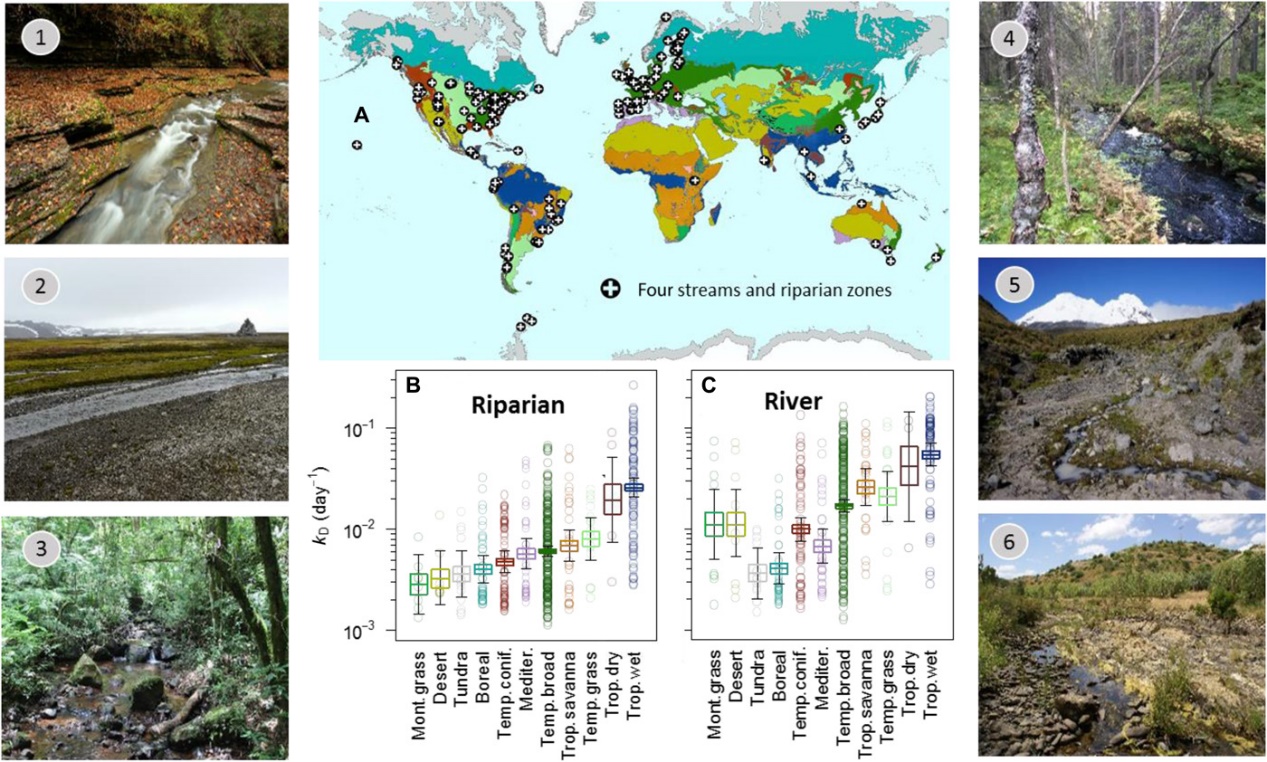
Fig. 1 Global distribution of field sites, mean decomposition rates across biomes, and photos of select field sites.
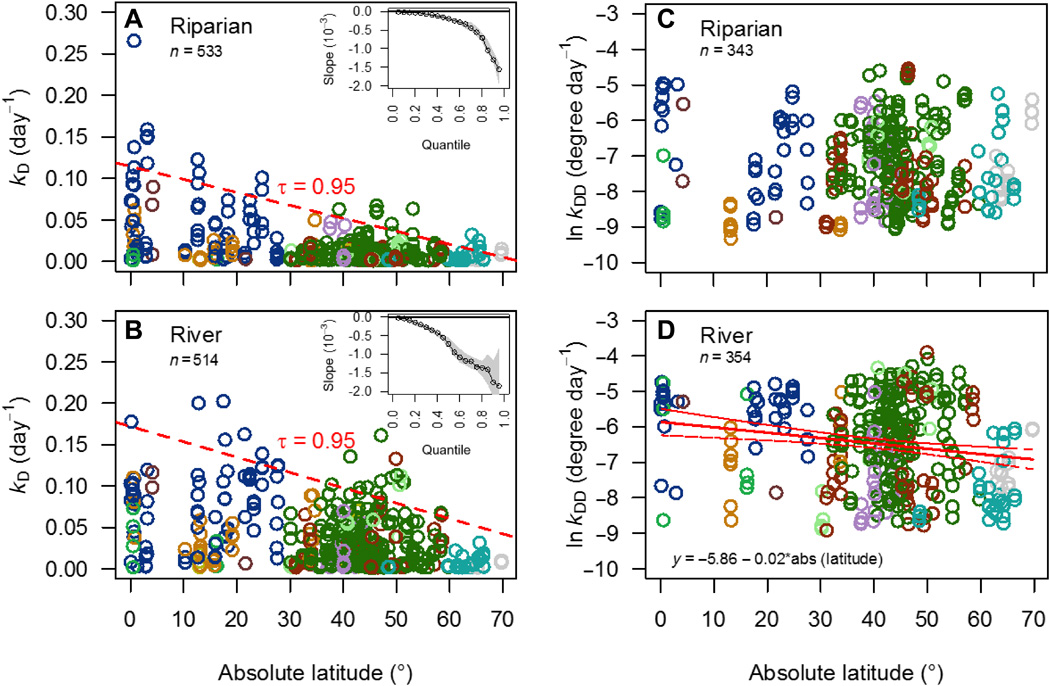
Fig. 2 Relationships between absolute latitude and decomposition rates in riparian zones and rivers.
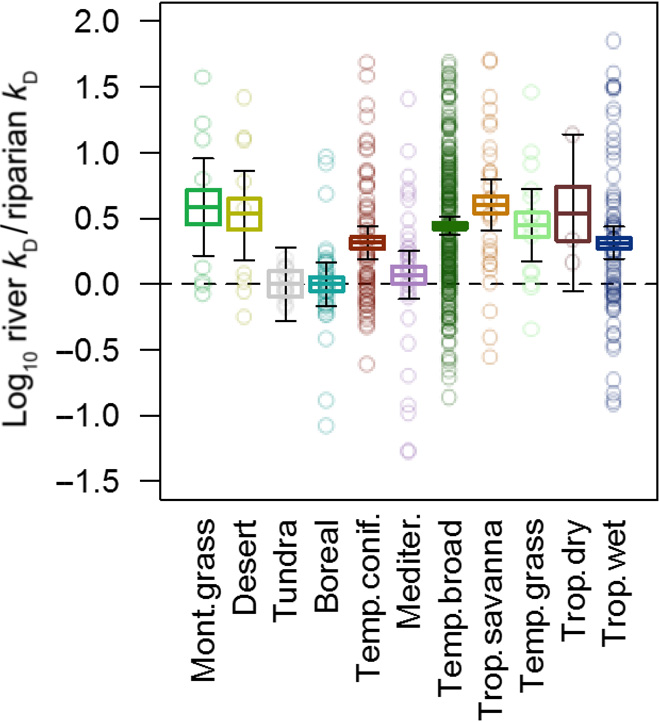
Fig. 3 The log response ratio of river decomposition (kD) to riparian decomposition (kD).
Conclusion:
The >1000 river and riparian sites used in our study were deemed relatively free of human impacts. Consequently, by using an identical assay at all sites, we can unambiguously ascribe the variability that we document to naturally variable environmental conditions and biotic communities. Importantly, these environmental drivers include those that are increasingly affected by human activities such as temperature and moisture availability. This sensitivity to anthropogenically affected variables gives our data added value as a baseline for the biomonitoring of a functional ecosystem property. Moreover, the validated utility of combining a straightforward field assay with a large peer-sourced network of researchers, in tandem with the baseline dataset presented here, sets the scene for gauging ecosystem functioning at large scales to monitor impacts of global environmental change. In doing so, we address pressing needs for effective process-based tools (25) that can be deployed at large scales (6) by emerging international assessment programs (e.g., Intergovernmental Science-Policy Platform on Biodiversity and Ecosystem Services and Intergovernmental Panel on Climate Change) (7).
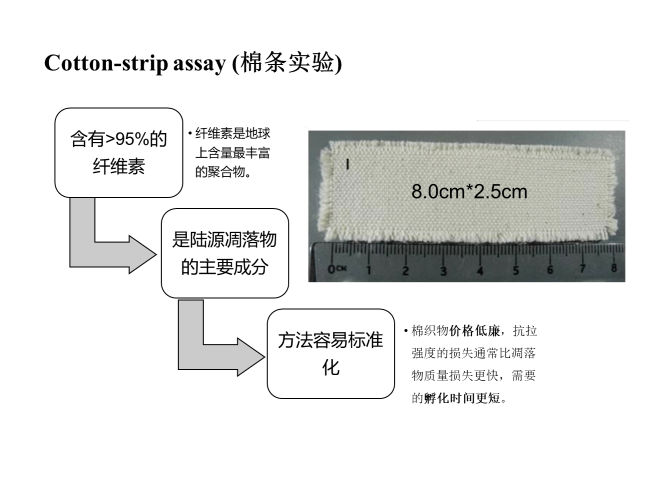
关注点:棉条实验是一种简单、快速和敏感的指示生态系统功能性的环境监测工具。
Title:The cotton-strip assay as an environmental surveillance tool for ecological integrity assessment of rivers affected by WWTP effluents
Download website:https://doi.org/10.1016/j.watres.2019.115247
Abstract:
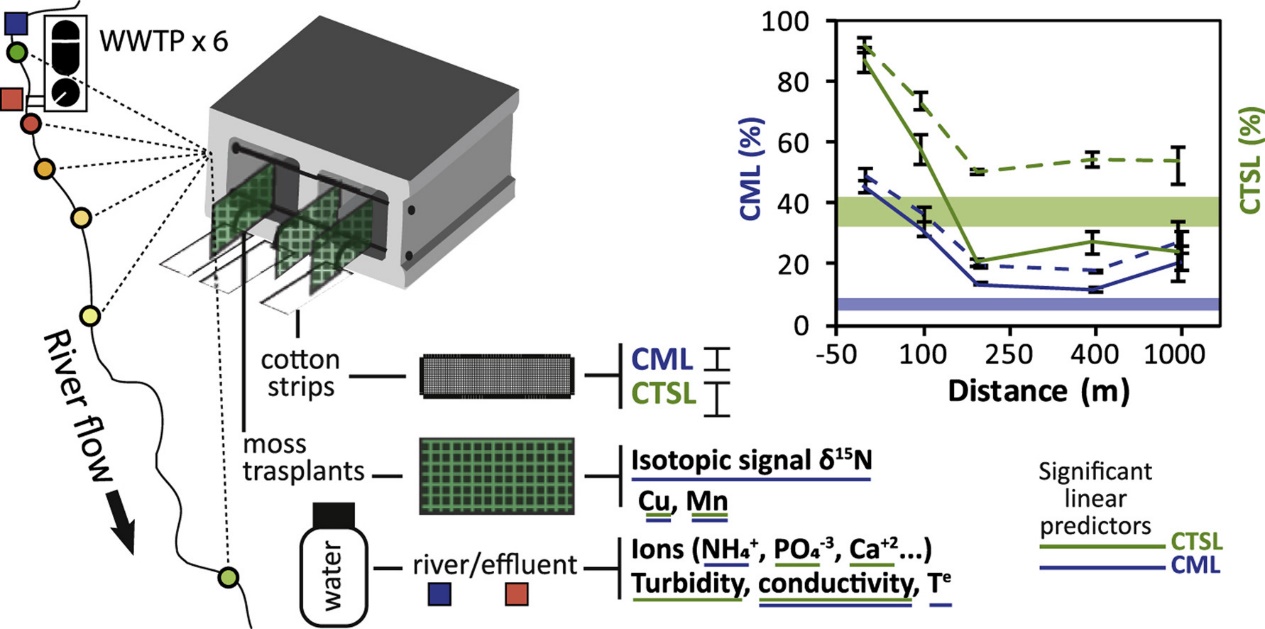
Environmental impact studies of rivers affected by wastewater treatment plant (WWTP) effluents have been greatly restricted by the difficulties associated with carrying out bioassays in the field and also by the complex interactions between the pollutants contained in the discharges. The cotton-strip assay (CSA) enables study of the organic matter decomposition potential, an important ecosystem process in rivers, by taking all of the factors affecting this process into account. However, the CSA has never been used for assessment of WWTP effluents. In the present study, we selected six fluvial zones affected by discharges from small WWTPs and placed cotton strips at increasing distances from the discharge points in each zone. After 17 days, we evaluated decay of the strips by measuring cotton tensile strength loss (CTSL) and cotton mass loss (CML). We then determined the relationships between these parameters and various physico-chemical and biological properties in the water, as well as the δ15N isotopic signal and metal contents of aquatic mosses transplanted in the same sampling sites and used as biomonitors. Although the WWTPs were similar, some of the discharges stimulated and others inhibited decomposition of the cotton strips. This was probably due to differences in the proportions of various types of pollutants (with trophic or toxic effects) in the discharges. The CSA proved to be a simple, practical and economic bioassay and suitable for evaluating the ecological integrity of fluvial ecosystems.
Graphical abstract
Highlights:
WWTP effects on riverine organic matter decomposition were assessed.
Cotton strip assay (CSA) was used.
Mass loss of cotton strips was a better endpoint than tensile strength loss.
CSA is a suitable assay for evaluating the ecological integrity of fluvial ecosystems.
Conclusions:
Despite the similarity in the WWTPs under study, the response measured by decomposition of cotton strips varied in the different sites and was more complex than originally hypothesized (i.e. a straightforward decrease in the decomposition rates with
increasing distance from the discharge points), probably because the complex interactions between the contaminants present in the effluents generate trophic and/or toxic effects in variable proportions. For most of the WWTPs considered, the effects of the discharges extended more than 1 km downstream. Mass loss appears to be a suitable measure of decomposition potential, showing even lower between-replicate variability than tensile strength loss. We recommend that bioassays such as the cotton strip assay, which can be conducted in situ under field conditions, should be included in environmental monitoring plans for WWTPs in order to evaluate the ecological integrity of the fluvial ecosystems affected. Such bioassays provide information about the effects on the receptor ecosystems, where the organisms involved in the decomposition process are exposed to effluent discharges under natural environmental conditions.
Article3
Title:Cotton-strip assays: Let’s move on to eco-friendly biomonitoring!
Download website:https://doi.org/10.1016/j.watres.2019.115295
Abstract:
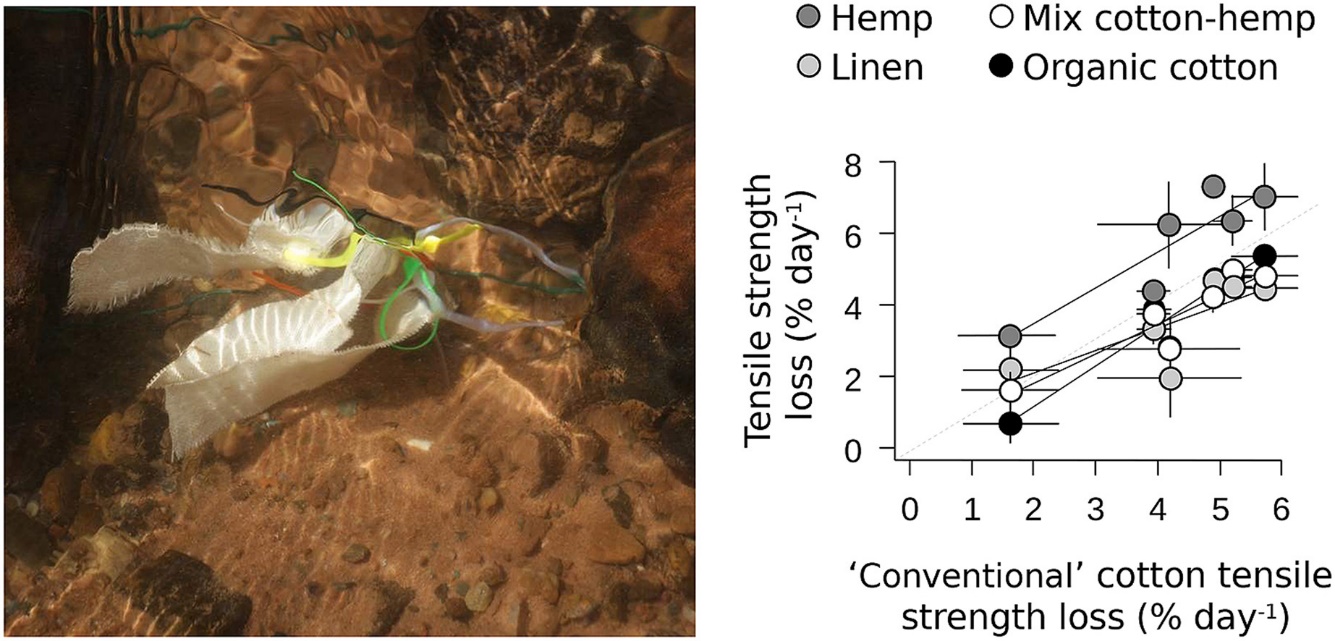
There is increasing recognition that functional bioindicators are needed for ecosystem health assessments. In this perspective, cotton strip assays are widely considered as a standard method to account for organic matter decomposition in streams. However, cotton cultivation and manufacture raise both environmental and societal dramatic issues that are – in our opinion – irreconcilable with the objectives of bioindication. In this study, we assessed the relevance of four alternative – eco-friendly – textiles (made of organic cotton, hemp and linen) by comparing their chemical composition and degradation rates in six streams. Chemical composition exhibited low variations among textiles, but contrasted sharply with the expectation that cotton is mostly composed of cellulose. Moreover, surprisingly high nutrient (0.49% N) contents occurred in the conventional cotton strips compared with the organic textiles (N < 0.12%). All textiles provided similar degradation rates across the six streams, meaning that they could be interchangeably used as alternatives to conventional cotton strips. We thus call for the adoption of such ethical and eco-friendly tools as ‘next-generation’ indicators for the functioning of stream ecosystem.
Graphical abstract:
Highlights:
We compared the degradation of conventional cotton vs organic textiles in streams.
Degradation patterns are similar across textiles despite variations among streams.
Organic textiles are eco-friendly alternatives to conventional cotton strip assays.
Conclusions:
- Organic textiles decompose at similar rates than conventional cotton across 6 different streams.
- The relatively low cellulose and high nutrient content exhibited by the conventional cotton fabric bring into question its use as a‘pure cellulose’ standard substrate.
- Organic textiles, and in particular organic cotton, can be used as eco-friendly alternatives to conventional cotton for the cotton-strip assay in streams.
刘润