
Zymography, a non-destructive in situ technique for two dimensional imaging, offers an opportunity for visualization of enzyme activities-spatial and temporal-in soil and in the rhizosphere. Here are three articles about zymograms.
Article 1:
Title: Rhizosphere shape of lentil and maize: Spatial distribution of enzyme activities
Download website:https://www.sciencedirect.com/science/article/pii/S0038071716300050?via%3Dihub
Main contents:
The rhizosphere, the small soil volume that surrounds and is influenced by plant roots, is one of the most dynamic biological interfaces on Earth. Enzymes, produced by both roots and microorganisms, are the main biological drivers of SOM decomposition. In situ soil zymography was applied to test the spatial pattern of rhizosphere activity is enzyme-specific and the distribution of enzyme activity along the roots is dependent on root system and plant species. Lentil (Lens culinaris) and maize (Zea mays L.), two species with contrasting root physiology, were chosen to test their effects on spatial distribution of activities of b-glucosidase, cellobiohydrolase, leucine-aminopeptidase and phosphatase.
Results:
1. The extent of the rhizosphere for each enzyme and plant species was estimated as a function of distance from the root. For the first time, we demonstrated plant-specific patterns of exoenzyme distribution: these were uniform along the lentil roots, whereas in the rhizosphere of maize, the enzyme activities were higher at the apical or proximal root parts.


2. The extension of enzyme activity into the rhizosphere soil was minimal (1 mm) for enzymes responsible for the C cycle and maximal (3.5 mm) for enzymes of the phosphorus cycle. This should be considered in assessments and modeling of rhizosphere extension and the corresponding effects on soil properties and functions.

Conclusion:
The enzyme-specific distribution patterns in soil and in the rhizosphere of different plants with contrasting root physiology. The rhizosphere shape is plant- and enzyme-specific and reflects the soil volume, from which roots and associated microorganisms mobilize nutrients and utilize carbon.
Article 2:
Title: Earthworm burrows: Kinetics and spatial distribution of enzymes of C-, N- and P- cycles
Download website:https://www.sciencedirect.com/science/article/pii/S003807171630058X?via%3Dihub
Main contents:
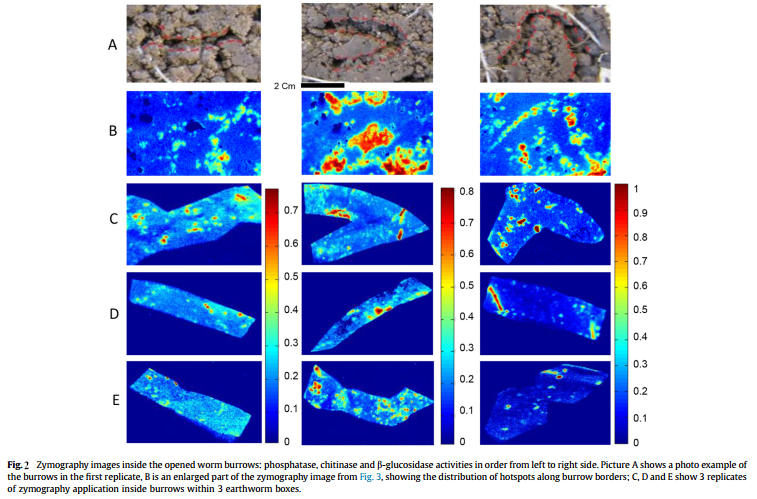
Earthworms boost microbial activities and consequently create hotspots in soil. Although the presence of earthworms is thought to change the soil enzyme system, the distribution of enzyme activities inside worm burrows is still unknown. For the first time, we analyzed enzyme kinetics and visualized enzyme distribution inside and outside worm burrows (biopores) by in situ soil zymography. Kinetic parameters (Vmax and Km) of 6 enzymes e b-glucosidase (GLU), cellobiohydrolase (CBH), xylanase (XYL), chitinase (NAG), leucine aminopeptidase (LAP) and acid phosphatase (APT) e were determined in pores formed by Lumbricus terrestris L. In earthworm burrows, the spatial distributions of GLU, NAG and APT become observable in zymogram images.
Results:
1. The significantly higher Vmax values for GLU, CBH, XYL, NAG an APT in burrows confirmed that earthworms stimulated enzyme activities. For CBH, XYL and NAG, the 2- to 3-fold higher Km values in burrows indicated different enzyme systems with lower substrate affinity compared to reference soil. The positive effects of earthworms on Vmax were cancelled by the Km increase for CBH, XYL and NAG at a substrate concentration below 20 μmol g-1 soil.

2. Zymography showed a heterogeneous distribution of hotspots in the rhizosphere and worm burrows. The hotspot areas were 2.4-14 times larger in the burrows versus reference soil (soil without earthworms). The earthworm burrows are microbial hotspots with much higher and denser distribution of enzyme activities than reference soil.
Conclusion:
Hotspots were twice as concentrated close to earthworm burrows as in surrounding soil. The prevalence of hotspots inside burrows proves that earthworms accelerate microbial enzyme activities. Different enzyme systems point to a shift in dominant microbial populations to burrow-related species with lower affinity to holo-cellulose and to N-acetylglucosamine and with higher affinity to proteins. The combined application of zymography and enzyme kinetic assays enabled relating the distribution of enzyme activity to enzyme kinetic properties in soil modified by earthworms.
Article 3:
Title: Distribution of phosphatase activity and various bacterial phyla in the rhizosphere of Hordeum vulgare L. depending on P availability
Download website:
https://www.sciencedirect.com/science/article/pii/S0038071715002230?via%3Dihub
Main contents:
Despite the importance of the rhizosphere for nutrient turnover, little is known about the spatial patterns of organic phosphorus mineralization by plants and by microorganisms in the rhizosphere. Therefore, the distribution of acid and alkaline phosphatase activity and the abundance of bacteria belonging to various bacterial phyla were investigated in the rhizosphere of barley (Hordeum vulgare L.) as dependent on the availability of inorganic P. A greenhouse experiment was conducted with barley growing in inclined boxes, and applied soil zymography and fluorescence-in situ-hybridization (FISH).
Results:
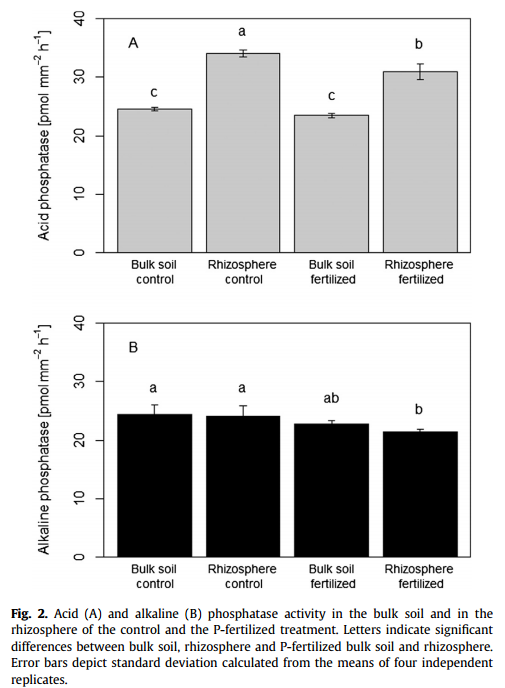
1. Acid phosphatase activity was strongly associated with the root and was highest at the root tips. Due to P fertilization, acid phosphatase activity decreased in the bulk soil, and less strongly in the rhizosphere. Alkaline phosphatase activity, i.e., microbial phosphatase activity was high throughout the soil in the control treatment and was reduced due to inorganic P fertilization especially in the rhizosphere and less strongly in the bulk soil.


2. P-fertilization slightly increased the total number of bacteria in the rhizosphere. Moreover, P-fertilization decreased the abundance of Firmicutes and increased the abundances of Beta- and Gamma-Proteobacteria. The total number of bacterial cells was significantly higher at the root surface than at the root tip and at a distance of 30 mm from the root surface.
Conclusion:
The study shows that bacteria and phosphatase activity were very heterogeneously distributed in soil, and that the effects of P fertilization on phosphatase activity differed strongly between bulk soil and rhizosphere as well as between various zones of the rhizosphere.
Contact: Cao Tingting
E-mail: 1274467369@qq.com