
Download website: https://besjournals.onlinelibrary.wiley.com/doi/abs/10.1111/1365-2656.12876
Maincontents:
Asdifferences in detritivore body size are a major determinant of interspecific interactions,they should be key for predicting effects of detritivore diversity on decomposition.To explore this question, a research of detritivore diversity and body sizesimultaneously in a microcosm experiment was manipulated. This research usedtwo smalls (Leuctra geniculata and Lepidostoma hirtum) and two largedetritivore species (Sericostoma pyrenaicumand Echinogammarus berilloni) in allpossible 1-, 2- and 4-species combinations, and litter discs of Alnus glutinosa.
Theauthor expected that larger species would facilitate smaller species throughthe production of smaller litter fragments, resulting in faster decompositionand greater growth of smaller species in polycultures containing species ofdifferent body size. To examine this hypothesis, a set of“diversity–interaction” models were performed to explore how decomposition wasaffected by different interspecific interactions and the role of body size andquantified the magnitude of such effect through ratios of decomposition ratesand detritivore growth between polycultures and monocultures.
Results:
1.Body size is a key trait mediating the effectsof detritivore diversity on litter decomposition in streams;
2.Faster decomposition and greater growth ofsmaller species were found in polycultures containing species of different bodysize;
3.In contrast to the enhanced growth of smalldetritivores in polycultures containing species of different body size, largerdetritivores showed similar growth in polycultures and monocultures, indicatingthat larger species did not benefit from the presence of smaller species.
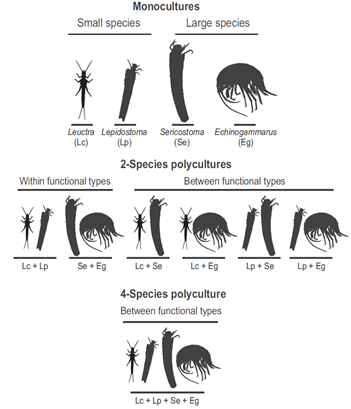
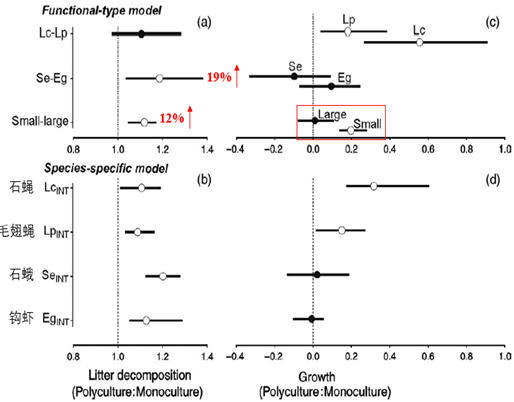
Experimental design with fourdetritivore species belonging to two functional types (left pics) and Ratio ofdecomposition rates between polycultures and monocultures (a, b) and differencein detritivore growth between polycultures and monocultures (c, d) (right fourpics).
Article title:Leaf litter diversity andstructure of microbial decomposer communities modulate litter decomposition inaquatic systems
Downloadwebsite:https://besjournals.onlinelibrary.wiley.com/doi/abs/10.1111/1365-2435.12980
Maincontents:
Leaflitter decomposition is a major ecosystem process that can link aquatic toterrestrial ecosystems by flows of nutrients.Especiallyin aquatic systems, an understanding of diversity effects on litterdecomposition is still incomplete. Here an experiment was conducted to test twomain factors associated with global species loss that might influence leaflitter decomposition.
Theauthor created two structures of decomposer community by filtering stream waterusing a 11 nm filter. Then the author tested (1) whether mixing different leafspecies alters litter decomposition rates compared to decomposition of thesespecies in monoculture and (2) the effect of the size structure of a loticdecomposer community on decomposition rates.
Results:
1.Leaf litter identity and quality significantlyand strongly influence decomposition rates;
2.Only in the case of Alnus and Fagus, mixing leaflitter species resulted in synergistic effects in decomposition rates. For theother species combinations, the effects were additive;
3.Top-down effects due to loss of species orfunctional groups in the decomposer community may be as important as bottom-upeffects.
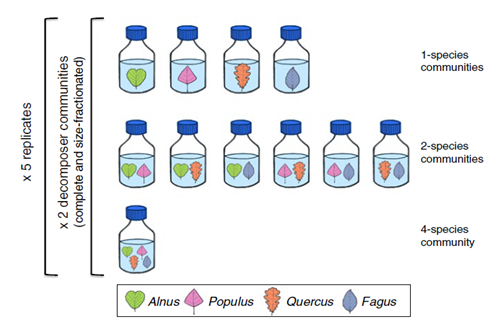
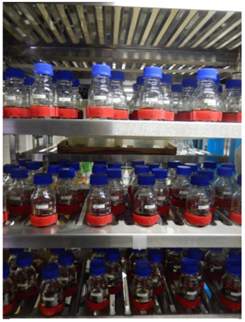
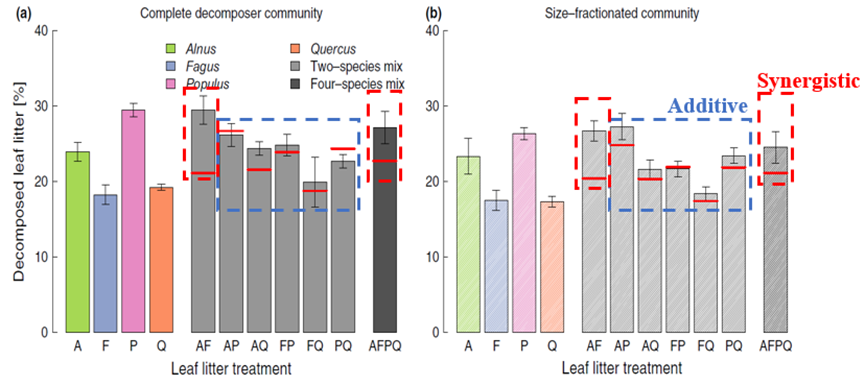
Experimental setup (abovetwo pics) and decomposed leaf litter of different litter types and theircombinations at the end of the experiment (day 72, below two pics).
Article title:Biotic and abioticmodifications of leaf litter during dry periods affect litter mass loss andnitrogen loss during wet periods
Downloadwebsite: https://besjournals.onlinelibrary.wiley.com/doi/abs/10.1111/1365-2435.13018
Maincontents:
In litter decomposition, exposure to high solarirradiance in dry periods often led to massive facilitation of litter decay insubsequent wet periods (“photoacceleration”), though in many studies thiseffect was absent. Recently, water vapour and dew were identified as modulatorsenabling substantial microbial degradation during rainless periods. Here, aresearch was performed to investigate (1) whether the activity ofmicro-organisms modifies litter traits, such as litter quality and microbialcommunity in dry periods, consequently altering the loss of litter mass andnitrogen (N) in wet periods, and (2) whether it can co-occur with photoacceleration.
Results:
1.The activity of decomposers during the dryseason is an important factor in modifying litter traits and consequentlyaffecting mass and N losses during the wet season;
2.Microbial degradation during the dry season ledto either facilitation or inhibition of ash-free mass loss, and to stronginhibition of N loss in the wet season;
3.dew and high humidity during night-time resultedin relatively high litter moisture, which ultimately enabled microbialdegradation during the dry season;
4.For Avenalitter, solar radiation in the dry season appeared to lead to photoaccelerationof decay during the wet season.
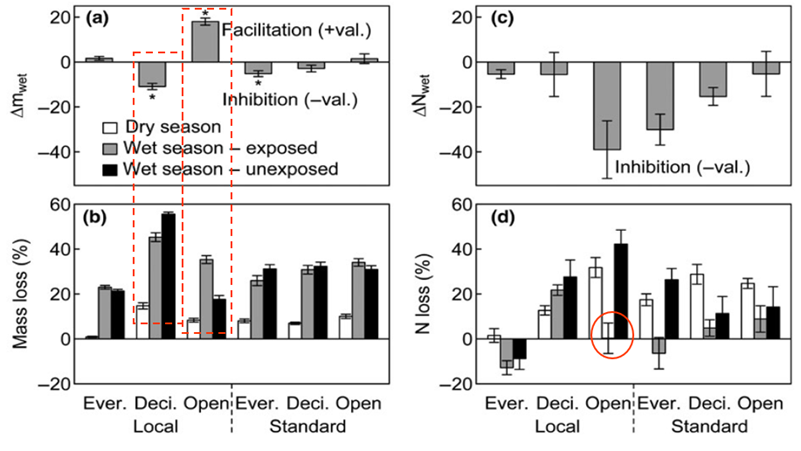
Litter decomposition bythe end of the dry and wet seasons, and facilitation and inhibition of ash-freemass and N losses during the wet season.
The sharer's English writing skills are poor,contacting the boy if you got any confuse about these papers, please.(junboyang123@163.com)