
Article 1
Title: Anthropogenic N deposition increases soil C storage by reducing the relative abundance of lignolytic fungi
Download website:https://doi.org/10.1002/ecm.1288
Abstract:Atmospheric nitrogen (N) deposition has increased dramatically since preindustrial times and continues to increase across many regions of the Earth. In temperate forests, this agent of global change has increased soil carbon (C) storage, but the mechanisms underlying this response are not understood. One long‐standing hypothesis proposed to explain the accumulation of soil C proposes that higher inorganic N availability may suppress both the activity and abundance of fungi that decay lignin and other polyphenols in soil. In field studies, elevated rates of N deposition have reduced the activity of enzymes mediating lignin decay, but a decline in the abundance of lignolytic fungi has not been definitively documented to date. Here, we tested the hypothesis that elevated rates of anthropogenic N deposition reduce the abundance of lignolytic fungi. We conducted a field experiment in which we compared fungal communities colonizing low‐lignin, high‐lignin, and wood substrates in a northern hardwood forest that is part of a long‐term N deposition experiment. We reasoned that if lignolytic fungi decline under experimental N deposition, this effect should be most evident among fungi colonizing high‐lignin and wood substrates. Using molecular approaches, we provide evidence that anthropogenic N deposition reduces the relative abundance of lignolytic fungi on both wood and a high‐lignin substrate. Furthermore, experimental N deposition increased total fungal abundance on a low‐lignin substrate, reduced fungal abundance on wood, and had no significant effect on fungal abundance on a high‐lignin substrate. We simultaneously examined these responses in the surrounding soil and forest floor, in which we did not observe significant reductions in the relative abundance of lignolytic fungi or in the size of the fungal community; however, we did detect a change in community composition in the forest floor that appears to be driven by a shift away from lignolytic fungi and towards cellulolytic fungi. Our results provide direct evidence that reductions in the abundance of lignolytic fungi are part of the mechanism by which anthropogenic N deposition increases soil C storage.
Article 2
Title: Anthropogenic N deposition alters soil organic matter biochemistry and microbial communities on decaying fine roots
Download website:https://doi.org/10.1111/gcb.14770
Abstract:Fine root litter is a primary source of soil organic matter (SOM), which is a globally important pool of C that is responsive to climate change. We previously established that ~20 years of experimental nitrogen (N) deposition has slowed fine root decay and increased the storage of soil carbon (C; +18%) across a widespread northern hardwood forest ecosystem. However, the microbial mechanisms that have directly slowed fine root decay are unknown. Here, we show that experimental N deposition has decreased the relative abundance of Agaricales fungi (−31%) and increased that of partially ligninolytic Actinobacteria (+24%) on decaying fine roots. Moreover, experimental N deposition has increased the relative abundance of lignin‐derived compounds residing in SOM (+53%), and this biochemical response is significantly related to shifts in both fungal and bacterial community composition. Specifically, the accumulation of lignin‐derived compounds in SOM is negatively related to the relative abundance of ligninolytic Mycena and Kuehneromyces fungi, and positively related to Microbacteriaceae. Our findings suggest that by altering the composition of microbial communities on decaying fine roots such that their capacity for lignin degradation is reduced, experimental N deposition has slowed fine root litter decay, and increased the contribution of lignin‐derived compounds from fine roots to SOM. The microbial responses we observed may explain widespread findings that anthropogenic N deposition increases soil C storage in terrestrial ecosystems. More broadly, our findings directly link composition to function in soil microbial communities, and implicate compositional shifts in mediating biogeochemical processes of global significance.
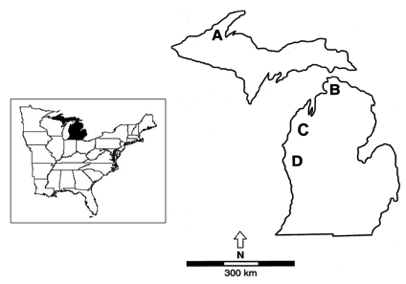
Figure S1 Locations of the four forest stands in our long-term N deposition experiment in upper and lower Michigan, USA.
Each stand contains six 30 × 30 m plots; half receiveambient N deposition (n = 3) and half have received experimentalN deposition since 1994 (n = 3; ambient N + 30 kg N ha−1 year−1 as NaNO3 pellets in six equal applications during the growing season).
Results
Fine root and SOM biochemistry
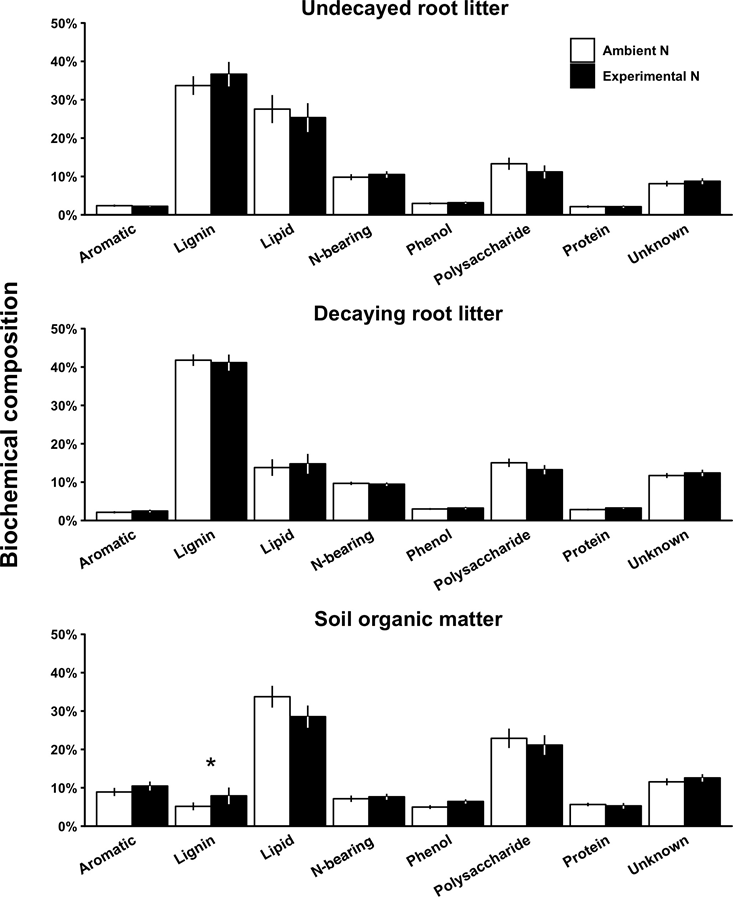
Figure 1 Biochemical composition of fine root litter and soil organic matter based on the relative abundance (%) of compound classes.
Effects of experimental N deposition on microbial community composition
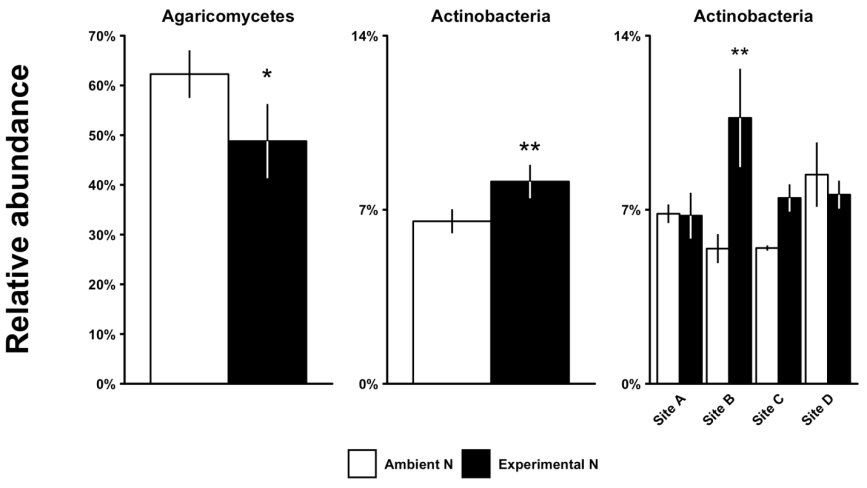
Figure S2 Relative abundance of Agaricomycetes and Actinobacteria under ambient and experimental N deposition on fine root litter decaying in the field. Bars represent mean relative abundances
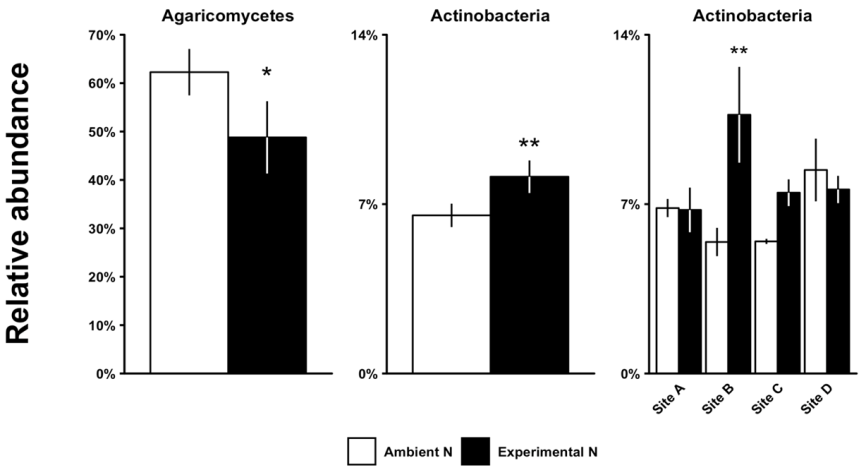
Figure 2 Relative abundance of fungal orders and bacterial families exhibiting significant responses to experimental N deposition after 12 months.
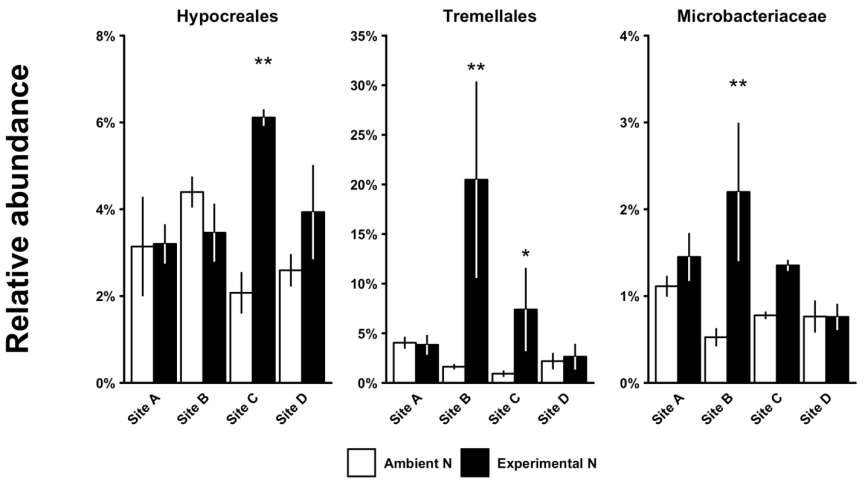
Figure S3 Responses of relative abundances of select fungal orders and bacterial families to experimental N deposition at each of the four sites in our long-term N deposition experiment.
Relationships between SOM biochemistry and microbial community composition
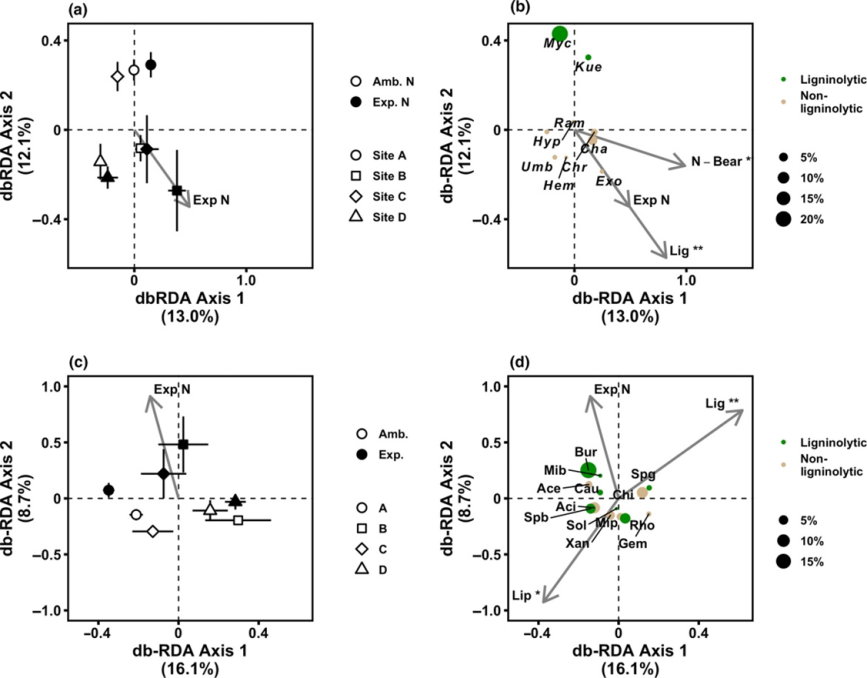
Figure 3 Distance‐based redundancy analysis (db‐RDA) ordinations determined from Bray–Curtis dissimilarity calculated using Hellinger‐transformed abundances of fungal genera (a, b) and bacterial families (c, d).
Discussion
This findings unite a growing body of evidence that experimental N deposition enriches SOM in compounds that are abundant in fine roots with the changes in microbial composition that are responsible for their accumulation. To better understand how experimental N will modify terrestrial C storage and mediate climate under future rates of anthropogenic N deposition, we must explicitly test ecological mechanisms (e.g., putative competitive interactions) that may alter microbial community composition and slow fine root decay, as well as better understand how the altered products of fine root decomposition are stabilized into SOM. Taken together, our findings link the composition and function of microbial communities, as well as highlight the role of compositional shifts in mediating biogeochemical processes of global significance.
He Weihua