
Plant-plant competition influences temporal dynamism of soil microbial enzyme activity
Title: Plant-plant competition influences temporal dynamism of soil microbial enzyme activity
Download website:https://www.sciencedirect.com/science/article/pii/S0038071719302792
Abstract: Root-derived compounds can change rates of soil organic matter decomposition (rhizosphere priming effects) through microbial production of extracellular enzymes. Such soil priming can be affected by plant identity and soil nutrient status. However, the effect of plant-plant competition on the temporal dynamics of soil organic matter turnover processes is not well understood. This study used zymography to detect the spatial and temporal pattern of cellulase and leucine aminopeptidase activity, two enzyme classes involved in soil organic matter turnover. The effect of plant-plant competition on enzyme activity was examined using barley (Hordeum vulgare) plants grown in i) isolation, ii) intra- and iii) inter-cultivar competition. The enzyme activities of leucine aminopeptidase and cellulase were measured from portions of the root system at 18, 25 and 33 days after planting, both along the root axis and in the root associated area with detectable enzyme activity. The activities of cellulase and leucine aminopeptidase were both strongly associated with plant roots, and increased over time. An increase in the area of cellulase activity around roots was delayed when plants were in competition compared to in isolation. A similar response was found for leucine aminopeptidase activity, but only when in intra-cultivar competition, and not when in inter-cultivar competition. Therefore, plant-plant competition had a differential effect on enzyme classes, which was potentially mediated through root exudate composition. This study demonstrates the influence of plant-plant competition on soil microbial activity and provides a potential mechanism by which temporal dynamism in plant resource capture can be mediated.
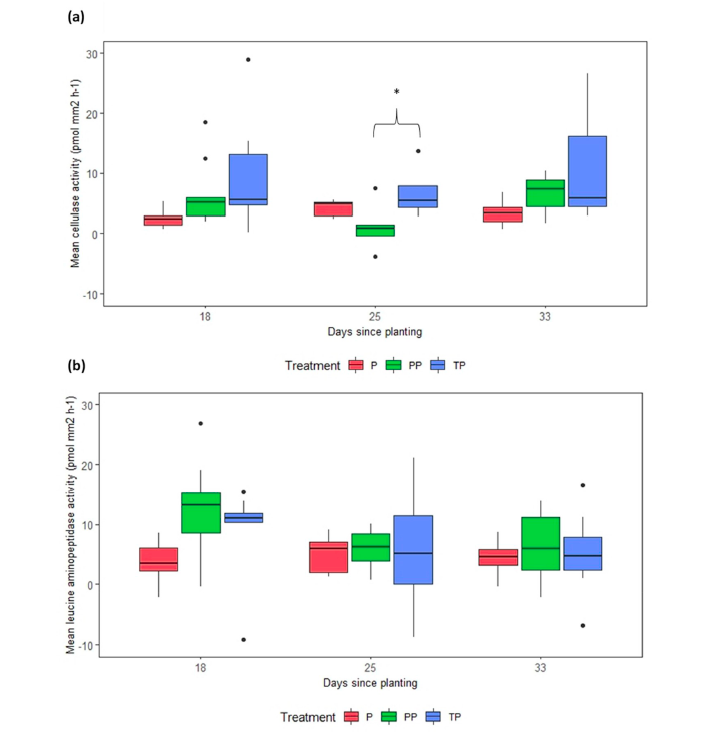
Fig. 1. Mean cellulase and leucine aminopeptidase activity (pmol mm- 2h- 1) along the root axis of Proctor roots grown in isolation (P), intra- (PP) and inter- (TP) cultivar competition (n=12). A=Mean root axis cellulase activity, B=Mean root axis leucine aminopeptidase. Boxplot shows the median, first and third quartiles and whiskers the maximum and minimum values. Significant differences (P=<0.05) denoted by asterisk.
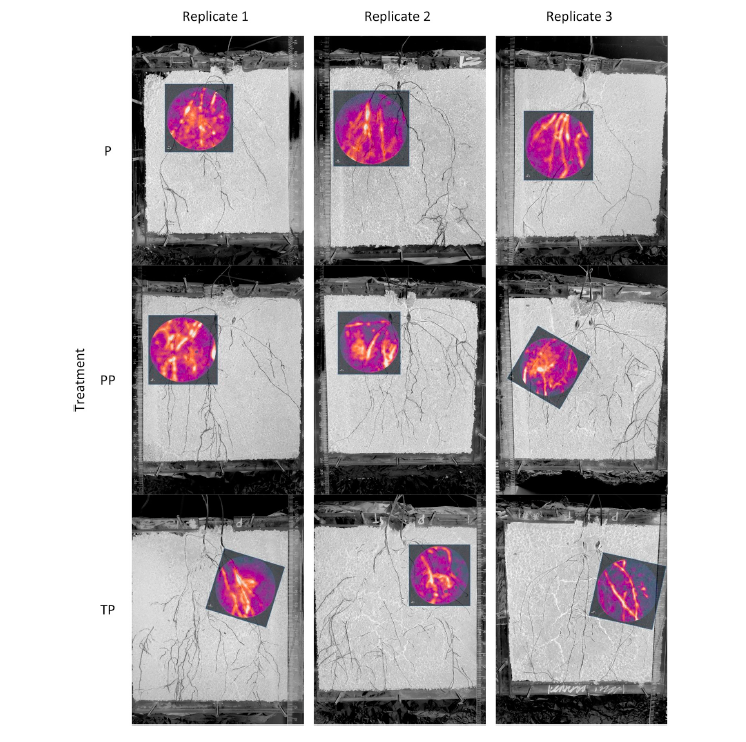
Fig. 2. Images of the sampled rhizoboxes, showing the consistent sampling location used in this study and the relationship between root presence and soil enzyme activity.
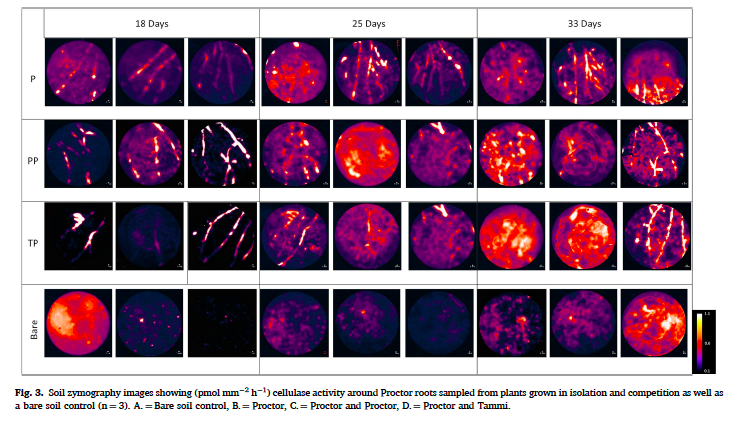
Fig. 3. Soil zymography images showing (pmol mm- 2 h- 1) cellulase activity around Proctor roots sampled from plants grown in isolation and competition as well as a bare soil control (n=3). A.= Bare soil control, B.= Proctor, C.= Proctor and Proctor, D.=Proctor and Tammi.
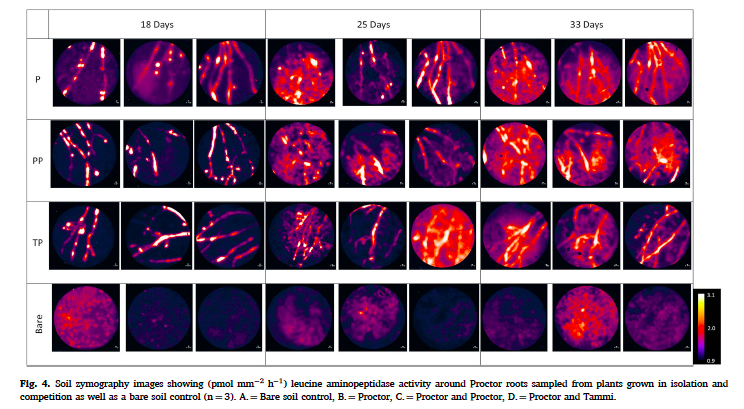
Fig. 4. Soil zymography images showing (pmol mm-2 h- 1) leucine aminopeptidase activity around Proctor roots sampled from plants grown in isolation and competition as well as a bare soil control (n= 3). A. =Bare soil control, B.= Proctor, C.=Proctor and Proctor, D.= Proctor and Tammi.
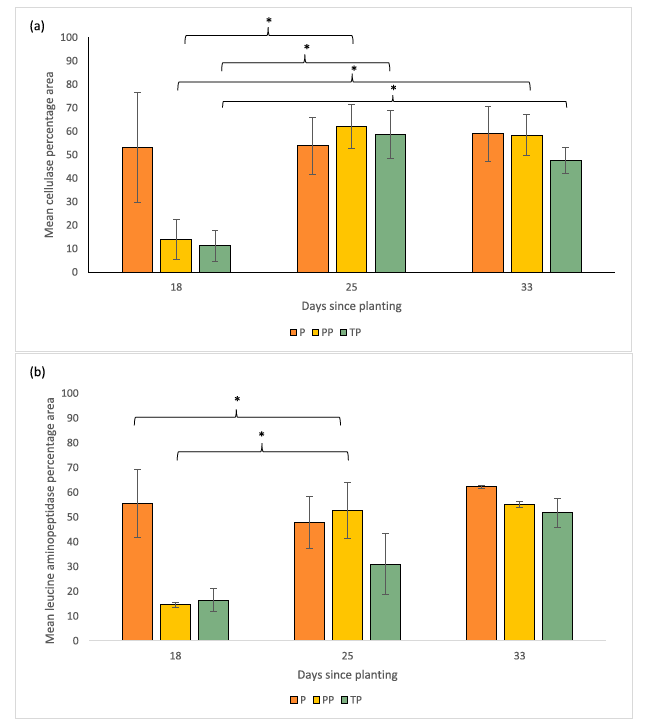
Fig. 5. The mean percentage of sampled areas in which the activity of cellulase and leucine aminopeptidase were recorded (n =12). Cellulase activity (a) and leucine aminopeptidase (b) activity were sampled surrounding Proctor roots outside the competition zone of plants grown in isolation, intra-cultivar competition and inter- cultivar competition. Significant differences (P = <0.05) denoted by asterisks.
Conclusion :Root axis activity of leucine aminopeptidase and cellulase was not temporally dynamic in response to plant-plant competition. Plant-plant competition influenced the root associated area of the two enzymes in this study differently. The extent of root associated cellulase area was delayed by inter- and intra-cultivar competition, whilst leucine aminopeptidase root associated area was only delayed by intra-cultivar competition. This may have been mediated through root exudates selecting for specific microbial functions. Therefore, conclusions concerning the temporal dynamics of nutrient cycling are likely to be dependent on the enzyme class being studied and method of image analysis used. Changes in these temporal dynamics may have been mediated through changes in the quantity and composition of root exudates by plants in competition, leading to a delay in peak soil enzyme activity. The extent of plant root influence was found to increase over time as exudates diffused away from roots, an important factor in studies of the soil microbial community activity. This study therefore demonstrates the close link between the temporal dynamics of plant and microbial resource capture and the influence each process has on the other.