Article 1: 离子液体预处理过程中木质素的化学转化的研究
Title: Understanding the chemical transformations of lignin during ionic liquid pretreatment
Abstract:
Unveiling the fundamental chemistry of lignin under ionic liquid (IL) pretreatment will facilitate the under standing of biomass recalcitrance involved in pretreatment processes. To examine in greater detail the chemical transformations of lignin under difffferent IL pretreatment conditions without competing reactions from plant polysaccharides, the IL pretreatment of the isolated poplar alkaline lignin (hardwood
lignin) under varying IL pretreatment conditions (i.e., 110–170 °C, 1–16 hours) was performed in an appropriate manner. The structural transformations of the lignin have been investigated by elemental analysis, 2D-HSQC spectra, quantitative 13C-NMR spectra, 31P NMR, and GPC analysis. Results revealed that a decrease of aliphatic OH and an increase in phenolic hydroxyl groups occurred in lignin as the pretreatment proceeded. The increased phenolic OH was mainly as a result of cleavage of β-O-4’ linkages, while the reduced aliphatic OH is probably attributed to the dehydration reaction. The cleavage of β-O-4’ linkages, degradation of β–β’ and β-5’ linkages obviously happened at high temperatures and resulted in the decrease of molecular weights. In addition, IL pretreatment selectively degraded the G-type lignin fractions and the condensation reaction took place more easily at S units than G units. Moreover, the demethoxylation preferentially occurred in G units, especially at higher temperatures. It is believed that investigating the fundamental chemistry of lignin during IL pretreatments would be benefificial to optimize and control the pretreatment process.
研究背景:
揭示离子液体(IL)预处理下木质素的基本化学性质,将有助于理解预处理过程中涉及的生物质难降解性。不同条件下的IL预处理会导致纤维素和木质素的不同结构变化,这将影响预处理底物的酶水解以及所获得的木质素馏分在生物精炼过程中的进一步应用。
研究内容:
分离的杨树碱性木质素(硬木木质素)在不同的IL预处理条件下以适当的方式进行,研究了木质素的结构变化。
研究方法:2D-HSQC谱、13C-NMR定量谱、31P-NMR谱、元素分析、凝胶渗透色谱分析(GPC分析)等。
Result analysis:
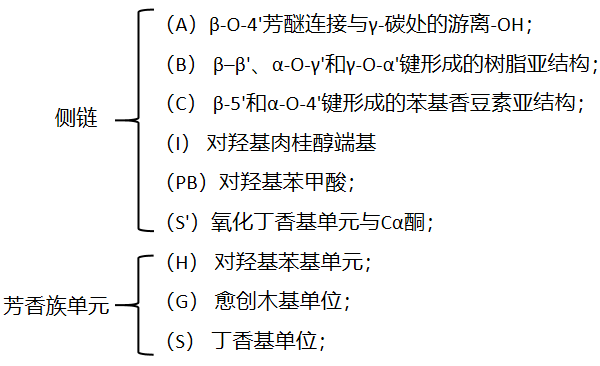
下图为杨树碱性木质素的主要经典亚结构,包括不同的侧链连接和2D NMR确定的芳香单元。

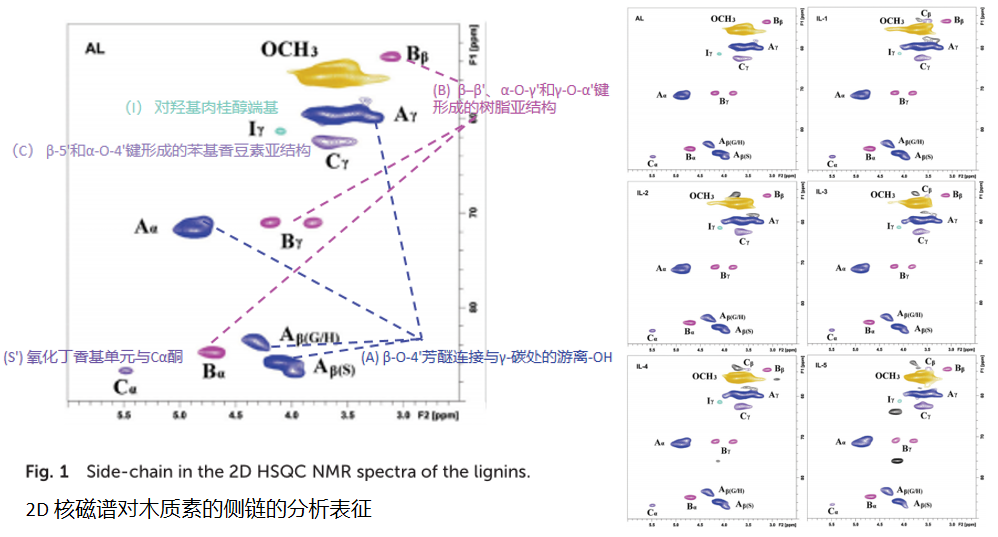
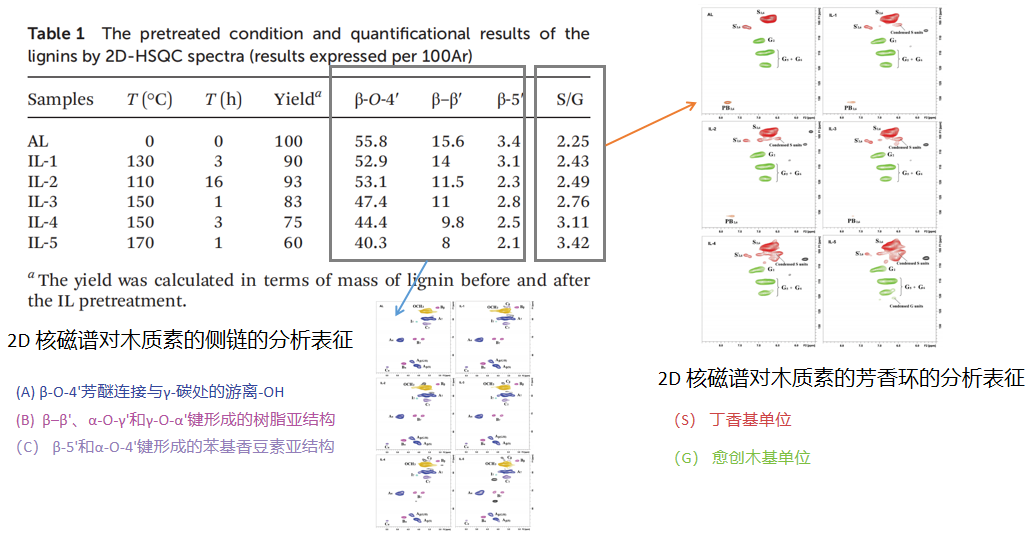
如下图,图一图二分别是五种不同强度的IL预处理后的木质素的核磁二维谱图。该二维谱图可以通过相对位置确定木质素的官能团。

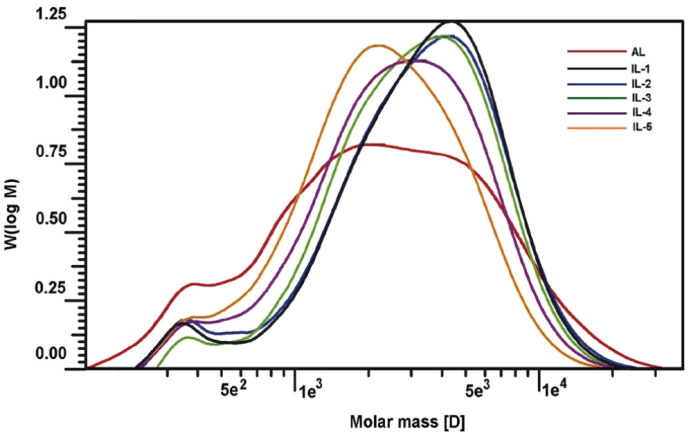
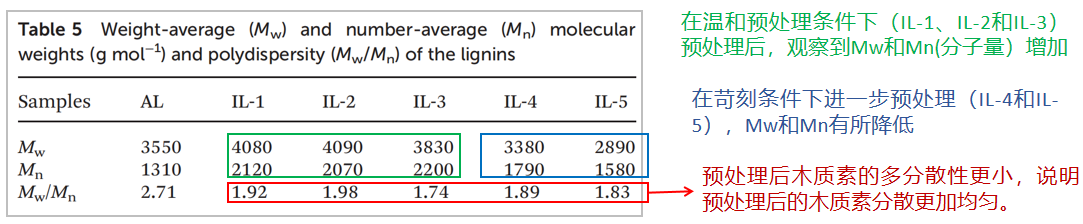
GPC的分析表明,在温和预处理条件下(IL-1、IL-2和IL-3)预处理后,观察到Mw和Mn(分子量)增加,在苛刻条件下进一步预处理(IL-4和IL-5),Mw和Mn有所降低。预处理后木质素的多分散性更小,说明预处理后的木质素分散更加均匀。
Conclusion:结合2D-HSQC谱和GPC分析,结果表明,
木质素侧链:随着预处理的进行,木质素中的脂肪羟基减少,酚羟基增加。酚羟基的增加主要是β-O-4'键断裂的结果,而脂肪羟基的减少可能是脱水反应的结果。β-O-4'键的断裂、β–β'和β-5'键的降解在高温下明显发生,导致分子量减少。
木质素芳香环:IL预处理选择性降解了G型木质素组分,S单元比G单元更容易发生缩合反应。此外,脱甲氧基化优先发生在G单元中,尤其是在较高温度下。
Article 2: 醇的烷基链长对木质纤维素预处理过程中木质素分离和离子液体循环的影响
Title:How Alkyl Chain Length of Alcohols Affects Lignin Fractionation and Ionic Liquid Recycle During Lignocellulose Pretreatment
Abstract:Alcohols of increasing alkyl chain length were investigated as precipitants in an ionic liquid (IL) pretreatment system. Switchgrass samples pretreated by 1-ethyl-3-
methylimidazolium acetate were characterized after the use of different alkyl chain lengths of alcohols as antisolvents. The resulting IL-pretreated switchgrass (PSG) samples were characterized by enzymatic hydrolysis, cross polarization/magic angle
spinning (CP/MAS) 13C nuclear magnetic resonance (NMR), Fourier transform infrared spectroscopy (FTIR), and 2D NMR spectroscopy. Glucan digestibilities of PSG samples were ∼80 % after 72 h at 5 mg protein g−1 glucan regardless of the antisolvent used. The use of 1-octanol as an antisolvent, with 10 % water to allow for use of wet biomass, enabled a partial lignin fractionation and multiphase separation for the IL recycle without compromising the chemical structure of the carbohydrates and lignin from the PSG. Lignin fragments were observed in the IL after pretreatment by gel permeation chromatography (GPC). After separation, both the IL and the octanol antisolvent were reused for switchgrass pretreatment and precipitation for an additional 3 cycles. The PSG samples derived from recycled IL were rapidly hydrolyzed, and a high glucan digestibility of 80 % was obtained even at a low enzyme loading of 5 mg protein g−1 glucan. 2D NMR analysis of residual solids of PSG postenzymatic hydrolysis revealed that lignin in these residual solids was depolymerized. This strategy enables an ease in separation of pretreated lignocellulosic solids, reduced water use, and recycle of both IL and the antisolvent.
研究背景:
某些离子液体(ILs)在对木质纤维素预处理的过程中可以部分溶解木质素,此外,工业上也有开发新的系统来去除溶解的物种并回收IL的要求。在本研究中,醇被用作IL预处理过程的替代沉淀剂。用于分离木质素和IL。 在离子液体(IL)
研究内容:
预处理系统中,研究了不同烷基链长的醇作为沉淀剂(抗溶剂)后,对经IL预处理的柳枝样品中部分木质素分馏和多相分离的影响。
研究方法:2D-HSQC谱、13C-NMR定量谱、凝胶渗透色谱分析(GPC分析)等。利用以上的方法研究了酶解后木质素单元间键和残余固体上芳香单元相对比率的变化。
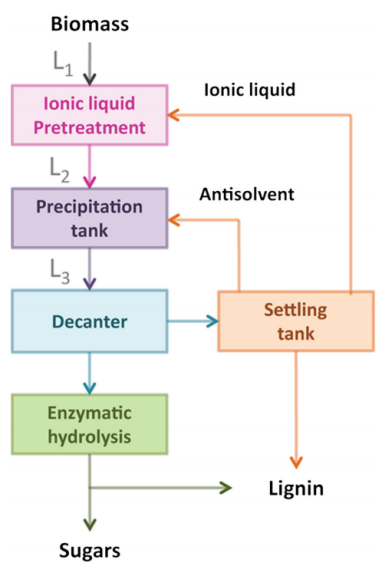
流程图:
结果分析:
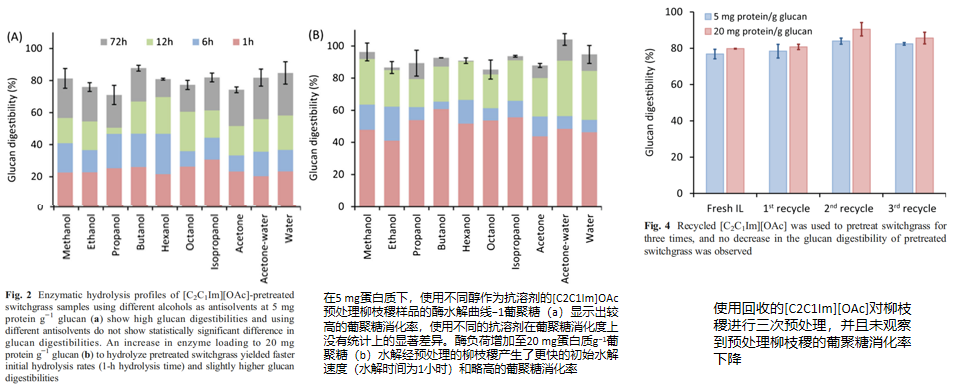
研究采用了甲醇、乙醇(ethanol)、1-丙醇(1-propanol)、1-丁醇(1-butnaol)、1-己醇(1-hexanol)、1-辛醇(1-octanol)、2-丙醇(2-propanol)、丙酮(acetone)、丙酮水溶液 (acetone-water)和水作为抗溶剂,使用不同的抗溶剂在葡聚糖消化度上没有统计上的显著差异,使用回收的[C2C1Im][OAc]对柳枝稷进行三次预处理,并且未观察到预处理柳枝稷的葡聚糖消化率下降 。
用凝胶渗透色谱法(GPC)测定了不同抗溶剂中木质素的分子量分布。GPC色谱图显示出双峰分布,表明SG(柳枝木质素)主要由高分子量木质素碎片和少量低分子量木质素片段组成。IL预处理后,部分木质素水解,如L2的多分散特征所示。预处理浆液中添加的抗溶剂显示出与L2相似的分子量分布,这是因为本研究中的大多数抗溶剂与IL混溶。其中,在正辛醇L3的情况下,在排除和保留中都观察到强烈信号 ,这意味着高分子量和低分子量木质素碎片都迁移到辛醇中,这表明木质素从IL中得到了更彻底的去除。
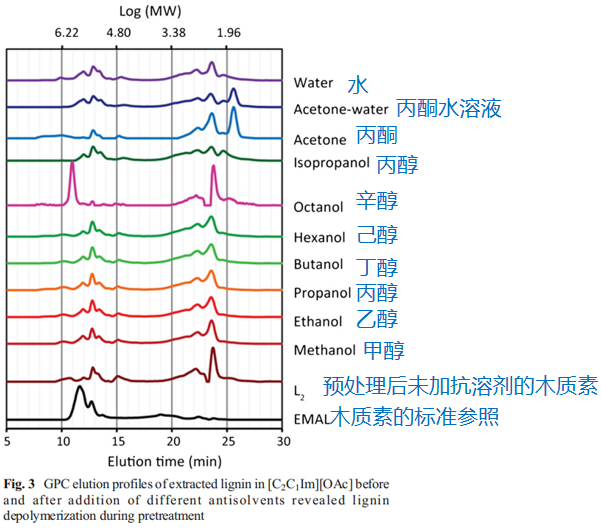
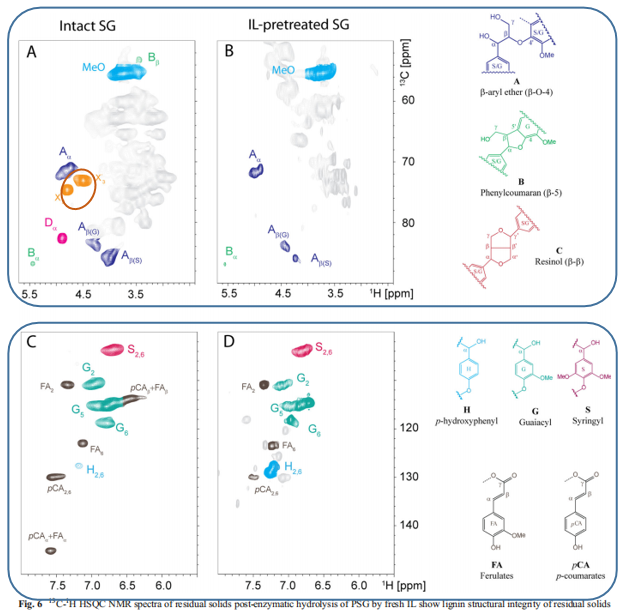
3.13C-1H HSQC NMR用于研究新鲜和回收IL酶解后完整SG和PSG样品的脂肪族(木质素侧链单元,图6A、B)和芳香族(图6C、D)区域的变化。完整木质素的脂肪族区域显示出两个明显的2-O-Ac-βD-Xylp(R)(X′2)和3-O-Ac-α-D-Xylp峰(X′3),表明完整SG中的半纤维素发生乙酰化。此外,完整SG木质素主要由β-芳醚(β-O-4)、树脂醇(β-5)组成。β-芳醚键是植物木质素中最丰富的键,与树脂醇和苯基香豆素相比,它很容易被裂解。IL预处理后,β-芳醚交叉峰变弱,表明乙醚键断裂,木质素碎片可能被释放。这一结果与GPC曲线一致,揭示了预处理后[C2C1Im][OAc]中释放的不同木质素碎片。